
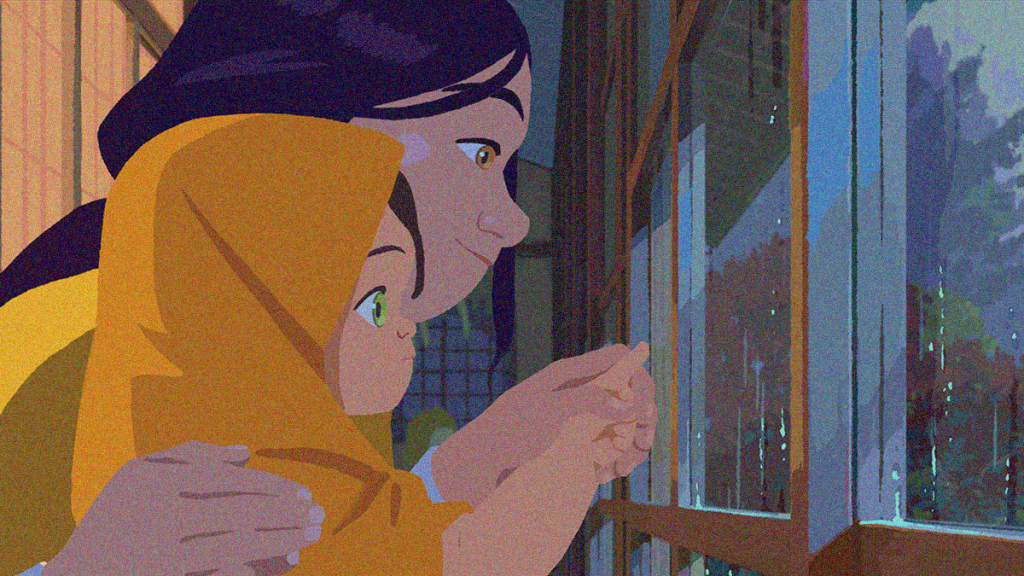
Rating: PG | Runtime: 77 minutes
Release Date: June 25th, 2025 (France/Belgium) / October 31st, 2025 (USA)
Studio: Haut et Court / Paradiso Filmed Entertainment / GKIDS
Director(s): Maïlys Vallade & Liane-Cho Han Jin Kuang
Writer(s): Liane-Cho Han Jin Kuang, Aude Py, Maïlys Vallade & Eddine Noël / Amélie Nothomb (book Métaphysique des tubes)
Memories last.
A Belgian born in Japan, Amélie (Loïse Charpentier) was thought to be trapped inside her own body. Her parents (Marc Arnaud’s Patrick and Laetitia Coryn’s Danièle) made certain she was still around them and her siblings (Haylee Issembourg’s Juliette and Isaac Schoumsky’s André), but it’s not until an earthquake at age two-and-a-half that she finally shows signs of life. Little did they know, however, Amélie had been watching and learning the whole time. So much so that she becomes enraged upon discovering she cannot speak yet.
Based on Amélie Nothomb’s (the pen name for Baroness Fabienne Claire Nothomb) autobiographical novel, Little Amélie or the Character of Rain is about the collision of cultures that occurs upon this awakening. While it’s a Japanese earthquake that stirs Amélie to break free from her prison, it’s a piece of Belgian white chocolate (courtesy of her grandmother, Cathy Cerda’s Claude) that gives her the clarity to turn her incessant bawling into fully formed sentences. The only thing that doesn’t change is the belief she’s God.
Directors Maïlys Vallade and Liane-Cho Han Jin Kuang (who both co-adapt with Aude Py and Eddine Noël) show this fantastical notion via a series of moments that defy logic and reality. We are obviously meant to know they occur only within the child’s imagination, but it’s fun to take them at face value as Amélie finds her way through the only world she’s ever known as a foreigner. Because Claude was the only one who treated her as more than a baby before returning to Belgium. And it’s only Nishio-San (Victoria Grobois) who does so after.
Hired by the family’s landlord (Yumi Fujimori’s Kashima-San), Nishio-San serves as housekeeper once Amélie’s diplomat father and musician mother reckon with what it means for their youngest to no longer just be a quiet, motionless figure in the background. She recognizes the “godliness” of the child (how Japanese culture sees babies before their third birthday evolves them into human beings) and treats her with respect insofar as her questions, curiosity, and emotions are concerned. Nishio-San promises to be Amélie’s Komainu guardian.
Narrated by this wise-beyond-her-years toddler, we find ourselves inside Amélie’s head as she learns about life through the blossoms of spring, death from a relative’s tragic passing, and history once we gradually start to understand the contempt Kashima-San holds for her European tenants. We see the magic of her gaze when looking upon hungry carp as empty-headed boys desperate for a meal. We see it when visiting the beach and deciding to part the waves to see the creatures beneath. And when her temper conjures new storms.
Because whether she’s a God or a tempestuous baby, Amélie is in full control. Those around her become slaves to her whims being that she’s too young to fully grasp situations that make her feel too much. So, her every interest is satisfied. Her boredom always fought against by a new activity thanks to Nishio-San’s willingness to embrace her as a friend and equal worthy of learning her nation’s customs rather than a stranger bearing too strong a resemblance to the enemies that killed her family during the war.
The filmmakers follow suit by never talking down to their audience—regardless of what many “family films” have become the past few decades. They allow moments to be scary (like the entrance of a Komainu lion) so they can be diffused with laughter. Others are allowed to be heavy with emotions (like the obvious sorrow Amélie feels despite not quite comprehending why) so the love of someone willing to explain can add context and provide the space to work through the pain instead of simply pretending it can be swept away.
This lesson is the one that allows the message of memory to shine through. Not just about its ability to hold onto the joyous moments of our lives, but also to remember the horrors in order to grow even as their darkness begs for you to get lost inside them instead. Because it’s one thing for Kashima-San to see the people who killed her husband and son in the faces of Amélie’s family, but it’s another to recognize the difference. To know that no one should be punished for something they weren’t old enough (or even alive) to do.
The weather within The Character of Rain is therefore more about its cleansing properties than destructive nature. Amélie’s name means “rain” in Japanese (“character” being its written symbol) and she loves to stand in it to become one with the water—a common theme for her rebirth and awakenings. The film’s animation style suits this truth too with its impressionistic color fields creating dimensionality rather than relying upon outlines. It lets the real and surreal overlap so the drama is always filtered through this child’s eyes.

Nominee:
Animated Feature
A scene from LITTLE AMÉLIE OF THE CHARACTER OF RAIN; courtesy of GKIDS.


 jaredmobarak.com
Leave a comment