
Rating: R | Runtime: 100 minutes
Release Date: October 17th, 2025 (USA)
Studio: Sony Pictures Classics
Director(s): Richard Linklater
Writer(s): Robert Kaplow / Lorenz Hart & Elizabeth Weiland (inspired by letters)
I’m always serious, that’s why people find me so funny.
Sometimes the demons overpower the genius. When the work ceases to be enough to continue ignoring the distractions and struggles of unprofessionalism, one cannot be blamed for choosing to move on. Lorenz Hart (Ethan Hawke) knows this truth, but it doesn’t make the pain sting any less. Because he didn’t just lose his partner in art for twenty-four years when Richard Rodgers (Andrew Scott) choose sanity above Hart’s alcoholism. He lost the opportunity to enjoy the unparalleled success their creative divorce would ultimately birth.
Robert Kaplow (inspired by letters written between Hart and the twenty-years-his-junior co-ed Elizabeth Weiland) conjures the night in which this unfortunate realization officially hits the famed lyricist like a ton of bricks: the afterparty at Sardi’s to celebrate Rodgers and Oscar Hammerstein II’s (Simon Delaney) debut hit Oklahoma! Not only must Hart ingratiate them for work he deems beneath himself (on-stage and conceptually considering he declined doing it himself), but he must also reconcile the fact he’s become Broadway’s the odd man out.
Directed by Richard Linklater, Blue Moon actually begins on the rainy night when Hart collapsed in an alley only to pass away four days later in the hospital. Why show us this first? Because he and Kaplow must only rewind seven months to find him regaling Eddie the bartender (Bobby Cannavale) and Knuckles the pianist (Jonah Lees) while awaiting Rodgers’ arrival. That’s how impactful the Sardi’s evening was to his demise. It’s the professional and personal (Margaret Qualley’s Weiland is also en route) emotional cliff he could never escape.
The resulting chamber drama unfolds with a powerhouse performance by Hawke as his Hart is engaged in almost unceasing conversation from start to finish. Act One has the room hanging on his every word being that he’s the star both in his stature with characters like Knuckles and inevitable sorrow with Eddie and Patrick Kennedy’s E.B. White understanding his mental state. So, Hart tries to distract them as much as himself by focusing on Elizabeth instead. Sure, he takes some jabs at Oklahoma! too, but he longs for that impossible love.
Why? Because its potential has rejuvenated him. He’s (mostly) on the wagon. He’s got his creative juices flowing if only he can corner his former partner and pitch a new epic Marco Polo musical. He’s clinging onto hope from an abyss of despair by entertaining his everyman audience and endearing himself to White’s parallel genius with the written word. And we become so enamored by his enthusiasm that we salivate at the chance of him sticking it to the guests of honor in Act Two. We don’t quite know yet that they don’t deserve the vitriol.
It’s like the lifting of a veil. All that manic self-aggrandizing is replaced by Rodgers’ genuine desire to keep working with Hart if he promises to get his act together and Hammerstein’s earnest appreciation of him as a mentor and icon to aspire towards. That’s not to say we didn’t realize the façade Hart had built for his own ego’s salvation or the sadness lying under his grinning exterior. It’s just hard to deny the suffering of watching people with the position and justification to remind him that he has no one to blame but himself.
Act Three is therefore up the air as far as Hart finding redemption in that naked truth or a newfound ambition to retreat into the ruse of remaining in his heyday of yesteryear with the promise of putting this trouble behind him. I guess it’s not that up in the air considering what we know from the first scene of him lying in the street, but it’s nice to think he might allow himself one more good time before the end. Because the others do try to supply it—whether from pity or not. They hope Hart can find the humility to enjoy in their success.
That’s a tough sell, though. Anyone who hasn’t found themselves in a similar situation of needing to remember your resentment is actually you denying your own part in your self-destruction is lying. It’s a thin line to walk. Hart wants to be appreciative and self-aware, but the jealousy and shame find him spiraling to the point where his flimsy mask of joy starts slipping to let some of that sarcasm through. And since the nerve is raw for Rodgers too, he can’t help but hear these jabs as attacks. As reminders of why he cut him loose in the first place.
Add Elizabeth and the over-arching theme of Hart as the consummate friend those he adores respect more than love shines through. He sees beauty and desires its company regardless of its intellectual, artistic, or emotional purposes. Even so, however, he can’t stop his compulsion to let those feelings overwhelm him. It leads to ill-fated marriage proposals, feelings of scorn, and a perpetual trend of unrequited love that leaves him in an even deeper depression. He knows friendship can be stronger than romance, but he craves the romance.
It’s a sentiment Hart shares with George Roy Hill (David Rawle), director of The Sting and Butch Cassidy and the Sundance Kid. His dialogue with White apocryphally inspires Stuart Little too. Kaplow wants us to see just how indelible someone can be to the world beyond a hit song like “Blue Moon” or a love that never manifests. Because people did respect him. They did listen to his words and take his advice. Rodgers himself admits he owes his whole career to Hart finding him and putting his talent to work. Hart just couldn’t see it himself.
Hawke is fantastic. Cannavale and Lees provide wonderful targets for his quick wit. And Scott adds poignant history with each reaction considering he can’t keep pretending the jokes aren’t hiding a dark narcissism that put his own career at risk. Blue Moon is also just a smart and lively script that lets the actors breathe the era’s attitude and energy while Linklater moves around the single locale to prevent the frame from stagnating—a feat made more impressive by the forced perspective necessary to keep Hawke so much shorter than everyone else.

Nominee:
Lead Actor, Original Screenplay
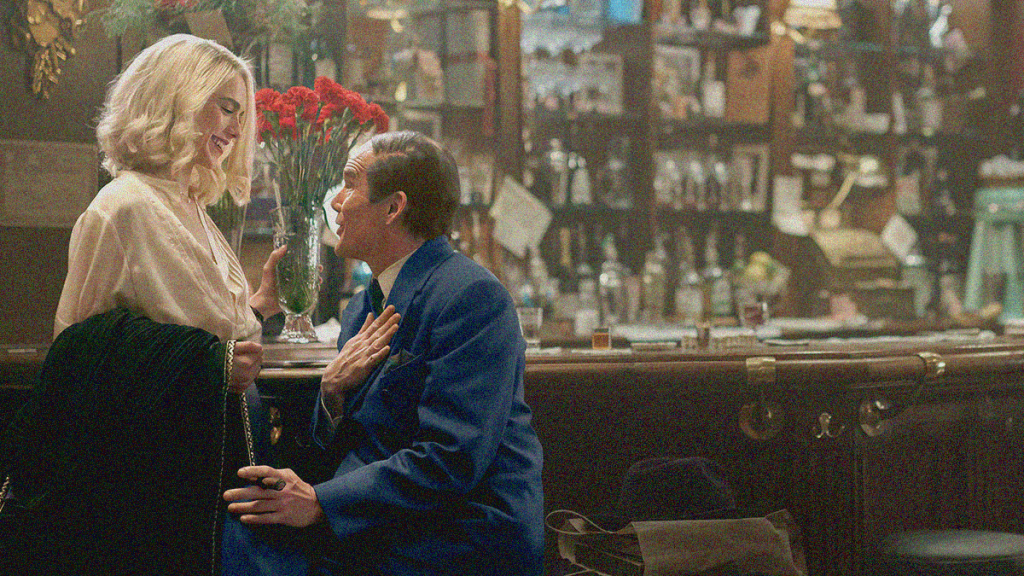
Ethan Hawke as Lorenz Hart, Margaret Qualley as Elizabeth Weiland in BLUE MOON; Image: Sabrina Lantos. Courtesy of Sony Pictures Classics.


 jaredmobarak.com
Leave a comment