
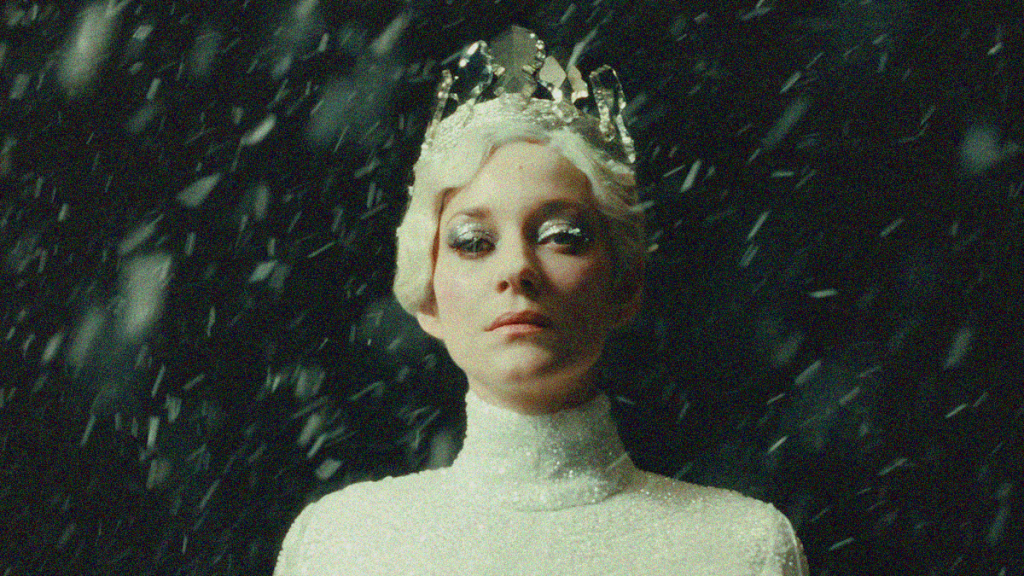
Rating: NR | Runtime: 117 minutes
Release Date: September 17th, 2025 (France) / October 3rd, 2025 (USA)
Studio: Metropolitan Filmexport / Yellow Veil Pictures
Director(s): Lucile Hadžihalilović
Writer(s): Lucile Hadžihalilović & Geoff Cox / Alante Kavaite (collaboration)
The world is full of danger.
Jeanne (Clara Pacini) is desperate to escape her foster home after finding it more claustrophobic each passing day. If not for young Rose (Cassandre Louis Urbain), she might have left much sooner to travel to the ice rink she’s been admiring from afar courtesy of a postcard image. So, she removes one of the beads from her bracelet to leave with her friend as a sort of protection talisman in her absence. Jeanne then treks across snowy fields, hitches a ride to the outskirts of town, and breaks into a nearby building for a good night’s sleep.
It’s here that the girl’s adventure begins once her shelter is revealed as a film set on which an adaptation of Hans Christian Andersen’s The Snow Queen is being produced. That story is Jeanne’s favorite and one she’s been reading to Rose at bedtime. To therefore see the titular character in all her beauty through a crack in the wall proves a profound experience. Here’s a powerful woman with everything Jeanne has ever wanted: a realm to call her own. No sharing. No threat of losing control. A home where she makes the rules.
Therein lies the twist in Lucile Hadžihalilović’s The Ice Tower insofar as why Andersen’s tale is merely used as inspiration. Jeanne isn’t taken by the Queen nor has she hunted her down to reclaim someone who has. She doesn’t fear the Snow Queen. She aspires to become her. So, much like those beads (whose origins we later discover), the girl yanks a crystal off the Queen’s dress as if possessing it might assist her quest. And who better to learn the Queen’s ways than the actor embodying the role on-stage (Marion Cotillard’s Cristina Van Der Berg)?
Hadžihalilović and her co-writers Geoff Cox and Alante Kavaite combine the roles of Kai and Gerda into one considering Jeanne finds herself trapped by the Queen’s allure and inevitably her own key to breaking the spell. The magic mirror has also flipped in that the world Jeanne sees through her own longing is one that hides its ugliness beneath hopes and dreams. She sees a angel when gazing upon Cristina. A woman wanting for nothing and holding the reins of her own destiny. Not the diva turning everyone’s lives into a nightmare.
As such, Jeanne can’t see that Cristina’s interest isn’t about helping her as much as it is helping herself. By taking the girl under wing, Cristina is able to hijack the production. She dictates her desires to the director (Gaspar Noé’s Dino). She throws her weight around to replace her co-star with Jeanne (through hostility if not actual sabotage). All these people are beholden to the project’s success whereas Jeanne is beholden to her. So, Cristina takes advantage and ultimately absorbs this new acolyte into her emotional turmoil.
It’s a fascinating journey that we must be skeptical about regardless of whether Jeanne feels the same. We know how to interpret the other cast and crew’s fear of Cristina. We can guess what it is her “doctor” (August Diehl’s Max) prescribes to get her back up from the latest bout of malaise. We see the depression and self-loathing that Jeanne cannot—especially not when Cristina starts to take an interest. She wants nothing more than to be locked in the Snow Queen’s tower. To know someone sees her like her mother did … even if it’s not real.
I love how Hadžihalilović subverts the usual empathy found in narratives with two characters of different generations who endured similar tragedies in youth. Whereas most would let that shared experience bond these two as protector and protected, The Ice Tower understands that the would-be protector having never been protected themselves almost guarantees they don’t know what it means to protect. Jeanne isn’t therefore the only one living out a fantasy. Cristina is too. A much darker one considering she never could escape her past.
Does that mean Jeanne will? Not necessarily. The film isn’t interested in such finite conclusions, though. It instead seeks to express how her journey isn’t yet as hopeless as Cristina’s. That the girl’s desire for escape isn’t simply about ending the past no matter the cost. She seeks to find a way that still embraces a future on the other side. Jeanne just needs a role model to tell her it will still be okay. So, in many ways, Cristina is the one hypnotized by the Snow Queen’s spell of abject futility. She’s lost to believe death is her only chance at release.
Pacini is quite good in her feature debut. The subtle smile whenever Cristina does something naughty to benefit their burgeoning relationship. The pain of filtering the world through her tragic backstory and desperation to cling to this potential way out. Cotillard is great as a troubled woman in suspended animation due to her own history so that moments of tenderness still can’t hide her narcissistic need for control. And cinematographer Jonathan Ricquebourg is MVP. Much like Hadžihalilović’s Earwig before it, The Ice Tower looks gorgeous.
Marion Cotillard in THE ICE TOWER; courtesy of Yellow Veil Pictures.


 jaredmobarak.com
Leave a comment