
Rating: NR | Runtime: 93 minutes
Release Date: June 22nd, 2023 (USA)
Studio: Red Splat Productions
Director(s): Brian Vincent
Writer(s): Brian Vincent & Heather Spore
I’m not that masochistic, sweetheart.
According to those who knew him best, Edward Brezinski never wanted people to ask, “Who’s Edward Brezinski?” It’s the main through line of Brian Vincent’s Make Me Famous, a documentary about him (and the 1980s East Village scene), since Brezinski was always hustling for name recognition. He was infamously known for passing out fliers to his own shows (which occurred weekly) at other gallery openings and his self-pitch was so aggressive that Berlin friends recall everyone balking at his trademarked icebreaker: “Do you want to buy it?”
While his art was neither collected nor commodified to the levels of his most (Jean Michel Basquiat, Keith Haring, David Wojnarowicz) or least famous contemporaries, Brezinski did posthumously make it into a MoMA exhibition about their collective movement ten years after his death. His is a complex legacy considering the Pictures Generation painter who wrote his obituary (Walter Robinson) can’t remember the work’s aesthetic and the unlikely collector who owns much of it is a waiter from Brezinski’s local bar (Lenny Kisko).
As one interviewee eloquently describes, this film is a “restoration” of an artist like one would restore an artwork. It won’t fulfill his wish to become famous like those who came before (Julian Schnabel) or after (Jeff Koons), but it sheds light on his struggles, philosophy, and place within the abstract expressionist oeuvre as a prototypical participant. Brezinski is called a boob. An alcoholic. Annina Nosei even calls him prescient in the sense that he saw the industry moving away from meaning into consumerism. He was undeniably unforgettable.
This line of anecdotal storytelling is ultimately where Vincent’s film shines brightest because Brezinski was involved in his fair share of insane moments. Hearing first-hand accounts of him throwing a glass of wine in Nosei’s face while they were surrounded by twenty-five-thousand-dollar paintings is riveting. Same with the time he got fed up with Robert Gober’s Dada-inspired fabrications of fabricated items and ate a donut from Bag of Donuts only to be rushed to the hospital after the artist explained they were treated in a poisonous resin.
Brezinski was an art piece himself. His penchant for confronting people with those fliers despite knowing they hated it or his Magic Gallery antics are very much performance art. Even Julie Jo Fehrle’s tales of running into him in Europe with an exaggerated “Oh, hiiiii” feel so singularly caricatured that you must wonder if a line between identity and persona existed. His actual paintings being shown some love by their subjects and critics almost becomes a bonus with a Nancy Reagan portrait proving a nice claim to fame by pissing her off.
There’s a lot of videocassette footage taken from shows back in the 80s and 90s to intersperse with the interviews being conducted, and it’s all edited together with a nice mix of chronological causality and emotional resonance. Vincent and producer Heather Spore even stumble upon a trio of Brezinski’s cousins for some early life context while the numerous questions surrounding his death lead them (and the artist’s friends Marguerite Van Cook and James Romberger) to Europe to find a death certificate so they can put rumors of him still living to bed.
You must also appreciate the historical context threaded throughout to flesh out the era itself. Talk about painting being replaced by film only to be replaced by painting again. Mention of Koons and others leveraging business savvy to steal fame as interlopers in the scene when those born from its squalor were either discovered or forgotten. Feuds between artists. Nosei rebuking Kenny Scharf. Eric Bogosian’s insights. And Mark Kostabi clocking in real-time how his desire to insult Brezinski as a way of praising himself actually did the opposite.
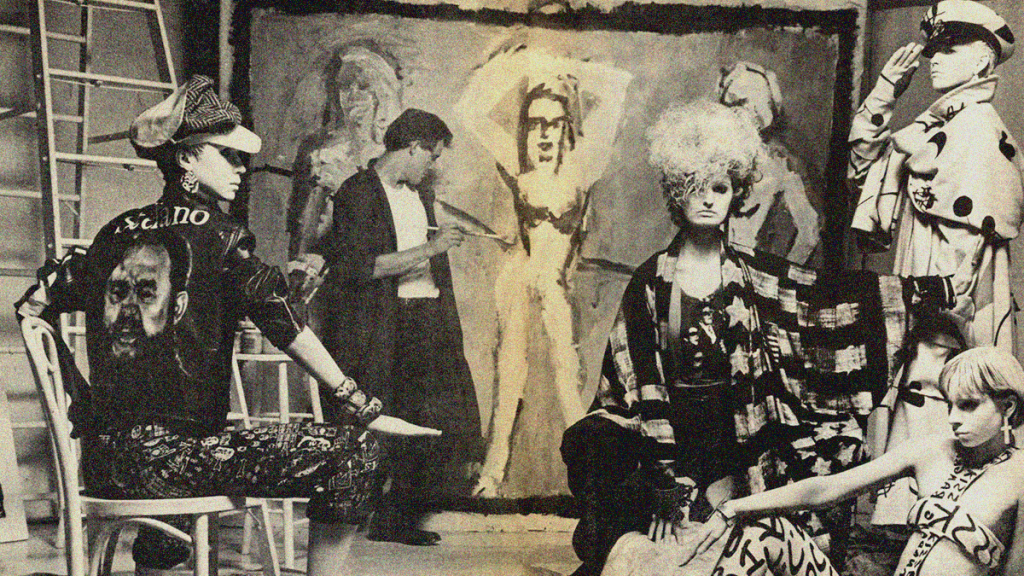
Painter Edward Brezinski and CLICK models for NY TALK Magazine, 1984 ©Jonathan Postal.




 jaredmobarak.com
Leave a comment