
Rating: NR | Runtime: 102 minutes
Release Date: September 11th, 2025 (South Korea) / September 26th, 2025 (USA)
Studio: Well Go USA Entertainment
Director(s): Yeon Sang-ho
Writer(s): Yeon Sang-ho / Yeon Sang-ho (graphic novel Face)
What’s the use of dwelling on hardships?
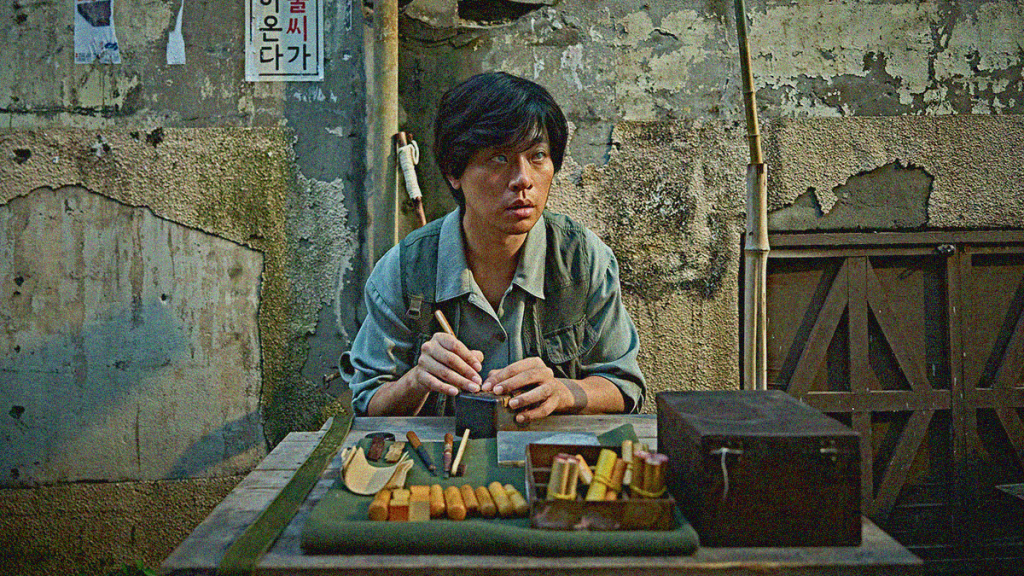
This isn’t the first time Im Yeong-gyu (Kwon Hae-hyo) has been interviewed. He’s an artisan who’s been blind since birth and yet is capable of crafting beautifully engraved characters upon custom wooden stamps. People hail him as a genius. A hero. He merely sees himself as a hard worker who strove to survive a very rough period in South Korean history. To hold his head up high, overcome the ridicule and abuse he faced his entire life, and raise a son who could be proud of him. Well, Im Dong-hwan (Park Jeong-min) is exactly that.
Documentarian Kim Su-jin (Han Ji-hyeon) likes a good human interest story, but she’s obviously looking for a little more bite by asking questions about Yeong-gyu’s ability to raise a child on his own despite his impairment. She wants to know about the struggle more than the art—like the scar on his hand he’s quick to hide upon it being mentioned. Su-jin pries just enough to make Yeong-gyu wonder if they should stop, but Dong-hwan knows too well what the exposure could do for their business. So, he coaxes him to keep playing along.
That’s when the bombshell at the center of Yeon Sang-ho’s The Ugly (adapted from his own graphic novel Face) is revealed. Despite the Im men believing their matriarch had run away all those decades ago, her remains have recently been found not too far from where Yeong-gyu’s first stamp stand was located. While the police don’t want to jump to conclusions, the way in which she was buried suggests foul play—regardless of the statute of limitations being too far gone to investigate. So, sensing a juicy subplot, Su-jin starts digging into it herself.
The first clue arrives from Jung Young-hee’s (Shin Hyeon-bin) sisters—family Dong-hwan didn’t know existed. The next from her former co-workers who ultimately point them in the direction of others who might know more. While the details escalate in drama with each interview (the film is broken up into chapters separated by these interrogations), one specific aspect remains the same: that Young-hee was so ugly that they called her a monster. Nicknamed “Dung Ogre” after a truly unfortunate incident, nobody cared to wonder where she’d gone.
It makes sense through a superficial and incomplete read of the story. A blind man who society deemed worthless meets an unattractive woman that same society reviles because she understands him and he can’t see her. Yeon’s film doesn’t simply leave this understandable revelation in the background before dealing with the mystery of Young-hee’s death, though. No, this dynamic’s inherent social and political commentary on the time and mankind’s shared penchant to forsake pariahs ensures The Ugly delves much deeper.
This nuanced journey is made possible by Yeon’s decision to keep Young-hee’s face hidden in shadows, underneath hair, or cropped off-screen throughout. As each eyewitness to her life shares their story (including Im Seong-jae as her convivial yet unsavory factory boss Baek Joo-sang), we are transported back in time to watch their words unfold. There’s Young-hee earning her nickname, meeting Yeong-gyu (played by Park in these flashbacks), and interacting with the interviewees. We’re forced to take their word on her appearance.
It’s a brilliant performance from Shin as a result. The meek voice, cautious movements, ashamed hand gestures—Young-hee’s position as an outcast comes through each and every scene. This is also why her eventual courage to stand-up for someone (who was never particularly nice to her either) proves so potent. We recognize the change in demeanor. There’s still a quiver in her voice, but it’s less from fear than anger. Is it because she’s simply had enough? Or is it because the love of her husband has empowered her to no longer suffer alone?
The answer is complex since the changing context from each perspective seems to render things much worse than we could imagine. Not just because of where Su-jin’s investigation inevitably points, but also the justification the murderer uses to absolve themself of any wrongdoing. I think it probably hits harder for those versed in Korean history and what Yeon calls its contemporary “growth-centric” period, but these are very universal lines of thinking that mirror the infinite growth capitalism ruining America too.
Workers are sacrificed for profits. Scandals are erased by financial security. Truth becomes secondary to mutually agreed upon lies. Purpose trumps actions. And since Young-hee was a person everyone was quick to cast aside so as not to confront their own ugliness, the world’s cruelty and injustice can continue. Young-hee doesn’t even need to be a monster for it to happen either. She must only be an easy target to dispose of without worrying that her blind husband might stumble upon the truth. Bullying is never about the victim.
Park Jeong-min in THE UGLY; courtesy of Well Go USA Entertainment.


 jaredmobarak.com
Leave a comment