
Rating: PG-13 | Runtime: 98 minutes
Release Date: September 26th, 2025 (USA)
Studio: TriStar Pictures / Sony Pictures Classics
Director(s): Scarlett Johansson
Writer(s): Tory Kamen
You have to talk about the things that make you sad.
You must hand it to Scarlett Johansson for deciding to tackle a subject that would never go down easy in a climate hellbent on eradicating nuance from public discourse. It’s not like there wasn’t a recent example to understand the sort of backlash coming either considering Amma Asante’s Where Hands Touch released seven years ago with a similarly knee-jerk and reductively reactionary response. Just as I found a lot to like in the contextualization of that film, however, I think there’s a lot to like here too. Even with its overt sentimentality.
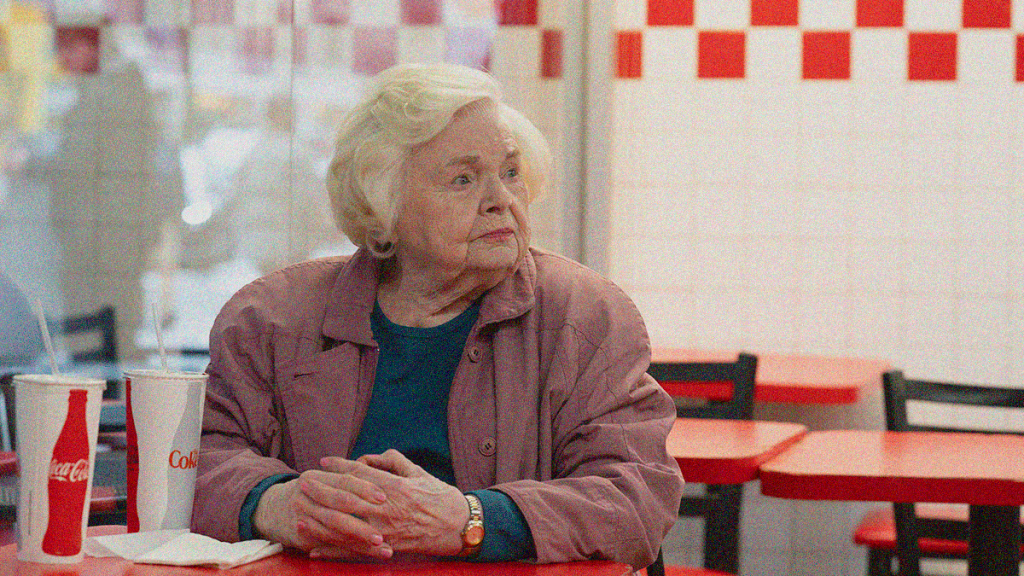
Written by Tory Kamen, Eleanor the Great is superficially about a nonagenarian who stumbles into a Holocaust survivors meeting and ends up orating the experiences of her best friend (who just passed away) as though they were her own. The idea is that it would allow Eleanor (June Squibb) to escape the awkwardness of leaving after all these strangers warmly welcomed her under false pretenses of their own making. And, in so doing, she could keep Bessie’s (Rita Zohar) memory alive to ensure her story didn’t die with her.
I say superficially because the act of lying here is never as important as the reason for the lie. Don’t therefore assume Bessie’s life being put on the record only becomes the film’s main motivation in the eleventh hour. No, the script highlights this factor very early via the survivor group’s rhetoric and Bessie’s own words. Eleanor had zero plans to keep the charade going past that initial instance. She hoped to simply fade from their consciousness and never return. She couldn’t have known how Nina’s (Erin Kellyman) presence would change everything.
It’s through her that this underlying purpose is found because Nina is also grieving a recent loss with no one to talk to about it. Not even her celebrity prime time TV journalist father Roger Davis (Chiwetel Ejiofor) was willing to be a shoulder to cry on because his response to the tragic death of his wife was to lock any and all things that might remind him of her away. If Nina even flirted with the subject, Roger would get lost on his phone or leave the room. So, hearing these Holocaust survivors speak about the unspeakable proves an inspiration.
So too does her budding friendship with Eleanor and their decision to stop dealing with their sorrow alone. The latter’s isolation isn’t surprising considering her daughter (Jessica Hecht’s Lisa) and grandson (Will Price’s Max) have their own lives for which Bessie was never a crucial part, but it doesn’t mean the loneliness hurts any less. And what’s the real harm in Eleanor using Bessie’s truth to rejuvenate Nina’s passion and set an example for letting yourself confront that which you fear most? Well … it’s complicated.
Eleanor the Great would be a completely different film if Eleanor intentionally exploited her friend’s life to enrich her own. That’s not the case here. Her situation is simply one that spirals out of control. Yes, she should have stopped it much earlier—either when Nina’s request for a classroom presentation became a filmed record at the hands of her professor or upon discovering who her father was knowing he might want a piece of the story too. But ignoring the therapeutic nature of the lie misses the point. Eleanor’s support system hinges upon it.
Nina’s does too since she becomes as personally invested in Eleanor’s life as she does to hers. You start to do the math and pray that things don’t expand outwards more than they already have despite knowing the bubble must inevitably burst. And it does so in spectacular fashion too—heartbreaking yet graceful in the decision by Kamen and Johansson to not play it for laughs. Because while this is a funny movie thanks to Squibb’s excellent comedic timing and zingers, it never mocks the severity of its subject matter. Death and tragedy remain sacred.
Could the filmmakers have built this same narrative upon a less charged topic for their lie? Of course. But that doesn’t mean they don’t treat it with respect or that using it doesn’t help shine a light on the reality that we need such accounts of survivors now more than ever due to the rise in Antisemitism, white supremacy, and genocide in today’s world. When we have a real lack of education about the Holocaust amidst increasing trends of white-washing chapters on slavery and civil rights in our history books, you cannot turn these topics into taboo.
Say what you will about the quality of the film, but don’t hide behind terms like “insensitive” when it objectively handles its delicate premise with the utmost sensitivity. Maybe too much as it becomes a bit emotionally manipulative while straining to ensure all its t’s are crossed and i’s dotted. Give Squibb, Zohar, Kellyman, and Ejiofor credit as their performances do a lot of heavy lifting insofar as grounding those emotions with as much authenticity as possible. In the end, the message is clear: silence is rarely—if ever—the answer.
June Squibb as Eleanor in ELEANOR THE GREAT; Image: Jojo Whilden. Courtesy of Sony Pictures Classics.


 jaredmobarak.com
Leave a comment