
Rating: NR | Runtime: 119 minutes
Release Date: March 21st, 2024 (Italy) / September 19th, 2025 (USA)
Studio: 01 Distribution / Sunrise Films
Director(s): Piero Messina
Writer(s): Piero Messina, Giacomo Bendotti, Valentina Gaddi & Sebastiano Melloni / Valentina Gaddi, Sebastiano Melloni, Piero Messina & Giacomo Bendotti (story)
Let her live again.
Within the universe of Another End, the titular product serves as a therapeutic tool to overcome the sudden grief of a loved one. Its technology downloads a deceased person’s memories (think Omar Naim’s full-life videos from The Final Cut) and feeds them into a compatible (age, gender, etc.) host to be resuscitated in order for the living to better prepare a proper goodbye. The simulant will not process that anything is amiss unless someone else triggers them to look close enough to discover the person in the mirror isn’t actually them.
Director Piero Messina and his team of co-writers (Giacomo Bendotti, Valentina Gaddi, and Sebastiano Melloni) do a really great job bolstering this implausibility by having Dr. Doyle (Pal Aron) use an optical illusion as a guide. Just as we cannot see the duck and rabbit or “My Wife” and “Mother-in-law” simultaneously in their respective ambiguous images due to the multi-stable perception phenomenon, having the deceased unknowingly awaken within a foreign body allows them to presume it’s theirs. If everyone reinforces the lie, there’s no cause to question it.
Sal (Gael García Bernal) wants nothing to do with the technology—mainly because he blames himself for Zoe’s death since he was at the wheel when the fatal accident occurred. Not only does he refuse to face her memories, however, but he also wishes he would have died too. His sister Ebe (Bérénice Bejo) has pretty much been on suicide watch as a result despite working for the company that facilitates the Another End program. So, in a last-ditch effort for him to cope, she asks Zoe’s parents to bring her back instead.
Enter Ava (Renate Reinsve), their assigned host. The plan is to stage an ambulance ride wherein Sal’s presence manipulates “Zoe” into believing they both survived the crash. Then she can be awoken again as though from a coma to explain the time loss. Both he and her parents (Angela Bain’s Clara and Philip Rosch’s Ben) will acclimate to her return, steel themselves to the loss, and share a joint “ritual” of telling her the truth and grieving together. The idea is that some therapy on the back end will hopefully bring them back to life themselves.
Intelligent concept or not, though, you can probably see the problem straight away: What about the people who don’t want to say goodbye? The company obviously has rules to prevent such cases by strictly adhering to contracted time frames (for the host’s safety to not absorb the memories into their own and the client to not fall harder into their denial), but Sal has an inside man to push the boundaries. It’s here where we see his true self. The selfishness and coercion. Everything “Zoe” describes when they fight on day one.
It’s more of why Sal blames himself. Not just for the accident, but for constantly pushing off the things they wanted. Marriage, kids, etc. He says they didn’t have time, but it was really just him. So, getting this second chance inevitably causes his mind to wander to what could have been. To aggressively push to keep the illusion going. And, worse yet, to find the real Ava and attempt to build a relationship capable of keeping Zoe close—albeit in a deranged way. The key is then to ensure we understand Sal is wrong while also empathizing with him.
The filmmakers do a fantastic job toeing that line with a mix of truly wholesome moments (Zoe’s father agrees because his wife asked, but the moment his anger thaws to longing is quite unforgettable) and equally tragic revelations to better align the parties to appreciate each other’s pain. It’s a small role, but Olivia Williams’ Juliette does a lot of work legitimizing the science fiction as a mirror to Sal’s hopes and mistakes with the process too. Add Ava’s own backstory and every bit of exposition goes towards cementing an authenticity of emotion.
Because things get real very fast. Sal’s do-over almost course-corrects too well to become everything he should have been seemingly overnight from “Zoe’s” perspective. Ava’s parallel psychology to Sal helping them both move forward if not for the lie of omission that they didn’t meet by chance. And even the debate at Another End where Ebe and Doyle confront the reality of their product and the worthwhile conversation of morality getting in the way of its true capabilities. Not for evil or profit, but for anguish-driven avoidance.
While Bejo and Williams are great in their plot specific purposes, Another End is ultimately a two-hander (with a “third wheel”) between García Bernal and Reinsve. Blurred intentions, deceit, and love entangle their characters in a genuinely moving yet impossible union—the fake one and the real one. It’s a Band-Aid. A crutch. But that realization might also save them from their sorrow. That Messina delivers this truth (and one final discovery I should have seen coming) is a testament to the script’s success and cast’s resonant performances.
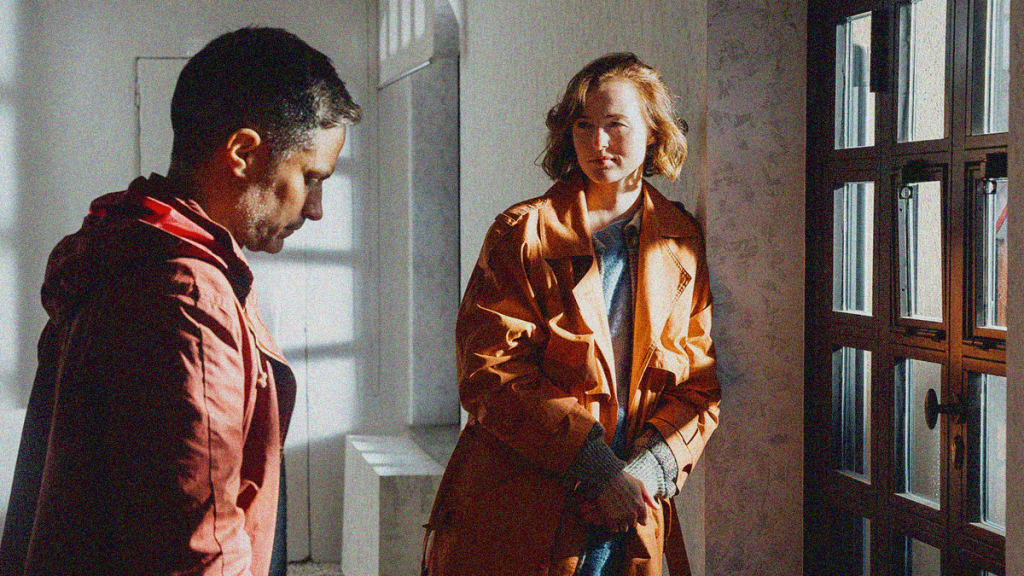
Gael García Bernal and Renate Reinsve in ANOTHER END; photo by Kimberley Ross.


 jaredmobarak.com
Leave a comment