
Rating: NR | Runtime: 91 minutes
Director(s): Or Sinai
Writer(s): Or Sinai
Why didn’t you tell me that everything’s changed here?
Mila (Evgenia Dodina) would do anything for her daughter. In so doing, however, the line between acting in Kasia’s (Katarzyna Lubik) best interests and for what she believes Kasia’s best interests should be inevitably blur. So much so that “mother” and “daughter” become hollow labels only provided meaning by past nostalgia and faded dreams. Since Mila’s need to support her family took her abroad to work as a live-in cook/maid in Israel, these two women haven’t seen each other in a very long time. They’ve become strangers.
An unexpected injury at the start of Or Sinai’s Mama suddenly forces a reunion for which neither was ready. Mila was engaged in a steamy affair with a younger man in Israel (Martin Ogbu’s Martin) while her husband Antoni (Arkadiusz Jakubik) held down the fort in Poland. He and Kasia found assistance from Natasza (Dominika Bednarczyk)—a relationship that became more for both than maybe they expected. That’s the risk of long-distance dynamics, though. That and finding yourself out of the loop on important life developments.
The latest: Kasia is getting married. And if that were the entirety of the news, Mila could genuinely be thrilled. Rather than explain the full situation, her family allows bits and pieces to be revealed as new and not so fun surprises. First is the news that Kasia will be quitting school to move where Yurek lives. She says she wishes to finish, but that the curriculum grew “too hard.” Mila knows that doesn’t sound like her daughter, so the second bombshell arrives as you might imagine. This whirlwind is a product of love, but also a forthcoming bundle of joy.
Mila goes into overdrive to create solutions to problems that only truly exist in her own eyes. Is all this news shocking? Sure. Is it unmanageable? To hear from Yurek’s well-to-do and caring parents, no. What transpires is therefore more about control than anything else. It’s about Mila losing her grip on the future she planned for their trio years prior that no longer fits their current circumstances. Building the big house with her Israeli money. Seeing Kasia become a professional so she mustn’t leave her own children like Mila. Pretending everything was fine.
What can she do in response? The obvious answer is to listen and evolve. Mila’s impulse is to instead reassert dominance as though she was still more than a money-making appendage to be loved in concept rather than practice. She plays mind games with Natasza to mark her territory. Puts words into Kasia’s mouth as far as going back to the original blueprint of graduation and career before motherhood. She even floats the idea of an abortion to put everything on-track while promising to remain and supervise. And she won’t take no for an answer.
It’s a myopic strategy destined to fail so horribly that Mila might never be able to recover as is, but Sinai introduces even more drama to make matters worse than you could ever imagine. These choices never feel inauthentic, though. The filmmaker simply has a keen sense of who her lead character is and just how selfish she can be when threatened. And the film is better for it too because it needs the ability to progress at a fast enough speed to ensure a breaking point arrives that cannot be taken back. A price must be set for believable resolution.
That’s exactly what we receive courtesy of Mila eventually recognizing the result of her decisions—both now in her hasty attempt to erase recent developments and then in her necessary choice to leave and set it all in motion. What truly makes Mama a success, however, is its refusal to let Mila wallow in regret. This is a strong woman who did what had to be done. Yes, the fruits of that labor aren’t what she hoped and the reality of what’s next unavoidably holds infinite sorrow, but what’s done is done. You remember the why of it all and just keep going.
The acting is stellar across the board, but special mention must be made for Bednarczyk since her Natasza could have been a throwaway point of conflict in a less assured script. This role and performance are instead handled with maturity and grace knowing what it is she’s done as well as the truth that her place cannot be erased as easily as one might assume. She is the familiar figure of love now. Maybe Kasia and Antoni could forget her if Mila truly stays and works to reclaim her spot as matriarch, but that’s an uncertain and steep uphill battle.
So, it’s no surprise Dodina sticks with you upon leaving the theater. She imbues Mila with the pragmatic dominance to grab hold of the reins she didn’t realize she lost and the devastating anguish when forced to acknowledge their absence. It’s such a good character because she’s ruthless when fighting for what she wants yet dignified in defeat. That doesn’t mean she won’t try to explain herself or work to be forgiven. She just won’t also disrespect everyone involved by refusing to recognize when the time for contrition has passed. Some fights can’t be won.

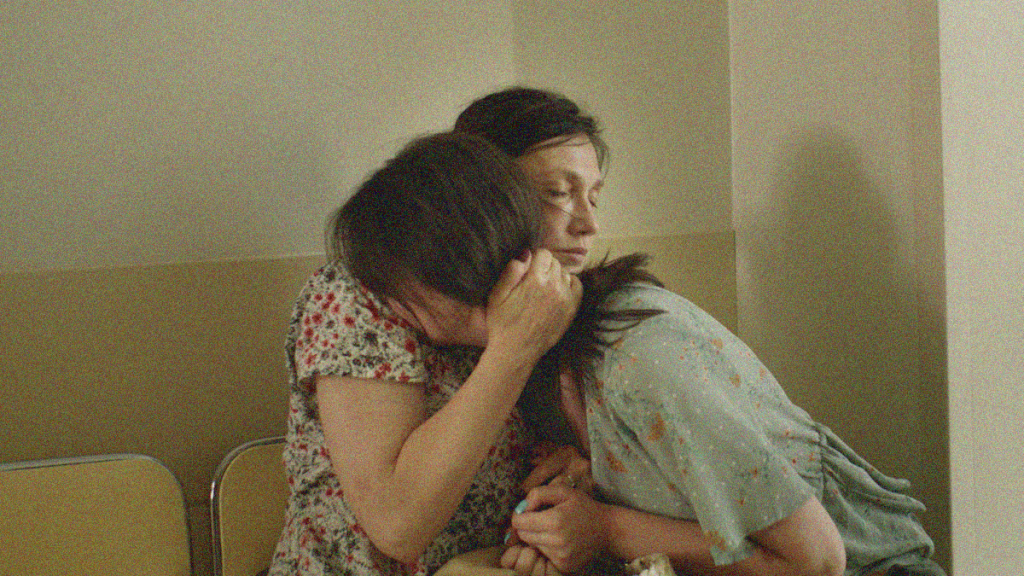
Evgenia Dodina in MAMA; courtesy of TIFF.



 jaredmobarak.com
Leave a comment