

Rating: NR | Runtime: 103 minutes
Release Date: October 4th, 2024 (Japan) / September 12th, 2025 (USA)
Studio: Bitters End / Film Movement
Director(s): Neo Sora
Writer(s): Neo Sora
It’s wrong to follow a society that’s wrong.
Near-future Japan looks a lot like present-day America when looking at it through the lens of Neo Sora’s Happyend. As the Prime Minister wields the potential of a cataclysmic earthquake to bolster his control over the country in a bid for martial law powers, a school principal (Shirô Sano’s Nagai) adopts his example to do the same. Would he have installed the Panopty surveillance system if students hadn’t used a forklift to stand his new sports car vertically on end? Probably. But that “act of terrorism” cleared any red tape with the potential to stop him.
The culprits are BFF wannabe-DJs Yuta (Hayato Kurihara) and Kou (Yukito Hidaka). The former has the idea when they and their posse (Yûta Hayashi’s Ata-chan, Shina Peng’s Ming, and Arazi’s Tomu) are squatting in the music research lab one night late after school. Kou loses a game of rock, paper, scissors to ultimately be the one manning the forklift and they both leave campus to go home. What they couldn’t have realized, however, is that the prank would coincide with yet another quake … causing the vehicle to fall onto its roof.
Suddenly, Panopty cameras are everywhere with a giant television screen in the main courtyard showcasing any student breaking a rule. Technology is advanced enough to identify anyone with a photo (Kou witnesses this fact when a police officer uses a face scan to learn he’s a Korean immigrant and demand papers the teen legally doesn’t need to carry), so the point deduction system utilized by the school is put in the control of a computer. And its program is wholly objective. Whereas no one cared about Ata-chan’s baggy clothes before, the AI does.
It becomes the last straw for many students—albeit in different ways. Yuta uses it as more proof that the world is over and freedom a myth, so he might as well throw caution to the wind and have fun. Kou, justifiably, sees it as another example of governmental power weaponizing discrimination and further eroding public trust in lieu of fascist oppression. The latter therefore find himself gravitating towards fellow classmate Fumi’s (Kilala Inori) anti-establishment activism and the former continues taking nothing seriously.
Set against their impending graduation, we’re shown how totalitarianism becomes effective in exploiting its victims’ desires for instant comfort. By threatening expulsion, they can dictate terms amongst a youthful populace prone to selfish desires (although the lack of a general strike for multiple reasons here in the United States reveals how adults are just as likely to cave under the pressure of fear). Not everyone is as strong as Fumi to stand their ground regardless. Yuta would never care enough to try, and Kou has a lot to lose if he does.
Happyend is therefore a smart microcosm of what many nations face today by taking the bigger issue of populism and fascism’s rise and projecting it onto a high school to play around with extremes knowing the legal stakes are lower than those faced by protestors being violently beaten in the streets. Ata-chan only gets points taken away for flipping off the cameras rather than a shattered skull. The non-naturalized students told to leave by their teacher when a military presentation is about to start losing points for following directions instead of getting arrested.
We still experience the injustice. We still relate to their anger at the result. And we recognize the argument had between Kou and Yuta as far as the former wishing the latter would grow up and see what’s happening in the world. Look a little closer, though, and you realize Yuta does see it. He simply chooses to rebel in his own way because the punishment for having fun alone is often the same as fighting the system in a group—his way just feels better because it provides him a semblance of control. The complexity of thought goes both ways.
Yuta hears what his friend is saying—more so from conversations he isn’t meant to hear, such as one where Kou wonders if they’d be friends had they met now rather than as children. It all leads to a final put-your-money-where-your-mouth is reckoning since Principal Nagai never pretends his every motivation is to get revenge for his car (going so far as shutting down the music research club just because he knows in his gut Yuta and Kou had something to do with the prank). Will Kou stand-up with conviction? Will Yuta altruistically act on his behalf?
Add a killer score from Lia Ouyang Rusli and great visuals via cinematography and special effects (the Panopty interface) and Sora’s film absorbs you fully from the opening scene. Credit the teen actors too, though, since their chemistry and humor truly jump off the screen. It’s a moment of change as they stand on the cusp of adulthood and try to figure out what that means for them individually as well as together. A coming-of-age tale amidst political unrest and civil rights abuses they can no longer ignore. Thankfully, the kids are still alright.
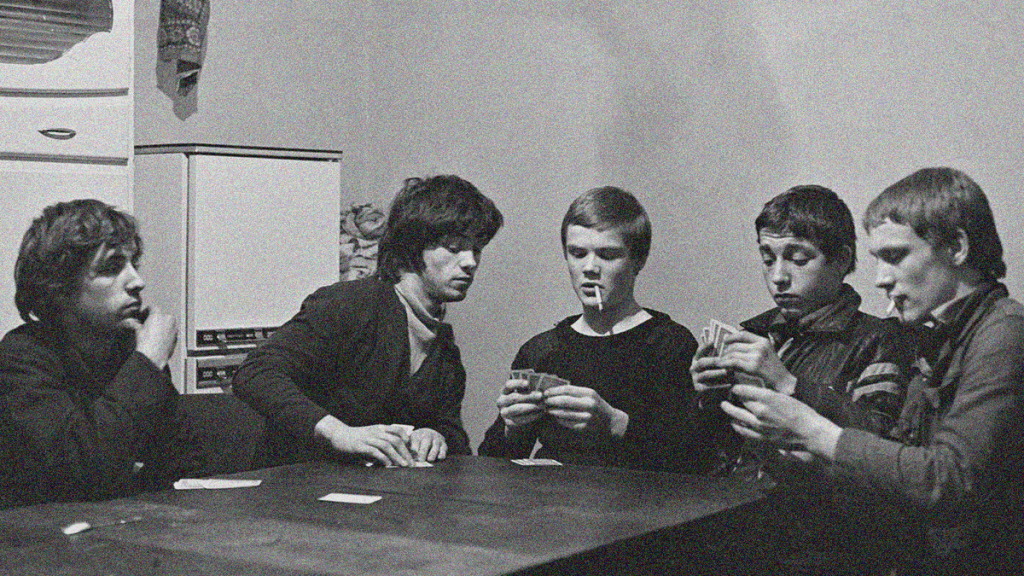
A scene from HAPPYEND; courtesy of Film Movement.



 jaredmobarak.com
Leave a comment