
Rating: NR | Runtime: 118 minutes
Director(s): Bikas Ranjan Mishra
Writer(s): Bikas Ranjan Mishra
A father knows what’s best for his child.
Despite being inspired by real case files surrounding the prosecution for rape of a commune leader known as “Holy Father” in India, there’s no mention of the source material in the press notes and a cursory internet search yields too many potential results to know which is correct. I’m not sure there’s a more sobering reality than realizing this subject matter has become too ubiquitous to track down. But that’s the unfortunate side of faith’s power when wielded by a malicious soul. The inherent exploitation. The survival instinct to stay silent. The knowledge that even more examples have probably gone unreported.
Bikas Ranjan Mishra’s Bayaan (translated as “testimony”) begins with a young woman’s harrowing act of defiance to smuggle out a letter explaining what’s been happening within the confines of her home by the hand of her sisters’ God, Maharaj (Chandrachur Singh). What we don’t realize at the time is that the danger born from blowing the whistle doesn’t solely come from within those walls. No, the Maharaj has accrued so much power that his most ardent devotees praise his name outside of them. They see only the money he pours into the community’s infrastructure and the pious smile. They know nothing of his true horror.
Exposing him becomes the task of first-time lead investigator Roohi (Huma Qureshi). Handpicked by her police chief in Delhi to follow in her famed father’s (Sachin Khedekar’s Kartar) footsteps, she arrives in a small Rajasthan town filled with the confidence to take down a monster. The head of the local police there (Paritosh Sand’s Chauhan)—an old colleague of Kartar’s—is all smiles when briefing her on the case, assigning Karnail (Vibhore Mayank) and Meena (Sampa Mandal) to her, and dropping the bombshell that she has only ten days before presenting to the judge. Roohi’s big break quickly starts feeling like a set-up.
No matter how confident you are guessing how far up the chain of command or widespread amongst the town’s residents it goes, however, you still might find yourself surprised. It’s what makes the investigation so compelling since Roohi is fully committed to finding the truth regardless. She’ll risk a contempt of court charge, walk right into the belly of the beast to strong arm commune supervisor Nirmala (Swati Das), and risk her own life to protect possible witnesses. And even when she gets everything necessary for a slam dunk trial, it somehow still seems to fall apart. Roohi’s only chance at success is changing minds one-by-one.
It’s a wild goose chase because Maharaj has covered all his bases. His mansion isn’t a school, so they don’t keep admission records. Acceptance of his protection leads to a religious rebirth wherein he gives each young girl a new name. And whenever something goes bad enough awry for one of them to run away, he personally finds them a husband so they can marry and spread his good word amongst the people. There’s an excuse for every action taken in these girls’ names and multiple layers of subterfuge shielding them and their family from being found after the fact. Anyone else but Roohi would have simply given up.
This is personal, though. This is a chance to step away from her father’s shadow and prove to young girls that they can aspire to be more than wives and mothers. Roohi stakes everything she has to see the case through and uncovers as many fearful co-conspirators as followers willing to be awakened to the truth. Because the best protection from criminal charges is a blind fan club. Sure, some of them will still refuse to believe their own ears, but not everyone. There are simply too many corpses not to take note and too much corruption for Roohi not to take her father’s advice, by way of Chauhan (and Fox Mulder), to trust no one.
Mishra’s script for Bayaan is an impressively drawn procedural with multiple walls needing to be torn down. He’s accounted for all the ground-level lies and shell games as well as the bureaucratic ones if Roohi ever gets that far without quitting or taking a promotion instead. It appears every single character beyond her has some secret revelation waiting in the wings too—either as the impetus for helping her or protecting Maharaj. Mishra is literally breathing life into the political turmoil afflicting his country today. So much so that he had potential producers backing out once its full scope was revealed.
Because it’s ultimately about integrity versus complicity. It’s about risking the little that you have in order to protect those with even less. And it’s about the duty of a father being about more than preserving honor or hiding shame. The comfort with which Singh’s Maharaj speaks about acting in the best interests of his “daughters” makes you want to take a shower to wash off his unchecked privilege, but the realization of what those words would mean out of Roohi’s father’s mouth or Pooja’s (Molshri) father’s mouth or Sati’s (Aditi Kanchan Singh) husband’s mouth might be worse. The misogyny on-screen isn’t isolated to one man.
That’s why it doesn’t just take a proverbial village to stop violence. It takes one to facilitate it too. So, the film lives or dies by Qureshi’s performance to ensure Roohi stands against the overwhelming horde of Maharaj apologists. The character even transcends its own case and metaphor too considering the rise of far-right populist regimes globally. America has all but turned into this Rajasthan town of zealots embracing their own pain like poor, twisted Nirmala (a complex character to whom Das gives a soul) because they’ve been told freedom away from it will be worse. We’re sadly still searching for our own Roohi to remind us how it won’t.

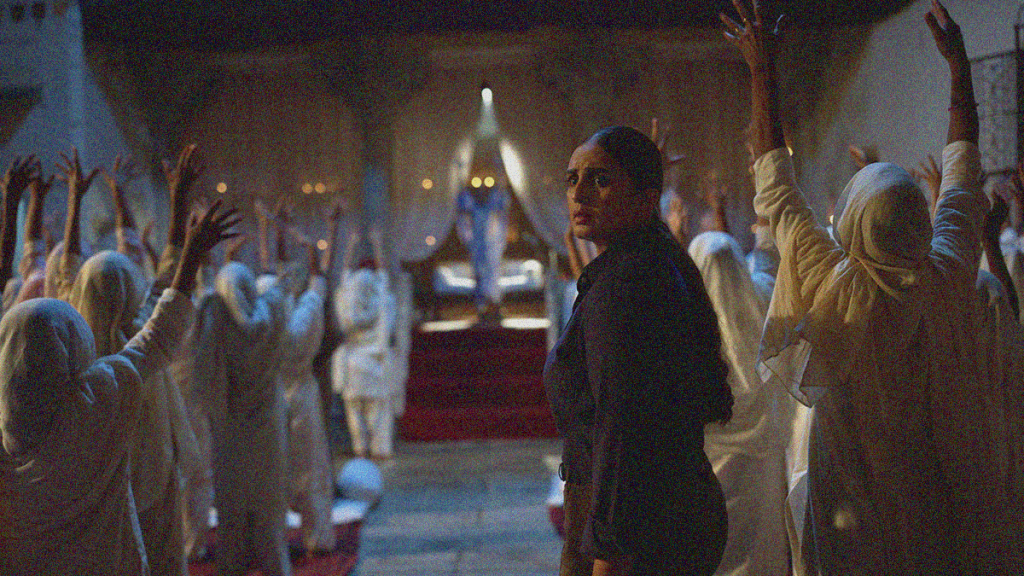
Huma Qureshi in BAYAAN; courtesy of TIFF.



 jaredmobarak.com
Leave a comment