
Rating: NR | Runtime: 88 minutes
Director(s): Seemab Gul
Writer(s): Seemab Gul
Their fear is a symptom of their ignorance.
Religious fundamentalism is a powerful drug. You mustn’t look further than the proliferation of American Evangelical Christianity since Ronald Reagan to understand this fact because the republican party has continued weaponizing their constituents’ faith-based ignorance to exploit them into forgoing their own human rights ever since. Whereas we still have a few (dwindling) checks and balances providing safeguards against full ethnocratic rule, other countries like Pakistan do not.
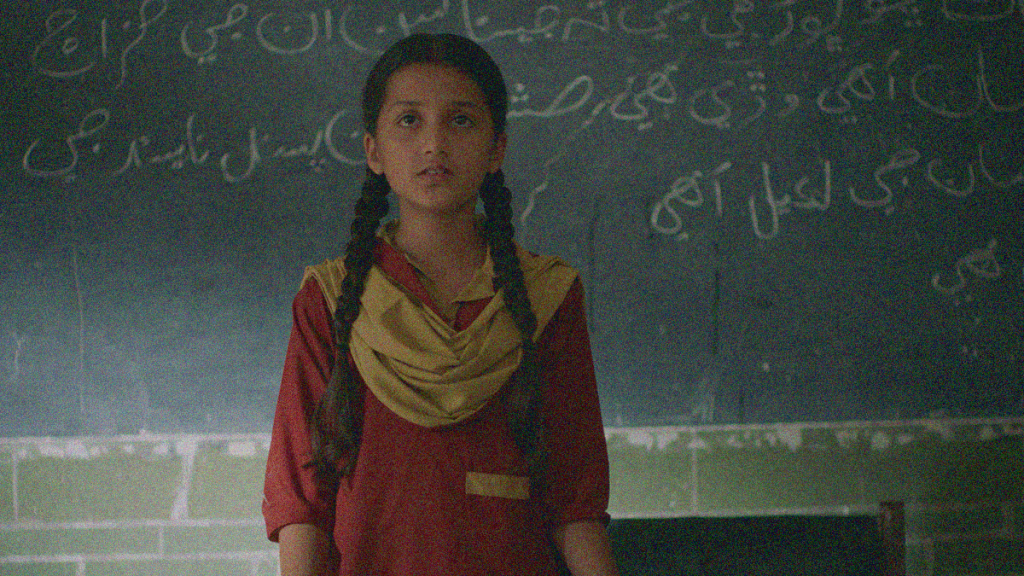
Without proper oversight to ensure politicians are working in their community’s best interests or a successful track record reiterating the importance of education for bridging a widening financial gap between rich and poor, any authority figure can shut a school down simply by saying a jinn took it over. Seemab Gul’s feature debut Ghost School therefore reveals how young Rabia (Nazualiya Arsalan) can become the only person willing to fight for her own future.
Rumors start flying on the first day back from summer vacation thanks to a security guard barring entrance to school grounds. While one teacher falling ill is unfortunate, losing all three is a pattern. So, when the principal (Adnan Shah Tipu)—the person they look to for answers—blames it on a curse, who would dare question him? Since the same thing happened to the village’s unfinished hospital and college too, it must be God’s will. And since jinn are in the Quran, they must be real. Fantasy becomes a political shield for corruption.
What’s really going on? The politicians promising new infrastructure for votes are splitting the necessary budget to do so amongst themselves. They use just enough to hire outside workers to start construction, eventually stop paying them so they leave, blame the result on supernatural forces not to be reckoned with, and keep cashing the checks. With nowhere else to go, poor students give up on education to learn a trade or become laborers instead. The cycle never ends.
Rabia believes in jinn too, but her love of learning demands context. She therefore roams the village to uncover her teacher’s address and inquire when he’ll conquer the spirit and reopen school. Some neighbors warn her not to meddle so the jinn doesn’t grow worse. Others begin lamenting how it’s all a smokescreen for governmental corruption. Rabia is cautiously parsing out the truth, but what’s a ten-year-old’s tenuous grasp on extortion compared to folkloric tradition?
You want to watch Rabia’s unfolding journey with a smile because you don’t want it to be true. But this is what happens in pious yet uneducated environments. The people are so afraid of demons that anyone who tells them demons aren’t real becomes labeled as an accomplice to evil. And when you also have bureaucratic red tape to deal with (Rabia’s teacher directs her to the principal and he to a district supervisor who might not even exist), the resulting futility tends to defeat those who were brave enough to get past the brimstone.
Ghost School uncovers the prevalence of apathy. A soon-to-be married neighbor tells Rabia not to worry about school since she’ll be engaged soon too. The grocer admits he quit school after fifth grade because he only needed to know that much math to be his own cashier. The principal brazenly explains his position that education is a privilege rather than a right and transcending one’s status would only deplete the “unskilled” labor force. Even Rabia’s mother (Samina Seher) wonders if being illiterate is better than being bought as an educated servant.
Add gender (a boys-only private institution is the sole alternative option) to the equation and you see why Rabia is the perfect entry point for the London-based Gul to expose the complicated web of injustice Pakistanis must combat. To look through a child’s eyes is to both blur the line between fantasy and reality and cut through it due to not being fully indoctrinated yet. Because Rabia still doesn’t quite understand. She still hopes for a solution to “illnesses” like bribery that includes flying white horses. The lesson being taught is for our edification.

Nazualiya Arsalan in GHOST SCHOOL; courtesy of TIFF.




 jaredmobarak.com
Leave a comment