
Rating: NR | Runtime: 105 minutes
Studio: Best Friend Forever
Director(s): Valentyn Vasyanovych
Writer(s): Valentyn Vasyanovych
I kind of feel like I’m too late.
Give Valentyn Vasyanovych a bigger budget and you can be sure The Clash’s “Should I Stay or Should I Go” would be playing at some point. Because that’s the question faced by the characters on-screen in this fictional post-war Ukraine. As we hear on the radio in Valyk’s (Vasyanovych) kitchen, the country’s population has been reduced to thirty million with twelve million now displaced throughout the world in exile. So, should the mostly women and children uproot the new lives they’ve created and return? Should the men who stayed go to them now that their nation is secure (depleting the census more)? Or do both sides start anew?
The film’s title To the Victory! isn’t therefore as joyous as you might initially assume since said victory demands complex conversations in the aftermath of decreased adrenaline and emotion. Valyk stayed because he believes in Ukraine and wants his filmmaking to be part of its rebirth. That doesn’t mean his wife disagrees—she would never have considered leaving if not for Russia’s invasion forcing it. But the world has changed and they’ve lived through wholly different experiences apart in the process. Add kids to the equation (especially when they are also separated) and the concept of a “correct” answer becomes obsolete.
All Valyk can do is continue making movies. And without the familiar infrastructure necessary to do so (like with Vasyanovych’s own name-dropped Atlantis blurring the line between fact and fiction further), he must do so with his friends. What we’re watching is simultaneously that film as well as the film about making that film. It’s why some descriptions call To the Victory! a documentary despite doing so proving, at best, a stretch. Yes, it’s autobiographical considering the topics he broaches are topics everyone on-screen will face in the aftermath of a ceasefire, but there’s definitely a layer of remove.
If I were to equate it to a non-fiction sub-genre I’d say it’s a speculative essay film. Its script and fourth wall-breaking conventions provide Vasyanovych a forum with which to grapple with his reality and find catharsis. The potentially looming divorce from his wife Sofia (Marianna Novikova). His best friend and lead actor Vlad (Vladlen Odudenko) considering choosing his family and moving to Spain. His son Yaryk (Hryhoriy Naumov) embedding himself in Ukraine to set down his own roots and begin his adult life. His aging father still visiting the cemetery to never be too far from his late mother, wife, and relatives.
Those cemetery scenes linger because they really drive home what it means to say goodbye. You aren’t just losing your homes or careers. You’re losing your heritage. That will ultimately mean different things to different people, but it doesn’t lessen the blow. Sofia should take her daughter into consideration since one could argue her age makes it so she’s lived more of her formidable years abroad than in Ukraine. So, at a certain point, the setting of her exile becomes the home she’d be leaving. Don’t begrudge Valyk for wanting to stay anyway, though. Sofia won’t. These are impossible decisions in unprecedented times.
It’s not all doom and gloom, though, as Vasyanovych captures the camaraderie that has sustained their nation against the aggression of a world power such as Russia thus far. A party scene of Yaryk celebrating his first paycheck is a ton of fun. Valyk jokingly figuring out how to make his somber film about separated families “sexy” is hilariously brought to life via their frustrations towards reality … and the assistance of alcohol. And even some of the pain finds a laugh or too like when Yaryk crashes his electric unicycle so that Valyk must carry him piggyback all the way to the hospital.
Would it have been more coherent and perhaps potent without all the shifts in perspective? Probably. The uncertainty of whether the latest static camera set-up is diegetic or not is initially exciting, but it also distracts upon losing its mystique. It still creates some incredible moments (the kite scene), but I’m unsure if it adds enough to not wonder whether they’d land just as well without. Because the real emotion comes from the conversations. Every time Valyk and Vlad are together. Yaryk’s resentment and appreciation of his father. Valyk and Sofia’s goodbye. The more authentic the set-up, the more profound—no camera tricks needed.

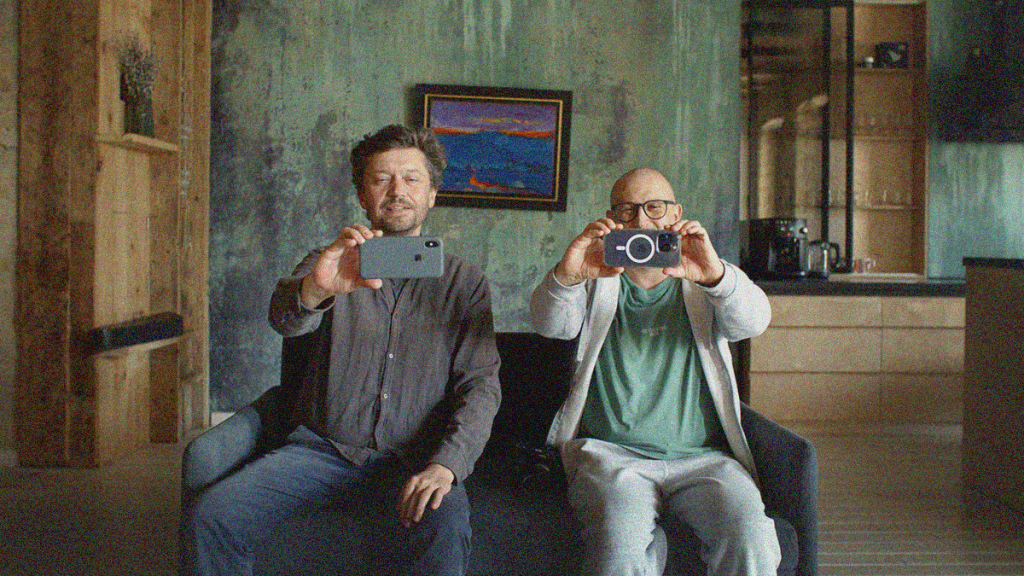
Valentyn Vasyanovych and Volodymyr Yatsenko in TO THE VICTORY!; courtesy of TIFF.




 jaredmobarak.com
Leave a comment