
Rating: NR | Runtime: 75 minutes
Release Date: April 11th, 2025 (Poland) / August 29th, 2025 (USA)
Studio: KimStim Films
Director(s): Stephen Quay & Timothy Quay
Writer(s): Stephen Quay & Timothy Quay / Bruno Schulz (book)
Everything that happens here happens only once and is irrovcable.
It’s been twenty-plus years since I binged the surreal short film collection of The Quay Brothers (alongside those of Jan Švankmajer). As someone who grew up on Disney animation and Will Vinton Studios claymation, it was an unsurprisingly eye-opening experience. The atmosphere. The textures. The hand-crafted, nightmarish figures and sets. The weirder and more obtuse the narrative, the better it felt. Because the vibes were captivating enough.
Well, I’m happy to say Stephen and Timothy Quay haven’t changed. Back with their first feature-length film in almost as long, Sanatorium Under the Sign of the Hourglass is what they call “an exploration of motifs and themes taken from the mytho-poetic writings of Bruno Schulz integrating both puppets and live-action to score the demiurgic nervature of Schulz’s 13th apocryphal month in the Regions of the Great Heresy.” Considering I’d understand that description just as well in Polish (a language I don’t speak) has me assuming viewers familiar with the source material will fare better.
Even so, this adaptation of Schulz’s dreamlike collection of short stories is obviously suited to the Quays’ unique sensibilities. The notion of a man visiting his deceased father in a sanatorium whose temporal environment is intentionally slowed so that the latter isn’t yet dead within its walls is perfectly suited for their creepily dark aesthetic. Whether you fully comprehend what occurs within that context will vary. (I certainly did not.)
The film is structured on three tiers. The first concerns an auctioneer (Tadeusz Janiszewski) who’s arrived home to find a mysterious metal contraption on his desk with a note describing its purpose. Said to contain a person’s retina, its seven random portholes are positioned to supply a window into the last seven images the eye witnessed. And on one specific night (which happens to be this one), the sun will shine just right to liquify the specimen and inexplicably animate the scenes immortalized.
The second is a man named Jozef (Andrzej Kłak) who has arrived to see the body of his father. The third is that same man (“J”) as a puppet who’s come by train for the same. It’s this last character that we follow for the majority of the runtime—a sort of otherworldly manifestation of the second that’s simultaneously a construct of his mind and the anomalous magic of this ghostly place. When “J” falls asleep, we return to Jozef. When Jozef becomes confounded by his surroundings, we return to the auctioneer attempting to process what he’s seen.
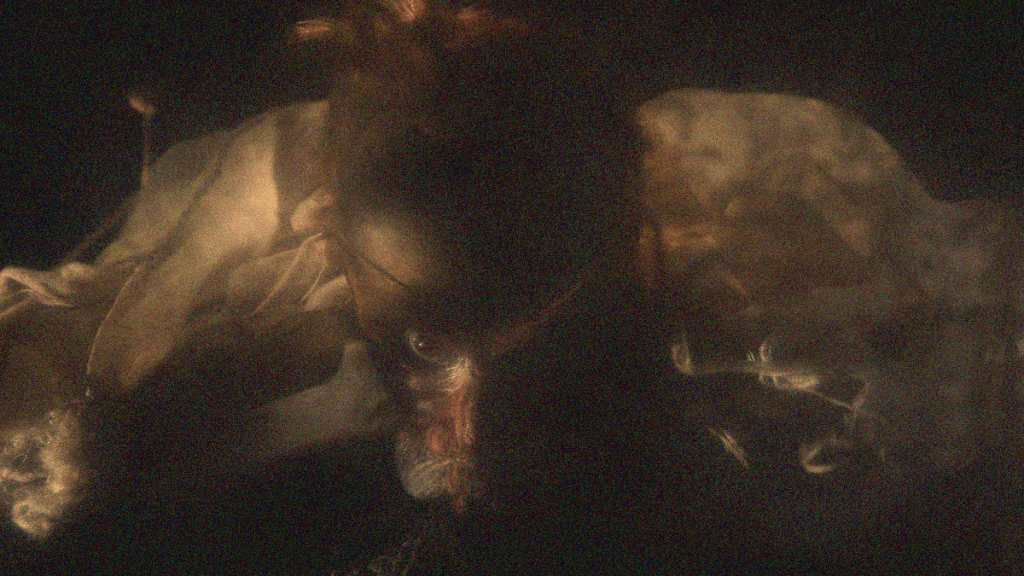
There’s a lot of repetition via echo with many sequences replayed with the camera either zooming in or out with each subsequent loop. The live-action footage with Jozef often has a stop-motion feel to it too as a result—especially when “J” loses his hat and the image flips upside to flicker between these worlds. We meet a six-armed doctor, a horned figure, and “J’s” father. We watch memories, metaphors, and processions. We witness a man losing himself to impossibility’s allure.
I’m not one to even try to put the plot (if you can even call it that) into words. Half the time I wasn’t sure who I was looking at let alone their relationship to the other characters considering many were alternate versions of my current point of focus anyway. So, you should probably treat the Quays’ work as a companion to Schulz’s novel rather than a replacement for it. Or you can simply enjoy the artistry by letting its horror-fueled hallucination wash over you like I did.
I was going to like it regardless since I’m a sucker for the craft. The use of light and the dust floating in its beams is gorgeous alone, but integrating its true passage of time with puppets lurching through their false time is awe-inspiring stuff. And the attention to detail in its dirty, scratched, and scuffed textures lends the whole a tactility you simply don’t get with mainstream animation.
A scene from SANATORIUM UNDER THE SIGN OF THE HOURGLASS; courtesy of KimStim.



 jaredmobarak.com
Leave a comment