
Rating: NR | Runtime: 98 minutes
Release Date: July 26th, 2024 (Pakistan) / August 15th, 2025 (USA)
Studio: Mano Animation Studios / Geo Films / Mandviwalla Entertainment / Watermelon Pictures
Director(s): Usman Riaz
Writer(s): Moya O’Shea / Usman Riaz & Moya O’Shea (story)
We’re a part of it now.
Usman Riaz has been working on The Glassworker for a decade-long quest to put his Mano Animation Studios and Pakistan itself on the map for hand-drawn animation. You’ll see his name all over the credits from director to co-composer to storyboard artist and it’s easy to appreciate his passion, and that of everyone involved, considering the final product delivered on-screen. It’s a first-love story between two kindred spirits from different worlds. A love letter to the arts as the one true embodiment of what it means to be human. And a tale of war’s unyieldingly destructive might.
Set within a land fighting its neighbor for control over a ravine housing precious minerals, young Vincent Oliver (Teresa Gallagher as a boy and Sacha Dhawan as an adult) wanted for nothing as he hung onto every word of his father’s (Art Malik’s Tomas) stories while learning the family tradecraft of glassblowing. But then the army arrived under the leadership of Colonel Amano (Tony Jayawardena)—a man with adoration for artistic beauty, but first and foremost a devotee to the totalitarian control of the resources (including people) proving necessary to his cause. Suddenly everything changes.
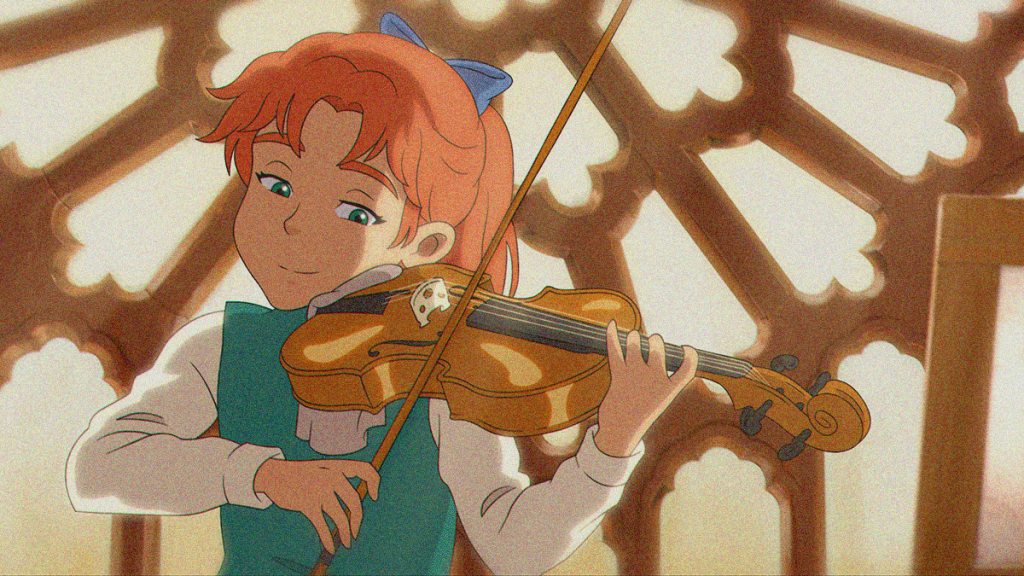
The Olivers become pariahs as Tomas’ vocal pacifism labels them cowards by the jingoistic townsfolk applauding their own kids for joining the cause as soldiers-in-waiting. The only person who refuses to join them is ironically the Colonel’s own daughter Alliz (Anjli Mohindra). She’s an artist herself—driven to be the best violinist in the nation thanks to her father’s love of the craft. Vincent and Alliz become fast friends even if their parents don’t see eye to eye, but the pressure of rising tensions and community fears ensure the dynamic’s foundation remains fragile at best. One pang of jealousy risks ruining everything.
As such, there’s a lot of heavy subject matter throughout. This isn’t just a Romeo and Juliet homage with love bridging a social divide. No, this is about the perils of war, the necessity to compromise one’s values for survival, and the reality that love is often not enough. It’s about not dismissing someone sight unseen because of their family or what neighbors say. It’s about pursuing your passion with every fiber of your being even as the world crumbles around you. It’s about lost time due to petty grievances and misguided assumptions. And the regret of never being able to say what’s in your heart and accepting that its pain doesn’t render those feelings any less true.
The animation is gorgeous with smooth movements and wonderful lighting—especially with all the glassworks. There are some fantasy elements by way of a top secret warship energy source Amano enlists Tomas into helping facilitate despite his moral compunction and a could-be-friendly/could-be-evil djinn hiding in a cave below the Oliver’s studio (the latter of which lends some cultural specificity to the proceedings beyond obvious allusions to Pakistani and Indian conflict while also teasing an impossible epilogue). And the music is memorably resonant—especially a climactic recital solo that’s crucial to everything that follows.
Told via flashback courtesy of Vincent reading a letter from his past, Moya O’Shea’s script expertly escalates the drama and emotions as life’s uncertainty leads these characters towards an extremely dark moment of unbridled chaos and tragedy. It really comes out of nowhere because we invest so heavily in the romance between Vincent and Alliz that we forget how tumultuous everything else is around them. We watch them desperately try to overcome that which they didn’t ask for only to end up self-sabotaging what they do want and yet it can all disappear in an instant as bombs drop from the sky.
And that’s the point. Both of the narrative and this film being willed into existence. Art lives on and the love that went into making it does too. Vincent was driven to make his father proud, but his real motivation was creating a glass piece worthy of Alliz. She was driven to play music to grant her father a reprieve from battle, but her pivot into composition was to prove to Vincent that she was capable of creating something worthy of him too. Whatever might happen to them in the end doesn’t erase what they made. The art itself is released into the world to heal old wounds and inspire new genius. Art is immortal.

Alliz and her violin in THE GLASSWORKER; courtesy of Watermelon Pictures.




 jaredmobarak.com
Leave a comment