
Rating: NR | Runtime: 105 minutes
Release Date: June 19th, 2024 (France) / August 15th, 2025 (USA)
Studio: Ad Vitam Distribution / Music Box Films
Director(s): Olivier Assayas
Writer(s): Olivier Assayas
I’ve spent a lifetime running away from this house.
The time is Spring 2020 and the COVID lockdown is in full effect. With the luxury of owning property that’s still somewhat off the beaten path (although civilization did eventually consume the region in the years since their childhood), brothers Paul (Vincent Macaigne) and Etienne Berger (Micha Lescot) decide to quarantine together away from city congestion. The former is a filmmaker who’s enjoying this pause despite his germophobic anxieties ratcheting up with each new protocol. The latter is ready to tear off his skin as the whole situation “steals” his freedom. It’s a reunion of sorts in a place of nostalgia that both reminds them of their shared history as well as their current singular lives.
I find it funny that Suspended Time writer/director Olivier Assayas gave his characters fictional names considering they are very obviously him and his brother Michka. Not only are their occupations the same and the location literally their family home, but Paul mentions wanting to do a new project with Kristen Stewart and, via voiceover narration, mentions his film Irma Vep. The distance—no matter how small—surely helped get his thoughts about the period down while ensuring he could remain as vulnerable as possible, but it still makes me laugh. Maybe he wouldn’t have allowed his stand-in to be quite so neurotic (with good reason, mind you) if he also had his name.
The film is very much a time capsule of uncertainty at a moment when nobody knew what would occur in the aftermath. We hear Paul talk to contemporaries about the industry and how it will need to change to confront its threat of exposure. We watch as he compulsively buys new products on Amazon while Etienne rails against him for supporting a war profiteer while small businesses go bankrupt. We relate to his desire to get his brother on the same page as far as masking and leaving foreign products outside for four hours before bringing them in while understanding Etienne’s frustration towards this overzealous caution (or the opposite depending on which side you align). Tensions mount.
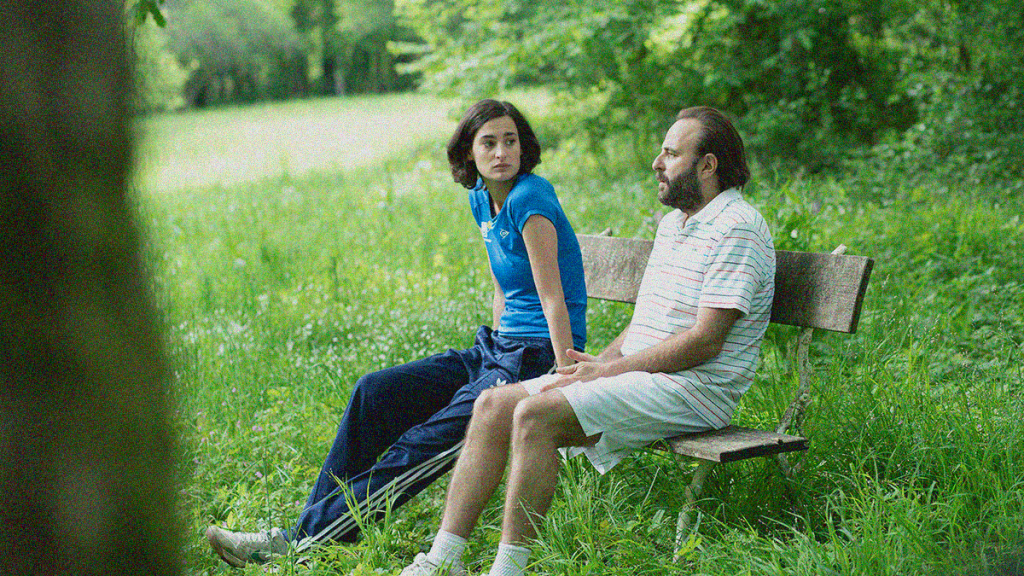
It’s why the women prove a crucial source of mitigation. It’s the first extended time either man has spent with his significant other since they began dating. Paul and Morgane (Nine d’Urso) have been together two years, but always separated by work. Etienne and Carole (Nora Hamzawi) have been together a few months, but always in secret as he traversed his divorce. So, there’s a level of pleasantry and self-censorship permeating the household. Neither brother wants to cause a scene in front of the newcomers, but some of the conversations prove they would love to do so (the heightened sarcasm of an exchange about television volume is my favorite). It’s a shared space of individual compromises with as much familial overlap as possible during meals.
And that’s pretty much it. Add the strain of quarantining away from their children (Paul, Etienne, and Carole all have kids) and the pressure of balancing the new world order against the old (Paul more or less steering clear of communal work to focus on writing while Etienne seeks to stay connected by continuing his radio show remotely), and it’s a relatable scenario once you strip away the obvious comfort and convenience of being financially secure enough to survive a lockdown of this magnitude. It’s about Paul figuring out who he is amidst the chaos and fear by diving back inside the memories of living in this home as a boy and all the influences that it provided his work and identity as an adult.
Assayas says himself that he wrote the script less as a movie and more as a journal to get his experiences on paper. So, the finished piece is also less of a plot-specific narrative than a personal essay filtered visually through fiction. Its true beauty and purpose are therefore bound to little moments and dialogue amidst the name dropping (Assayas was so inspired by David Hockney’s artistic output during COVID that Morgane jokingly tells Paul to start speaking for himself rather than always beginning conversations with “Hockney says …”). Morgane’s words about Paul and Etienne growing up in the same world to pursue similar occupations yet becoming total opposites in the translation linger most.
Appreciation will surely vary since it’s the type of project that gives viewers only as much as they’re willing to put into the experience. Considering my partner and I still mask in public spaces five years later proves Paul’s meditations about the future resonated with me. Those more aligned with Etienne might see it all as more of a comedy than it is with Paul serving as their whipping boy. Or, perhaps, you’ll just dismiss it as an artist’s solipsistic need to create by putting his thoughts into the public sphere regardless of any demand for them. Hopefully you aren’t the latter, though, since Assayas has made a career delivering thoughtful semi-autobiographical cinema. Those who aren’t willing to give Suspended Time a chance should know not to watch it at all.
Nine d’Urso & Vincent Macaigne in SUSPENDED TIME. Courtesy of Music Box Films.




 jaredmobarak.com
Leave a comment