
Rating: NR | Runtime: 88 minutes
Release Date: May 7th, 2025 (France) / August 8th, 2025 (USA)
Studio: Sophie Dulac Distribution / Watermelon Pictures
Director(s): Hind Meddeb
Writer(s): Hind Meddeb
I still can’t really believe that what happened, happened.
The title isn’t a mistake. Sudan, Remember Us speaks to the fact that most of the revolutionaries Hind Meddeb captures throughout the four years unfolding on-screen no longer live in their country. They’re amongst the 12.7 million Sudanese who have been displaced to Egypt and beyond while another estimated 150,000 were killed. These are the citizens declaring there will be no surrender who eventually realized the conflict had too many external forces assisting the military regime and not enough global journalistic exposure to combat it. So, they chose to live to fight another day and hope their homeland doesn’t forget their sacrifice.
Meddeb ensures it by putting them on film. A French-Moroccan with Tunisian roots, she went to Sudan a month after the people’s peaceful protests helped guide the Sudanese Armed Forces to overthrow President Omar al-Bashir. There was hope in the air as Lt. Gen. Ahmed Awad Ibn Auf took control of the government to steward a transfer of power to civilian leaders. Before that could happen, however, Auf resigned over protests against him for not extraditing al-Bashir to the International Criminal Court. Despite his successor being a direct ally to the people’s movement during the coup, Lt. Gen. Abdel Fattah Abdelrahman Burhan had other ideas about Sudan’s future.
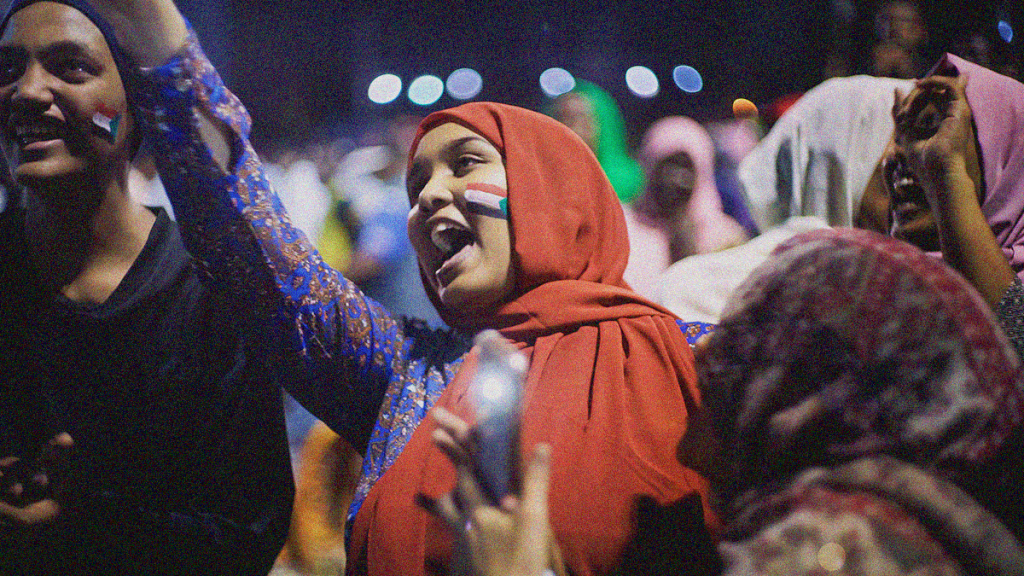
With her own footage and videos shot by protestors and soldiers (the latter documenting their own brutality during the Eid massacre two months later), the film goes from jubilant optimism to abject despair. Focused solely on the revolutionaries’ plight, we see their reactions to events that would ultimately replace an Islamist regime with a military one that restarted all al-Bashir’s oppressive systems with even more violence and secrecy than before. Meddeb’s subjects talk about hope and progress only to end up back in the streets for more civil disobedience. Sudan’s youth become radicalized by the promise of freedom and the government sells its soul to the bidding wars of nations desperate to secure control over the nation’s resources.
The film is therefore a document of a time and place that no longer exists. A portrait of a generation willing to give their lives for the promise of freedom who realized their blood wasn’t enough if no one was paying attention. Platforming their voices alongside the words of the Sudanese poets and rappers who inspire them means that Meddeb doesn’t provide much expositional context beyond a few words to set-up each new phase of the revolution. Her goal is to instead humanize the conflict, reveal the prevalent philosophical mindset, and show the sheer number of protestors to fully understand the will of the people is not being heard.
Now it’s on audiences to do the research, identify the players, and ensure what’s happening in Sudan remains transparent to prevent any rhetoric to the contrary from becoming uncontested historical truth. Sudan, Remember Us is powerful enough to propel that mission regardless of it being intrinsically incomplete for those ignorant to the ordeal. It grabs our attention with its emotion to win allies and advocates rather than a dense lecture that may alienate those who aren’t already invested. And it also serves as a reminder to the exiles to not forget Sudan either. Maybe they won’t be able to go back during their lifetimes, but immortalizing what they did might mean their children will.

A scene from SUDAN, REMEMBER US; courtesy of Watermelon Pictures.




 jaredmobarak.com
Leave a comment