
Rating: NR | Runtime: 121 minutes
Release Date: January 25th, 2024 (Israel) / July 25th, 2025 (USA)
Studio: Playhouse Tlv / Greenwich Entertainment
Director(s): Michael Winterbottom
Writer(s): Laurence Coriat, Paul Viragh & Michael Winterbottom
We do the same.
The hypocrisy is the point. At least that’s what I’m taking away from Michael Winterbottom’s Shoshana. It’s a necessity considering he, Laurence Coriat, and Paul Viragh don’t afford the Palestinian Arabs within their story the same complexity they give to the Zionists. They intentionally keep them at a distance in order to hope no one notices instead. Because, to their credit, it is made quite clear that this was a region occupied by Arabs for thousands of years before the Treaty of Versailles ceded Palestine to Britain control in 1919. That’s when Jewish immigrants began arriving by the thousands. That’s when the Zionist movement dug in. That’s when it became a war between “terrorists” and “assassins.”
Rather than give credence to the notion that Palestinian Arabs have a claim on this land and have been acting on self-defense ever since, Winterbottom and company use this fact to muddy the waters of what becomes a war pitting Zionists against Britain. They set this stage so an exchange between Avraham Stern (Aury Alby), leader of Zionist terrorist organization Irgun, and Geoffrey Morton (Harry Melling), newly anointed leader of Britain’s Tel Aviv office, hits with an appropriate dose of that aforementioned hypocrisy. These are two psychopaths going toe-to-toe to smugly state their entitled authority over Palestine. Two foreigners leading opposing occupying forces caught within a drama that all but forgets the Arabs trapped beneath their feet.
The question is therefore whether you can fully judge Shoshana without weighing this omission. Should you fault it for what it never sought to be if it succeeds at telling its intended narrative? I believe it being a true story with real life characters means you should. Especially since the duality supplied to the Zionists (one faction fighting for a Jewish state that would allow Arabs independence while another faction seeks spilling as much blood as necessary to claim it all for themselves) is not afforded to the “violent Arab rebels” mentioned only at the start (to contextualize Zionist revenge bombings) and the end (as enforcers of a Holy War once the partition is announced). Despite that foundation of Palestinian displacement, they still get reduced to aggressors.
As for the narrative presented removed from this glaring reality: it is well told. Split between the vantages of the titular Jewish socialist Zionist Shoshana Borochov (Irina Starshenbaum) and her British detective lover Thomas Wilkin (Douglas Booth), we’re given a history lesson of this period in Palestine’s history. There’s the nuanced police work of Wilkin understanding the rebel group Shoshana aligns with is on his side as far as stopping Irgun’s bombings. The nuanced philosophy of Shoshana holding her activist father’s Zionist ideal of a shared Palestine while her brother joins the Irgun and her friends question her allegiance. And the muddied water Morton splashes over both with his binary approach of shutting everyone down to assert British dominance.
It’s a multi-faceted espionage thriller beneath a front-facing romance that reveals as much compassionate empathy at the start as it does radicalized violence by the end. Because while the constant threat of Shoshana and Wilkin needing to both eventually “choose a side” is presented as one where a third might reveal itself to be love, that’s not the case. Love is simply used to accept the other’s problematic loyalties to remain together. It’s their respective sides that will ultimately choose once it’s learned that this sort of ideological and myopic war isn’t conducive to love. Not when you’re willing to kill without due process, sacrifice women and children, or cut bait and leave if the cost outweighs the benefit.
I enjoyed Starshenbaum and Booth’s performances as they juggle desire with duty. But it’s the history lesson that truly captivates. Stern’s capture and release. The Irgun and British truce once World War II breaks out. The fracturing of Irgun into the even more extremist Lehi. It’s a fascinating evolution in clandestine warfare that parallels Britain’s goal to control Palestine with the Zionist’s goal to undermine them and do the same. Winterbottom does well to maintain his plot’s numerous spinning plates by filtering everything through Shoshana and Wilkin’s lens. And the moment it all comes crashing down, the truth is exposed: compassionate colonization is a myth. Genocide will always be inevitable.
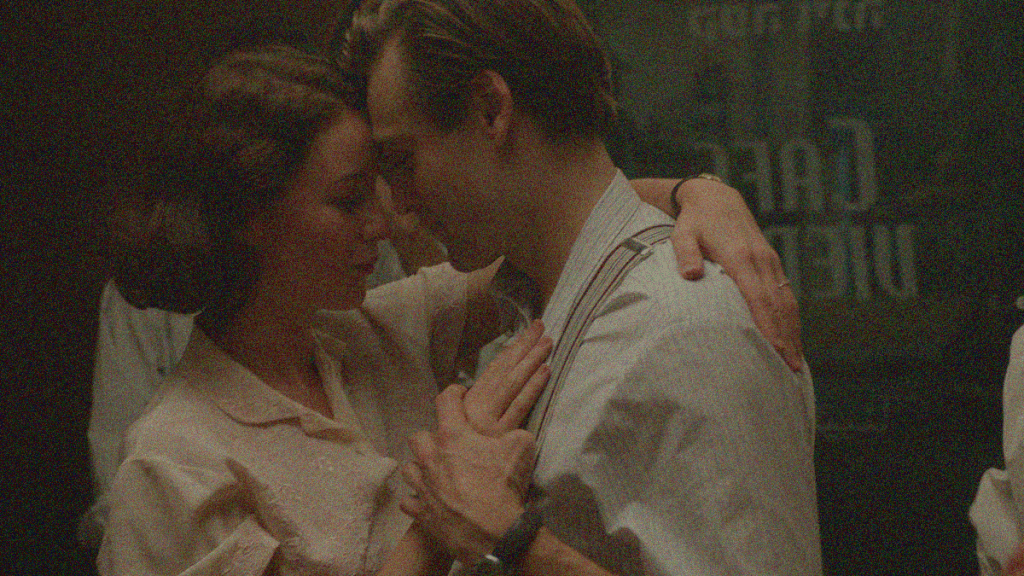
Irina Starshenbaum and Douglas Booth in SHOSHANA; courtesy of Greenwich Entertainment.


 jaredmobarak.com
Leave a comment