
Rating: NR | Runtime: 103 minutes
Director(s): Chloé Cinq-Mars
Writer(s): Chloé Cinq-Mars
You have to learn how to handle your drinking!
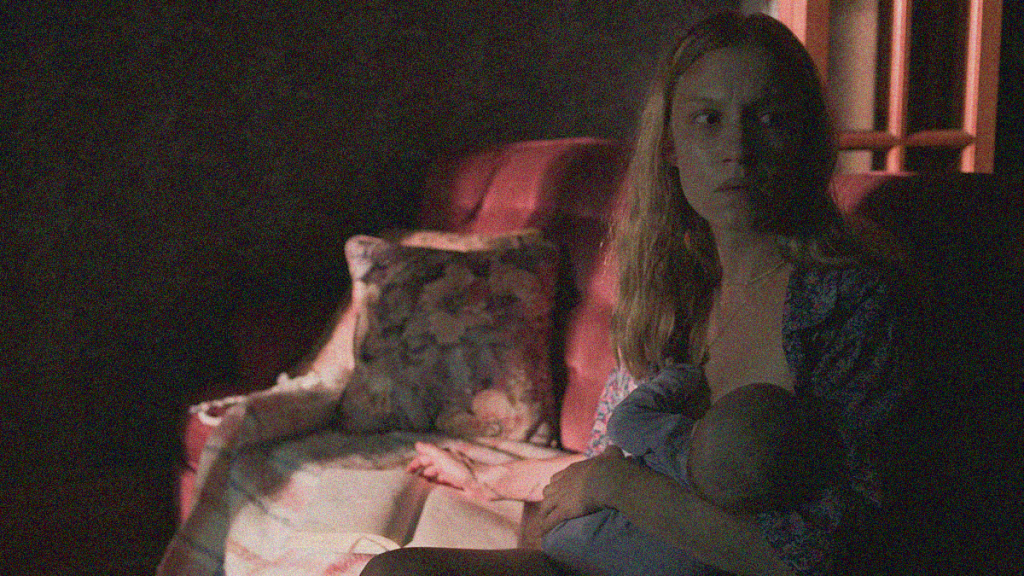
Chloé Cinq-Mars’s Peau à peau begins as a postpartum drama. Despite nursing little Lou every three hours as advised, Pénélope (Rose-Marie Perreault) can’t seem to get him to put on weight. The doctor wonders if there’s been any additional stress or a change in her routine and Pénélope can’t help but answer with a sarcastic “I had a baby.” What else is she supposed to say? The baby is why she’s up all night. Her boyfriend (Simon Landry-Desy’s Gaspard) is too stoned to take a turn (“you need to breastfeed him anyway). Her parents and mother-in-law don’t seem willing to help. She can’t get out of the house to work. And the pregnancy was so difficult she almost died.
There’s more to the tension in Pénélope’s life than motherhood, though. More too than surviving a convenience store robbery in which she ignored the gun-toting criminal’s demands to get on the floor so she could protect her baby instead. You see, Peau à peau is also a ghost story. Because everywhere Pénélope looks, a vision of Charlotte (Marie Bélanger) manifests. First, it’s a product of confusion wherein she recognizes this figure from her past in other people. Then it’s a trick of the camera with Cinq-Mars adding her reflection in mirrors or glass that Pénélope is passing. And once we learn about her identity, Charlotte becomes a harbinger of death whose presence places Lou’s life in danger.
This duality allows the film to tread through horror tropes as more than merely metaphor. While Pénélope’s gradual descent into psychosis would still work on a purely poetic level, Charlotte adds another layer of mystery for the audience to question everything we’ve seen as supernatural. We know Charlotte is the reason Pénélope decides to reconnect with Edward (Saladin Dellers) after so long. Seeing her conjures memories of better times and her current struggles with Gaspard beg for the comfort of familiarity. But she’s also why the prospect of mice roaming the house puts her into sensory overload. This isn’t something we know straight away, but its truth reveals that a lot more might be a result of Charlotte too.
Pénélope’s anxiety isn’t therefore just resentment towards the child who has thrown a wrench in her life. It’s also a product of whatever emotions have wrapped themselves around this ghost. Is it guilt? Longing? A bit of both? Why does she begin to not only fear Charlotte’s presence, but also the idea that she might take Lou away from her? This is the wrinkle that sets Peau à peau apart from others with similar subject matter because the situations where Pénélope puts her baby in danger are more often than not an attempt to keep him safe. She leaves him in the bathtub to ensure Charlotte isn’t the voice she hears outside. She places him in the car because the house isn’t secure.
Our investment is therefore two-fold. We’re watching to see if Pénélope can dig herself out of this psychological hole before crossing a point of no return and to find out what actually happened to Charlotte. Something within the former’s mind is connecting Lou to the latter both as a surrogate and target. So, we can infer these young women shared a deep bond and can presume the topic of safety is a connection since Lou (and Pénélope) barely survived their trauma while Charlotte couldn’t survive hers. And then there’s Gaspard treading water as far as what to do. Despite him being a full liability Pénélope would have been correct to ditch at the beginning, he does embrace his responsibility just in time.
Cinq-Mars is patient with her reveals so that the film almost unfolds in chapters. The first shows us that Pénélope is a good mother despite what she might think while Gaspard repeatedly lets her down and Edward presents a path back to joy. Then, with the reveal of a photograph, that path transforms into a place to hide. Everything begins to darken and the reasons for Pénélope’s actions change under that dimming light of recognition. And, just when Gaspard reappears as a potential savior, Pénélope descends further into paranoia as though things finally starting to turn a corner means the horrors of her mind are given room to expand. There can ultimately be no future without first confronting the past.

Rose-Marie Perreault in PEAU À PEAU; courtesy of Fantasia.

 jaredmobarak.com
Leave a comment