

Rating: NR | Runtime: 104 minutes
Release Date: October 16th, 2024 (France) / March 21st, 2025 (USA)
Studio: Les Films du Losange / Janus Films / Sideshow
Director(s): Alain Guiraudie
Writer(s): Alain Guiraudie
A crime must not stop life going on.
Jérémie (Félix Kysyl) has returned to his former village after ten years away to attend the funeral of his old boss. Martine (Catherine Frot) is happy to see him. Both she and her late husband adored him, and she knows his being there would have meant a lot him. Her son Vincent’s (Jean-Baptiste Durand) reaction is colder, though. They shake hands and kiss on the cheeks, but there remains an awkwardness that can’t be ignored. The ceremony completes. They gather at Martine’s with family (Vincent’s wife and son) and friends (David Ayala’s Walter and Jacques Develay’s Father Philippe). The night ends with an offer for Jérémie to stay over rather than drive home. And morning comes with the thought that he might never leave again.
It’s here that Alain Guiraudie’s Misericordia begins to ratchet up tensions by introducing secret/unknown relationships via the drama Jérémie’s presence creates. Martine offers him the family’s bakery knowing it could still be viable in the right hands. Vincent worries he’s trying to move in on his mother sexually because he doesn’t know what she already does. Jérémie suddenly takes an interest in Walter despite it always seeming as though he didn’t like him in the past. And Father Philippe pops up around every corner whether at Martine’s table, in the forest picking mushrooms, or just standing outside the abbey with a knowing look. Vincent wants Jérémie gone and the latter’s desire to stay almost becomes solely about not giving the former the satisfaction of leaving.
The title is a Latin word that translates as “mercy.” Our assumption is therefore mercy for the bereaved. To not leave Martine alone. To offer friendship to Vincent. To remember the deceased. As things progress, however, Guiraudie provides examples of the characters giving Jérémie mercy. Forgiveness for leaving. Compassion for returning. Desire for him to stay. Well, everyone but Vincent. Maybe something happened to sow such distrust or maybe he’s just always been a hothead in need of a target, but their guest’s extended stay has him itching for a fight. And while it may initially appear to be born from a silly notion considering what we soon learn about Jérémie, he doesn’t help his own cause when igniting chaos by insinuating himself into Vincent’s relationships.
Is Jérémie trying to replace Vincent? Not with his wife, but definitely as son, friend, and parishioner. He’s been positioned as the “better man.” Showing kindness and love—perhaps too much of both—when everyone knows the village would hardly lose sleep if Vincent’s violent temper ever disappeared. That doesn’t mean they won’t still worry when he does vanish, though. It’s one thing to consider the quiet that might result, but it’s another to wish for it to happen. Even so, you can’t help feeling a sense of Stockholm syndrome washing in. Jérémie is hardly their captor, but they empathize with him in ways that don’t necessarily benefit themselves. As though securing his stay to fill Vincent’s absence is worth ignoring whatever he did to create it.
They fall over themselves to be Jérémie’s alibi or talk the police into believing whatever alibi he uses. Even the authorities are quick to take his word despite suspicions—going far enough to cross lines for interrogation but never to dig the spot they know must harbor a clue (some mushrooms shouldn’t be growing this early in the season). But Jérémie is protected by a layer of Teflon and luck that even he isn’t certain he can accept once guilt and the stress of lying sets in. It isn’t of his own making, though. He’s not trying to convince or trick anyone. They’re doing it all on their own. Not because they didn’t love Vincent, but because murder has become commonplace. Society has turned a blind eye to atrocities so readily these days that it’s easier to pretend nothing happened.
That’s quite the message. Not quite anti-restitution as far as murdering murderers not actually bringing victims back to life, but an apathy towards the reality that we can’t care too much about loved ones dying if we also refuse to care about strangers dying at all. Guiraudie is shoving our hypocrisies in our faces at a time where they’ve never been clearer considering how long Russia has been allowed to kill Ukrainians since their invasion and how far this current chapter of Israel’s ongoing genocide of the Palestinian people has escalated. Why worry about Vincent being gone when you Jérémie is arguably an improvement over him? We choose to go about our lives because we don’t want to think about how we might be next. Blissful ignorance and morality simply don’t mix.
It’s why Misericordia is so entertaining. I wouldn’t have called it a comedy until reading its billed genres (dark or not), but you can’t deny that it unfolds with a perpetual smirk. That’s what happens when you make you most likable character into the villain. Guiraudie is able to play with our preconceptions and stretch our capacity to forgive someone for the permanence of a solitary act of aggression upon someone who permanently acts with aggression and to vilify the latter despite the former. The characters don’t laud Jérémie as heroic, but his freedom and support arise through the mechanisms of heroism. Because they all selfishly want him in their lives. They might not condone what they know he did, but their lives are better with him in them. We’ve been conditioned to live in that gray.

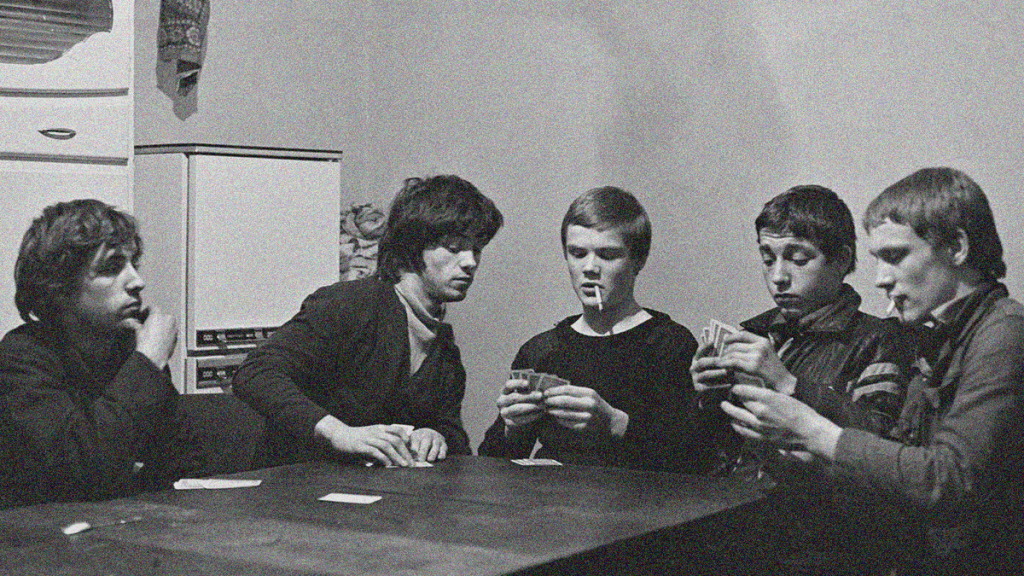
The cast of MISERICORDIA; courtesy of Janus Films © CG Cinema.



 jaredmobarak.com
Leave a comment