Rating: R | Runtime: 104 minutes
Release Date: June 13th, 2025 (USA)
Studio: Apple TV+
Director(s): Michael Pearce
Writer(s): Brad Ingelsby
I can make her do anything.
It’s easy to vilify a parent for giving up on their child because blah, blah, blah. But sometimes people truly don’t deserve a second chance. Or a third. Or a tenth. Richard Garretson (Kyle MacLachlan) sees that. Sure, he’s obviously a bastard and thus warrants our instant hate for everything he says and does (including giving his ex-wife the money he swore he wouldn’t right after chastising her for doing the same with their daughter over and over again), but those things mustn’t be mutually exclusive. He can be a jerk. Kate (Julianne Moore) can be a pushover. And Claire (Sydney Sweeney) can be troubled beyond help. Maybe their combined volatility created that truth. Maybe that truth created the volatility.
Whichever the reason, director Michael Pearce and writer Brad Ingelsby rely on our prejudices (and their exploitation of them) to quickly empathize with Kate’s plight. Because Echo Valley isn’t just about her roller coaster of emotions where it comes to her daughter’s drug habit and instability. It’s also about the grief of having lost her wife nine months prior. Kate has been taking care of their farm by herself all that time—wishing she could stay in bed, but knowing she must feed the horses. In a perfect world, Claire would be there to help. To support her mother in her time of need. But she’s instead become a drain on Kate’s savings for rehab stints she never even finishes.
So, it’s difficult to sympathize with Claire. No matter how much we understand Kate’s instincts to love her unconditionally, we, as outsiders, can only grant so much room for authentic change before wishing this widowed mother would cut her loose. Ending the story early can become a better outcome than enduring the constant examples of why she should have done so before it ever got to this point. Add an extremely violent altercation between Kate and Claire early on and we receive front row seats to the evidence that proves it. Thankfully that incident does finally break the blind maternal hold. Kate tries to move on knowing her daughter will probably end up dead and we accept it’s probably for the best.
That’s when the plot kicks in. Right when we assume Claire and her boyfriend Ryan (Edmund Donovan) will turn up as cadavers in the morgue courtesy of psychopath Jackie Lawson (Domhnall Gleeson), she turns up on Kate’s doorstep with blood-soaked clothes and a body in her car. It’s a wild scenario, but one that can be excused due to the circumstances set forth. Claire is an addict and thus highly erratic. Kate is an open heart who always chooses the people she loves above herself when forced to make a quick decision. Yes, it’s funny that Claire decides wrapping the person she accidentally killed in a sheet and duct tape was smarter than calling the police and feigning self-defense, but she hasn’t done anything for us to believe smarts would ever trump impulse.
So, the narrative shifts away from a mother coping with loss and attempting to stay strong enough for another. Now it’s a quasi-suspense thriller surrounding a crime Kate has implicated herself in to save Claire. We know there’s no way it won’t backfire because Claire is destined to screw it up and we still have an hour-plus of runtime to go, but how it backfires might surprise you. I applaud Pearce and Ingelsby for the twist because everything was going rather straightforwardly until that rug pull—even if it proves obvious in hindsight. From there it’s an uncomplicated journey towards watching Kate try to save herself. There’s something empowering in it because the only way to succeed is by finally letting herself leave her wife and daughter behind.
It’s why I didn’t necessary love the ending (I’d have given the film an extra star if it finished with a door slam instead of a more ambiguous cut to black that all but ensures the door stays open). It’s one thing to forgive, but it’s another to move on. While Kate might still do the latter, nothing we’ve seen prevents us from assuming the former was a foregone conclusion regardless of whether she’d have the self-control to not provide it as freely as in the past. Echo Valley seems so intent on exposing the complexity of this mother-daughter relationship that a more cynical end game seemed the point. Chickening out doesn’t undercut the action, but it does render it somewhat anticlimactic.
So too does the inevitable rewind to show us what “really happened” despite the result already explaining it without further handholding. As soon as the police officer (Albert Jones) explains details we didn’t know would be found by his investigation, everything clicks into place. And the why is always more important than the how. Give us a glimpse of horses running free and another Fiona Shaw wink and we’ll put two and two together. We don’t need a lengthy runback to prove what we already know. For a film that took pains to be more show than tell, this moment does undercut the potency of what occurred because it shows the filmmakers didn’t quite trust their own work.
The film is still worth watching, though. Moore and Shaw are great. Sweeney is intentionally annoying with a nice ability to garner sympathy even as we know Claire holds all the blame. And Gleeson is having fun chewing scenery with a huge grin. It doesn’t reach the heights of Pearce’s debut Beast, but it is a step-up from his previous work, Encounter. He’s an intriguing filmmaker who’s always bolstered by great casts, but it’s hard not to wonder if there’s a reason Amazon and Apple have been his last two homes. That’s not to say they don’t or haven’t bankrolled quality art. It’s just that they also often bankroll scripts other studios wouldn’t for content purposes alone. Echo Valley has its moments, but I mostly kept thinking about The Deep End and God’s Creatures instead.

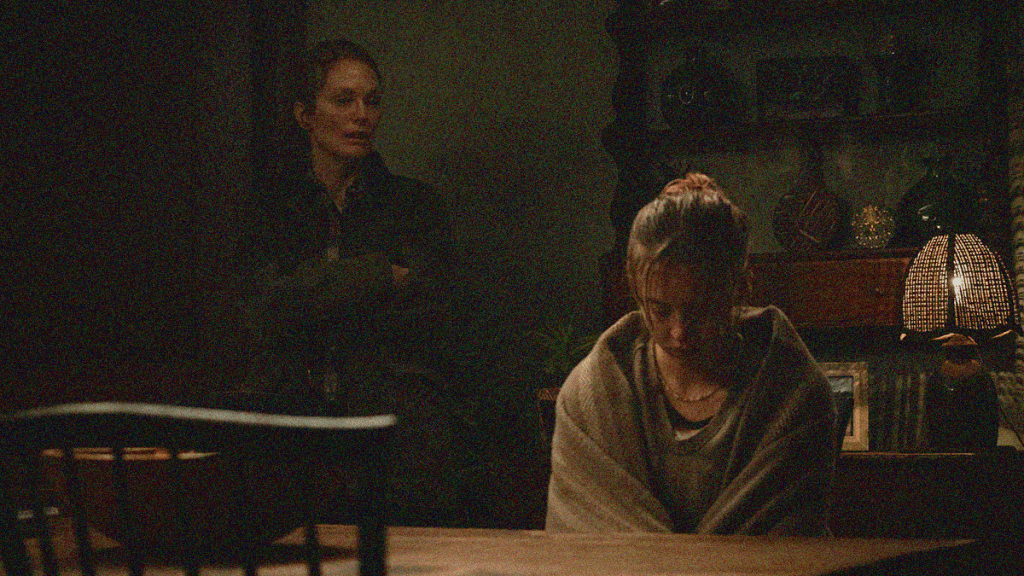
Julianne Moore and Sydney Sweeney in ECHO VALLEY; courtesy of Apple TV+.


 jaredmobarak.com
Leave a comment