
Rating: NR | Runtime: 96 minutes
Release Date: July 6th, 2023 (Australia) / May 23rd, 2025 (USA)
Studio: Roadshow Films / Vertical Entertainment
Director(s): Warwick Thornton
Writer(s): Warwick Thornton
Amen.
We meet Warwick Thornton’s nine-year-old aboriginal protagonist (newcomer Aswan Reid) at the start of The New Boy as he’s putting a grown man in a chokehold. Alone and roaming the Australian desert, we can presume many things. Maybe this white man saw the boy stealing something and made chase to punish him. Maybe he was out searching for orphan natives to kidnap and send to assimilation camps run by the Catholic church. Maybe the boy attacked him first. Either way, what happens next falls under the government’s bid to “breed out the black.” Capture him, send him away, and don’t let him back into “civilized” society until he resembles a “good” Christian man.
Born from a script almost twenty years old, Thornton draws from his own experiences as a rambunctious child sent off to a Catholic boarding school to calm down. He admits that it worked and that he embraced the religion—in large part because of the similarities to his own native spirituality. Thornton makes an interesting point in his director’s statement, however, that this commonalty only ever truly works in one direction since Catholicism demands power and control. Aboriginal people are quick to adopt the Church’s lessons because the familiarity adds to what they already believe. But it isn’t taught with addition in mind. The Church wants to indoctrinate via subtraction. To accept Jesus is to forsake all else.
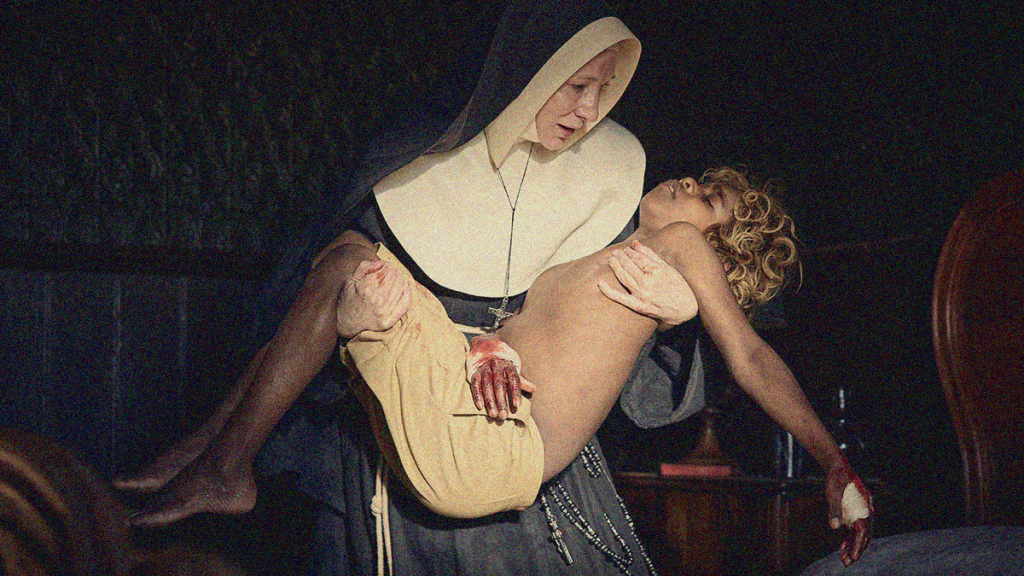
To portray this dynamic, he sends Reid (known only as “New Boy” until the very end) to an orphanage run by a “renegade” nun named Sister Eileen (Cate Blanchett). It’s never fully explained, but she writes to the government agencies financing her establishment and sending new wards as Dom Peter, a priest. Was he actually in charge only to die with her adopting his position to keep things running? Did he ever exist? She knows what she’s doing is a sin as far as repenting during confessional with herself (apologizing for baptizing the boys under her care despite not having the authority), but also that it’s a necessity to maintain her mission. They need her guidance, and she loves them in return.
This is why it can be difficult to see where things are going at first. Sister Eileen isn’t a taskmaster. She lets “New Boy” go at his own speed so he can learn their routines by observing the rules the other boys follow. She creates a safe place for him to join the others and allows Sister Mum (Deborah Mailman) and their handyman-of-sorts George (Wayne Blair) as much responsibility and independence as she provides herself. They all do their chores, listen to music, and enjoy each other’s company while questioning the wartime orders from her superiors to risk cutting the orphans’ studies short so they can work towards the cause. It’s only when a new statue of Jesus on the cross arrives that Thornton’s dramatic motivations become clearer.
That early moment where “New Boy” rubs his fingers and conjures a floating spark of light to laugh with isn’t a flight of fancy solely housed in his own imagination. No, it does happen and, if he wasn’t under his bed while doing it, the other boys would see that spark too. The question then is whether this magic is good or bad. We inherently know it’s the former, but that never stops an entity like the Catholic Church from saying the opposite with enough force to make its faithful agree regardless of what they actually believe. This is even true if that magic performs a miracle, which this one does during a potential tragedy. Because what does that miracle mean to its observers? That God has taken this boy as His vessel to prove their work converting aboriginal children is a success.
One false step, though, and that sense of wish fulfillment—that bona fide proof of Sister Eileen’s faith—can turn to blasphemy. If that boy does something “wrong” purely out of innocent ignorance considering he has no clue who Jesus is or what he stands for beyond idolatry without the words to learn, the reverence she had for him sours into fear. That spark becomes a test for her rather than the salvation of the boy it saved. It’s a trick meant to steer her from her path and thus a reminder that these boys need “cleansing.” Because, as Thornton said, Catholicism, despite all its beautiful ideas, will always be ruled by its desire to conquer. An unbaptized aboriginal boy with a lost soul doesn’t know the one true God yet, so anything “good” he does must be in service of “evil” until being “saved.”
How Thornton portrays this truth is a sobering treatise on just how damaging something as powerful as belief can be when used in service of alienation rather than empathetic unification. You see it in Sister Mum and George—aboriginal themselves—looking upon Reid with terror even if, in the case of George, it’s less about faith and more about not wanting to lose the comfortable life he’s found. You see it in Sister Eileen’s self-flagellation in response to letting herself be distracted by what she wanted to see rather than what her duty to the Church demands. And, most traumatically, you see it in “New Boy” when his inability to understand what’s happening risks severing the connection to his magic.
It’s quite the dual threat of metaphor via fantastical realism and the cultural violence inherent to colonialism by an artist who lived it. And it means more that Thornton admits Catholicism helped him because the film doesn’t become a hit piece as much as a level-headed, compassionate view of how close we are as a species to realizing how alike we are if we were willing to open our hearts to those similarities and stop seeking out the differences instead. That’s the crucial bit about intolerance that the intolerant refuse to see because of their innate fragility. You must listen and learn to become better people. You must be willing to adapt. Because if your plan for “peace” is to simply call yourself better and force everyone to conform, you truly have nothing to offer but hate.
Cate Blanchett as Sister Eileen and Aswan Reid as New Boy in THE NEW BOY; courtesy of Vertical.



 jaredmobarak.com
Leave a comment