
Rating: NR | Runtime: 85 minutes
Release Date: May 9th, 2025 (USA)
Studio: 1993
Director(s): David Mamet
Writer(s): David Mamet
The illusion of law exists to celebrate a lie.
Even when it’s proven you were the mark, you refuse to believe you are a mark. Because that initial betrayal cannot be the norm. It must be the exception. It would have happened to anyone since mankind is inherently good. Right? At least that’s what people say. That’s what you’ve chosen to accept as the basis of your own incorruptible kindness. But, as we’ve seen throughout history, this idea that humanity is inherently good has mostly been exposed as a lie. Because we aren’t. We’re greedy. Opportunistic. Fearful. We will hurt ourselves in the process of hurting others simply because the person who told us he was our savior fingered them as the problem. We hail ourselves as heroes while willingly gifting our souls to the Devil so he can tell the next person we’re the problem now.
This archetypical figure is generally presented as an innocent in ways meant to instill hope in an audience. Think Forrest Gump. Or Being There. Or any of the countless other cinematic tales of naïveté being used to personify wholesomeness and admiration. David Mamet isn’t interested in following suit. Not because that portrayal can’t be helpful—it can. But because we’ve reached a point as a society in which fairy tales can no longer survive our innate cynicism. Because the happily ever after we’ve been fed for centuries has revealed itself to be the lie it’s always been. We don’t live under a two-party system or even a government that cares about its constituents’ well-being. Capitalism has rendered our politicians into board members interested only in their profits. And they’ve recently discovered their “product” was the one thing getting in the way.
Mamet’s Henry Johnson is therefore a cautionary tale. He has weaponized our collective cynicism to create a character who is so willing to think the best of people that he’ll continue doing so even as that trust sinks him deeper and deeper into despair. It’s not empathy that drives him, though. No, Henry (Evan Jonigkeit) is ultimately driven by the same vanity that drives us all. He wants to belong. To be liked. To be loved. To make a difference. Unfortunately, he’s completely unable to think for himself. He’s a lemming. A lamb led to slaughter. He’s embraced the belief that people act in good faith and has inevitably ceded control of his own life to those selling him the unrealistic utopian dream he still thinks is possible. He doesn’t epitomize hope. He proves hope is dead.
Told in three acts (and retaining its stage aesthetic to allow the performances to take over), Mamet presents Henry as a “student” to life’s hard truths. Rather than be a sponge capable of processing what he learns and thinking through the reality of their contradictions, however, he simply accepts it all at face value. Because he yearns for the indoctrination. He yearns for the ability to let blind allegiance provide success regardless of that success having zero basis in common sense. He is our parents drawn to the glow of the television as Fox News spouts nonsense targeting their baser instincts. A parrot repeating what he’s “learned” as if the mere act of it being said aloud grants it authenticity. That old college acquaintance who once “offered” Henry a girl to sleep with is his “friend” because he says he is and that knowledgeable cellmate describing everyone as a charlatan is definitely not a charlatan himself.
I love the structure Mamet uses too considering the ways in which Henry is revealed as a puppet. The true perpetrator of the first chapter isn’t present, but the act of him being debated by Henry and his boss Chris (Chris Bauer) makes Chris into a different sort of puppet-master. Because the damage is already done. Henry has already left himself vulnerable via his actions to help a “friend” and Chris is astutely and entertainingly positioning himself as devil’s advocate to help him reckon with this yet unseen truth. And by methodically peeling away the layers of Henry’s self-defeat, Chris is also receiving something in return. It’s a little bit pragmatic in this time spent having purpose and a little bit personal in the sense that Henry’s eventual understanding renders his fate more painful.
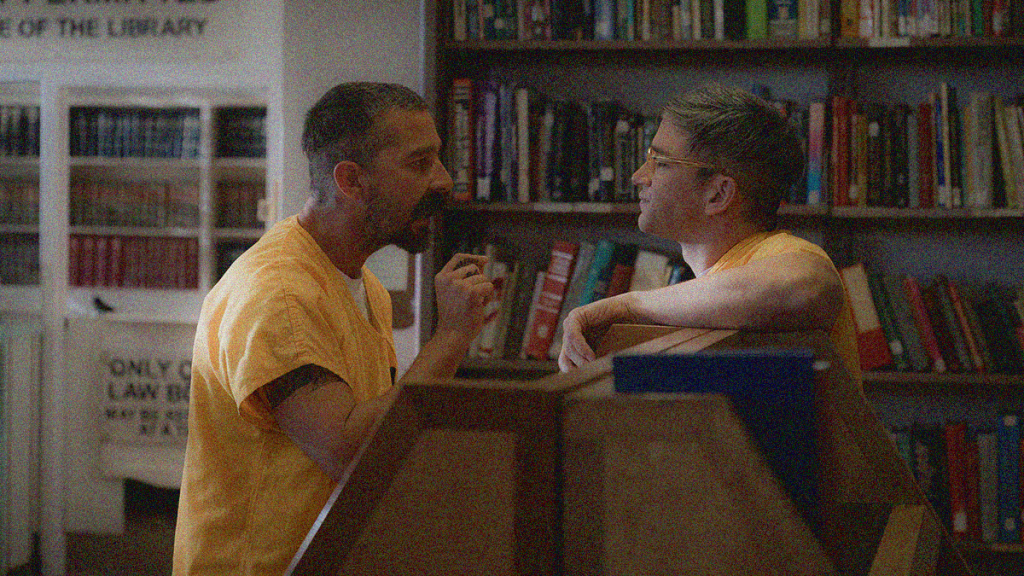
The perpetrator of the second chapter is present via Gene (Shia LaBeouf). In many respects, we get to see the years-long grooming at the background of the first portion compressed and augmented through a couple highly enjoyable conversations that prove Mamet hasn’t lost his magic. The initial dialogue seeks to explain Henry’s situation by way of teaching him what to avoid. Gene calls him out for his propensity to be duped and hurt in order to position himself as savior. It’s exactly what Henry’s “friend” did to keep him in his pocket for a rainy day, just with more intent and fear-mongering to put him in Gene’s pocket immediately. And Henry has no recourse because he again conflates “trust” with being told what he wants to hear. Why question what you’re being asked to do if they promise the outcome will get you want you want?
But it’s never about what you want. It’s about getting you to give them what they want. Case and point: chapter three’s Jerry (Dominic Hoffman). For the first time all film, Henry is the one with the power. Yes, he’s still the mark with zero leverage in the bigger picture of the world (as metaphorically presented via the confines of a prison), but he is the one in control of the dynamic between himself and Jerry in this room. So, why do the tables can turn so quickly? Because Henry’s trust remains for sale. What’s better, though, is that Mamet preys upon the lessons his lead has learned in the previous sequences. Henry won’t let Jerry bide his time a la Chris or feed his paranoia a la Gene, but he’s still cannot combat blind faith. He still believes in humanity despite all evidence to the contrary.
Henry is neither the hero or villain of this tale. He’s a mirror used to strip away the façade that someone else will save us. I think that’s why Mamet’s play (as performed by these four actors and directed by Marja-Lewis Ryan in 2023) sold out so many shows despite relying solely on word-of-mouth (or so the press notes explain before LaBeouf invited the Los Angeles Times on his own). It speaks to our collective rage under authoritarian rule at both those dismantling our country and those standing idly by as if they have no power to stop it. One could argue it does the opposite too in the sense that people asking for our help have ulterior motives and a penchant to harm us for that charity (the line being fed by republicans when twisting the literal job of any government), but that’s the point.
Does it make more sense that you’re being exploited by people with less power than you or more power? What does the latter have to gain by making you believe former? Everything. Because once their initial target for your hate is gone, guess who takes their place?
HENRY JOHNSON will be available for rental starting May 9, directly from its official site, with nationwide theatrical screenings throughout the summer beginning on the same date.
Shia LaBeouf and Evan Jonigkeit in HENRY JOHNSON; photo by Pam Susemiehl.



 jaredmobarak.com
Leave a comment