
Rating: NR | Runtime: 89 minutes
Director(s): Timothy Hall
Writer(s): Timothy Hall
I don’t go upstairs.
Agnes (Moira Glennon) hasn’t been home to Macon in years—with good reason. Something happened during her childhood that went beyond just losing her mother, but no one would believe her when she tried to explain it. Not even her brother. Agnes’s father was simply too respected in the community. As the local Baptist pastor, he could do no wrong in their eyes. Sure, she was hurting, but she was “projecting” the source of that pain. She was “creating” a villain rather than dealing with an evil that was all her own. And the more she acted out, the less the congregation believed anything she said. They made up their mind, pitied her father instead of her, and, presumably, were glad when she left.
Why the return? To watch his corpse lowered into the ground. To know he was truly gone and couldn’t hurt her (or anyone else) again. To collect the sizable inheritance a man of his stature would have accrued as leader of a prosperous church evangelizing the hard-earned money of its parishioners. To, hopefully, move on. Except that would be too easy. That would demand her brother (Jeffrey Charles Morgan’s Joe), the new senior pastor who took over for their father, show real compassion rather than the airs duping his flock into tithing the money for a “church” dirt bike. No, he sat back as Agnes was written out of the will and hatched a plan to keep her under foot, if not guarantee getting rid of her forever.
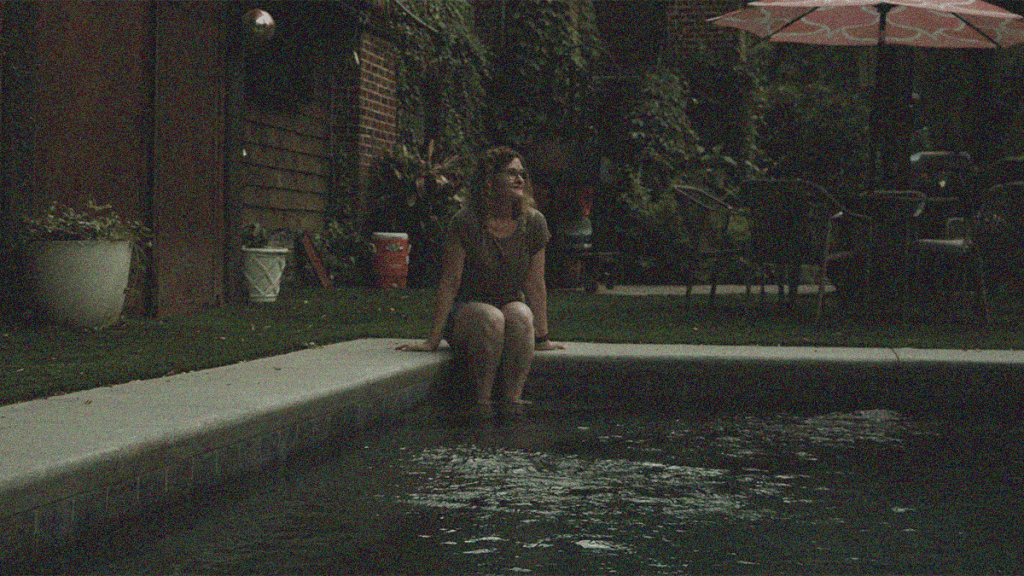
This is what we learn during the first half of Timothy Hall’s The Pastor’s Daughter. Shot on location in Georgia through a full-frame, rounded-corner vignette matte, we’re shown a series of moments from the past and present with voiceovers from both Agnes and an unknown woman. There’s a poetic nature to this stylistic choice that turns a bit sinister considering the subject matter and score. Hall is really making certain that we understand how fabricated this community of God-fearing souls is considering it’s been built upon an abusive charlatan’s back. With neighbors showing their sorrow as some performative sacrifice to Agnes’s unwanted altar and Joe’s perpetual guilt-tripping, we brace ourselves for things to grow even worse.
I enjoyed “Part One” a lot in large part because of Glennon’s idiosyncratic performance. There’s a child-like sense of rebellion to Agnes’s actions. The leftover frustration of never having been listened to or kept safe by the people now lining up to tell her they understand her loss because they feel it too. It’s a singular position in the sense that she refuses to placate them since she feels no loss at all. As she eventually admits, her father’s death has allowed her to breathe again. Agnes therefore understands none of their words are real. It’s a script they believe must be said to be seen as worthy in God’s eyes. It’s the age-old fallacy of religion: that specifically “pure” actions can make up for all the specifically “immoral” actions you still allow yourself to make.
It’s refreshing to watch her call out their hypocrisy via silence, protest, and … more humorously aggressive acts. This is a character who owns who she is and realizes her coping mechanisms (breaking into houses to feel the excitement of potentially being caught) were misguided while also proving necessary to sort through her troubled emotions (Agnes only feels her mother’s spirit in beautiful things and loving households—unlike hers—are beautiful). I became a vicarious supporter of her antics to intentionally undermine the farce that is her father’s funeral and an empathetic supporter of her choice to pick-up the pieces in the aftermath before ultimately finding herself stuck in the same pattern due to the realization that her chance to be that happy family was stolen decades ago.
There’s much to like about “Part Two” in this vein too, including Agnes’s new job as an Uber driver providing her own “confessional” to hear the troubles of her passengers as well as a road map to find the type of loving homes that can conjure her mother’s presence. But it also supplies the means with which to expose her brother Joe as the same kind of man their father was: a liar, cheat, and opportunist exploiting his position for personal gain. Unfortunately, so much of the second half is spent focusing on his potential demise that Agnes becomes an afterthought—a pawn within her own story despite being so wonderfully centered as an empowered and independent figure at the start. Yes, there’s a karmic satisfaction to Joe’s plight, but I’m unsure if much is gained narratively.
I do get the impulse to be more overt in this commentary on the hypocrisy of pious men and women, but it can become heavy-handed—especially since the message comes through clearly via Agnes’s more surreal path anyway. The second half of the film splits into two very distinctive styles with Joe digging himself into a karmic grave via a straightforward lens while Agnes tries to tread water via Hall’s more esoteric eye for the metaphorical. It’s surely meant as a continuation of the mirror being held up to show how it’s Joe who lives in the chaos of earthly pleasures while Agnes is the one touched by God’s grace through the memory of their mother, but the former risks undermining the effectiveness of the latter. Not to ruin the whole, but to wonder if something was left on the table.

Moira Glennon in THE PASTOR’S DAUGHTER; courtesy of Born River Bye.



 jaredmobarak.com
Leave a comment