

Rating: NR | Runtime: 114 minutes
Release Date: November 27th, 2024 (France) / April 18th, 2025 (USA)
Studio: Bac Films / Altered Innocence
Director(s): Alexis Langlois
Writer(s): Alexis Langlois, Carlotta Coco & Thomas Colineau / Alexis Langlois (idea)
You fisted me to the heart.
It’s been fifty years since Mimi Madamour (Louiza Aura) and Billie Kohler (Gio Ventura) met backstage during auditions for the televised singing competition “Starlet Factory”. No one knew then that they’d end up with a stranglehold on the music-loving public for a decade. No one knew that they were in love either. Because that fateful afternoon put them on diverging paths despite their blossoming romance. One would prove victorious on the show en route to making all her stardom dreams come true while the other would be thrown off the lot and left to wonder if she’d also be forgotten by the person who said they’d be together forever.
Rather than tell this story from their perspectives, Queens of Drama director Alexis Langlois (who co-writes with Carlotta Coco and Thomas Colineau) introduces a third character by way of SteevyShady (Bilal Hassani). Forgotten by the public who knew him for his controversial YouTuber antics—much like those aforementioned idols—he decides to log-on and commemorate this auspicious occasion by telling the world (us) the real story of Mimi and Billie. Their affair. Their falling out. Their successes and failures. Everything SteevyShady loved so much that he leveraged his stalker behavior into becoming a rabid fan/critic and everything he abhorred enough to do his part to ruin their lives.
This choice revels in celebrity’s fabrication. The artists, financiers, publicists, and fandom are all manufactured arms of the same capitalistic image machine, desperate to jack into the current zeitgeist long enough to make a few millions before it inevitably disappears. Mimi and Billie launch themselves on the ideal set before them by the previous generation (Asia Argento’s Magalie Charmer and Mona Soyoc’s Elie Moore) in the hopes of mirroring their highs and avoiding their lows. Parasites like Guy Brilland (Thomas Poitevin) seek to control them by ingratiating themselves on their brand before jumping to the next “hot thing.” And SteevyShady’s parasocial relationship to it all lets him go along for the ride until discovering hate sells quicker than adoration.
Is this an apology? Not really. It may seem like one at first considering SteevyShady admits his part in the circus, but he’s also telling Mimi and Billie’s story on his terms. He’s once again using their notoriety to augment his own. First it was via the fictional “friendship” he formed with Mimi (complete with great Chris Crocker homage). Then it was the weaponized vitriol of taking her and Billie down in the most attention-seeking way. And now it’s through the nostalgia of a milestone regardless of whether the world even remembers who they are … let alone him. Langlois could have achieved a similar satirical glimpse into the “fifteen-minutes” machine by having Mimi and Billie start a podcast to set the record straight too. There are infinite ways to profit off success (and its loss) whether yours or someone else’s.
Beyond the obvious industry commentary, however, is also the unfortunate realization that audiences (not critics) ultimately gate keep what art is allowed to be “great.” Because this should simply be a love story between two artists who come together to make their lives and careers better. Instead, it’s about mainstream appeal and the changing status quo. It’s about Mimi only being able to hit it big if she projects a Cishet aura that sticks to the popular consensus that female vocalists must be lusted after by men and envied by women to be worthy of a consumer’s time. So, she can’t declare her love for Billie. She can’t cheat on her forced gender identity or music genre. Not if she wants to rule the world.
This type of consensus is fickle, though. The masses tire of what worked in the past and seek a newer, flasher toy for the future. So, when Mimi’s star unavoidably begins to wane, it’s only logical that Billie’s punk-infused counterculture mystique (dialed to eleven once her heart gets broken) would fill the void. The people are rejecting the “good girl” trend and jumping on the bandwagon of “bad girl” danger. Lock your doors. Hide your daughters. The fake glam of sanitized pop buckles under the grungy allure of rebellion. Parents want their kids to aspire towards Mimi, so the kids choose to rebuke their parents and idolize their worst nightmare instead.
Yet it’s all still a lie. Because the moment the truth arrives, whatever good will either starlet received is erased in an instant. It’s no longer about what parents or children want. Now it’s about the tastemakers and influencers. You don’t need to actually like it. You must only say that you do so you aren’t left on the curb. Mimi is really a drug-loving wild child? Billie’s transgressive aesthetic is based in plastic pop motif? They’ve been lying to us?! How dare they! We must revolt. We must prove that we are the most important part of this equation. Not the artists. Not the art. No, it’s our narrative. But, as SteevyShady learns, not even that survives.
The messaging is sound with a package dripping in gender queer excess. That the music is catchy and fun almost becomes an afterthought since the lyrics and style are more a tool for the themes than the plot. You must only watch a drag show remix of three songs (two by Mimi and one by Billie) to realize how intent can be twisted to serve another’s needs. Because even if Langlois delivers what we want (for Mimi and Billie to block out the noise and be their true selves together), it was never what the people wanted. At least, not in the way they should have wanted it. First it would have been “too gay.” Now it’s too “sentimental.” So, if they must have it, they will rejoice in the mess with hare. They’ll make it about themselves … as they always do.
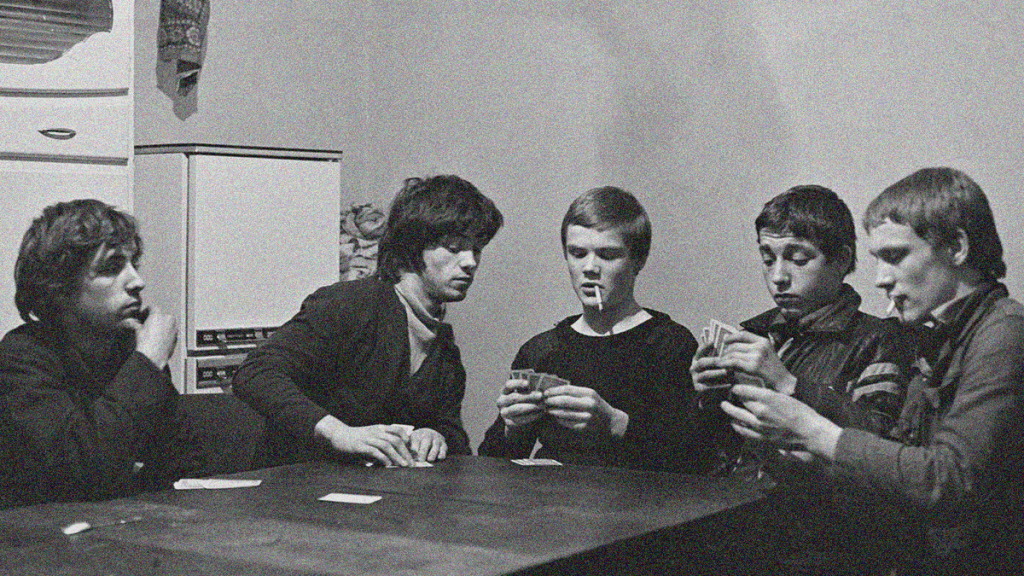
Louiza Aura and Gio Ventura in QUEENS OF DRAMA; courtesy of Altered Innocence.


 jaredmobarak.com
Leave a comment