
Rating: R | Runtime: 120 minutes
Release Date: March 28th, 2025 (USA)
Studio: Bleecker Street Media
Director(s): Scott McGehee & David Siegel
Writer(s): Scott McGehee & David Siegel / Sigrid Nunez (novel)
How can you explain death to a dog?
I joked to myself that Scott McGehee and David Siegel’s adaptation of Sigrid Nunez’s The Friend was the cinematic equivalent to the bumper sticker “Who Saved Who,” not knowing that it actually kind of is. It was funny in my head because Iris (Naomi Watts) is as need in of Apollo the Great Dane as he is of her. And Walter (Bill Murray) knew that would be the case. He saw her struggling with writing and teaching and asked her to edit a book of his correspondences (to his ex-wives, plural, mistresses, and friends) as a means of working off the block. So, it makes sense he’d also unofficially bequeath Apollo to her upon his death knowing his absence would prove as debilitating to Iris as to the dog.
But then we see her watching It’s a Wonderful Life and waxing poetic on the idea of the selfishness of suicide and the notion that an angel could choose to save someone from doing it for the wrong reasons. These words come out during an emotionally cathartic moment wherein Iris imagines a conversation with her deceased best friend to work through her anger at what he did. She accuses Walter of not thinking about anyone but himself when he took his life—least of all the dog left helpless on the other side of the door. And while Iris might not overtly come to the same epiphany, we realize that the opposite might be true. Because Walter didn’t just find Apollo a home, he found Iris a friend.
It’s a simple yet profound sort of sentiment that truly does epitomize that annoyingly cloying sticker so many rescue owners place on the trunk of their cars. Considering we get a scene with Iris telling the psychiatrist (Tom McCarthy) from whom she’s attempting to receive a “service dog” certificate that she feels like Apollo’s “service human,” it’s a literal representation of it too. Dog lovers won’t be able to resist the symbiotic relationship that blossoms between these two characters as Iris works through her grief. It’s probably why Nunez’s novel was a bestseller and why this film has resonated so much since its Telluride debut last year. Yes, it may seem superficially cliché enough for Walter to admit as much himself (through Iris’ imagination), but it still remains honest.
Learning that the book was exactly how Iris explains she would write it—the only character with a name would be the dog—you must applaud McGehee and Siegel’s ability to turn what amounted to a speculative fiction unfolding in the mind of a narrator reconciling her emotions into a fully realized dramedy that takes place in the real world. All the other characters surrounding their lead become mirrors and sounding boards. You have Val (Sarah Pidgeon) presenting the same conflict as far as what to do with Apollo once an eviction notice shows up at Iris’ rent-controlled apartment door. Barbara’s (Noma Dumezweni) forceful “he’s not my problem anymore” white lies to get him out of her hands. Tuesday’s (Constance Wu) materialistic, wannabe savior believing that caring for Apollo would be easy.
I love the constant barrage of condolences spun through the existence of the dog too. There’s one instance of someone saying “sorry for your loss” as a drive-by in a school hallway, but we know every subsequent “oh, you’re the one with the dog” feels just as infuriating because her being in possession of said animal is a direct result of her loss. Iris’ use of the word “intervention” is correct because everyone thinks they know what’s right for her. But they really only know what would be right for them. They wouldn’t want to lose that small yet affordable apartment, so, of course, Apollo must go. Iris agrees with them too … mostly. At first. Because she has become mired in the writer’s block, routine, and complacency. Only Walter truly acted in her best interests—well, he at least thought of her when acting in his own.
Because the thing she really needed was someone to love. Walter gave her that. It wasn’t perfect or romantic, but it was true. She was literally the only woman he was ever able to have a lasting relationship with since all the others were seen as sex objects first. He was willing to break those bridges for the physical intimacy. He conversely stopped the physical intimacy to maintain a kinship with Iris. I don’t necessarily like how the film ultimately puts her happiness into his hands both when alive (ending the romance) and dead (foisting Apollo onto her), but you can look past it because it takes two to tango. She stayed close with him despite the red flags elsewhere too. Add the “Daddy issues” notion, however, and the film’s depiction of agency leaves something to be desired.
But, like with the It’s a Wonderful Life metaphor, Walter is more Clarence than George in the analogy. The interesting thing is that he plays the role for both the dog and Iris. Because he does kill himself. As such, it was he who saved Apollo from a life of isolation roaming NYC—not the opposite. And then it was his death that strove to save Iris from a dearth of creativity. That’s the messed-up part. You could read The Friend as Walter killing himself to save her. As though he realized his presence was keeping her tethered just like her sick father needed her to care for him. Iris was always too quick to turn her existence into a tool to assist his genius. And now to protect Apollo. The psychological possibilities are endless. Regardless, the messaging is sweet. The depiction of human/canine love and affection is pure. And Watts is given a wonderful part to excel in.
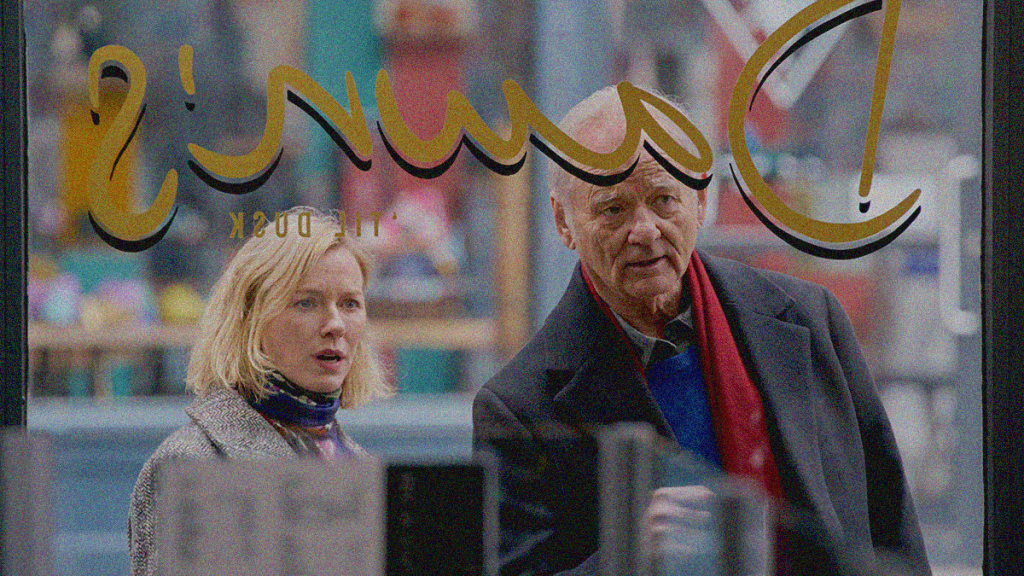
Naomi Watts and Bill Murray in THE FRIEND; courtesy of Bleecker Street.




 jaredmobarak.com
Leave a comment