
Rating: NR | Runtime: 88 minutes
Release Date: September 20th, 2024 (Lithuania) / July 18th, 2025 (USA)
Studio: Alpha Violet / Dekanalog
Director(s): Laurynas Bareisa
Writer(s): Laurynas Bareisa
Hurray for the guys!
It’s a phenomenon wherein someone who survives a near-drowning incident faces complications because the body doesn’t know the danger has ceased. Your vocal cords spasm and close to prevent water from entering the lungs, but the absence of that water forces the event to also stop air from entering. So, you ostensibly drown despite your lungs being dry.
While there’s a depiction of this condition within Laurynas Bareisa’s Drowning Dry, it’s merely a catalyst for the drama that follows. Inspired by a similar real-life occurrence that forced the filmmaker to resuscitate his two-year-old son, the film mainly deals with the traumatic impact such scenarios cause for those involved. Bareisa ultimately found himself revisiting the almost-tragedy, repeating what happened in his mind only to find subtle shifts in perception or details within his memory. He uses this emotional response to infer upon the formal structure of his script so that the audience experiences the helpless panic that results.
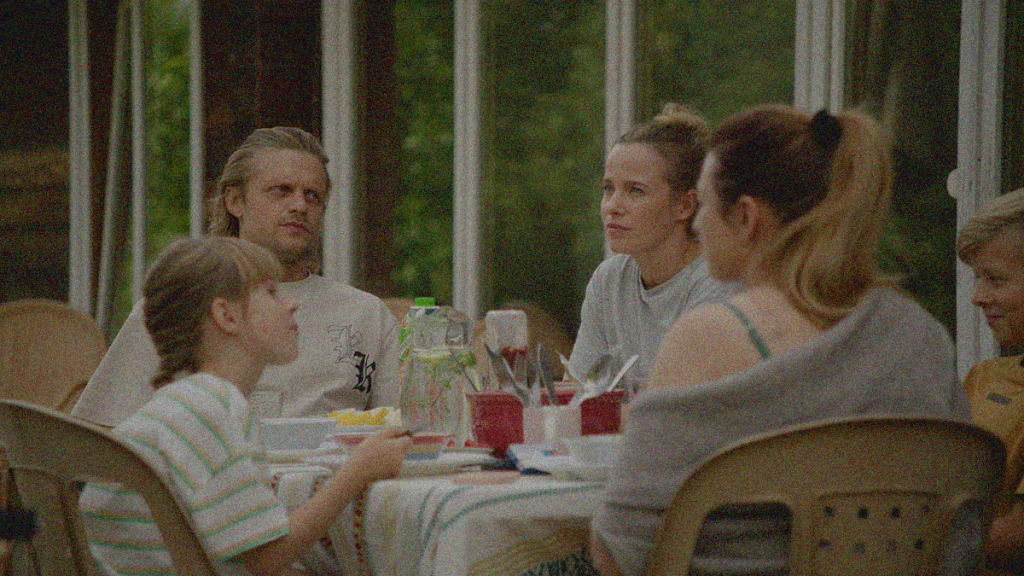
A family summer vacation unfolds linearly for the first almost forty minutes. Since Lukas (Paulius Markevicius) wins an MMA tournament the same weekend as Tomas’ (Giedrius Kiela) birthday, their wives (sisters in Gelmine Glemzaite’s Ernesta and Agne Kaktaite’s Juste) plan a trip to their parents’ country home to celebrate. Unspoken rivalries ensue whether it’s Lukas trying to keep up with Tomas’ reckless driving (to almost tragic ends), Tomas proving he can fight (he can’t), or the women leaving their husbands to fend for themselves with the kids: Lukas and Ernesta’s Kristafus (Herkus Sarapas) and Tomas and Juste’s Urte (Olivija Eva Viliüné). Ernesta copes with the risk in Lukas’ career. Tomas copes with middle-aged insecurities. They all seek balance in an uncertain world.
Culminating with a catastrophic morning at the lake, we suddenly fast-forward an unknown number of days to witness an aftermath we assume was born from one truth only to discover a different one. It’s upon this revelation that Bareisa takes us back to the unfinished drama to complete the scene and show us where our terror went awry. Rather than simply pick-up where he originally cut to black, however, Bareisa rewinds a bit further to repeat a song and dance number the women performed before heading to the water. Everything occurs much like we remember except for the song selection. It’s a jarring moment because we become unsure whether we’re about to see what happened after what we already saw or an alternative reality entirely.
The final forty-plus minutes therefore unfold non-linearly as we learn a bit more of what happened only to skip forward yet again. The result is less like my initial assumption of Bareisa being an unreliable narrator and more like we’re being exposed to the truth through Ernesta’s PTSD. We are to treat that initial cut to black as the point of no return. That’s when the adrenaline spike of fear began and it never let’s go. What’s more, however, is that everything we’ve missed and are about to understand (either visually or through dialogue) has already been seen before. Bareisa is very meticulous in ensuring the unseen horror is itself a mirror image of something we’ve already experienced. Maybe you cheat death once, but your luck runs out.
It’s a fascinating way to tell what is an otherwise familiar tale of fateful tragedy and the inevitable implosion of its survivors’ lives. I’ll admit that the first rewind had me dismissing Bareisa’s choice as a gimmick seeking to breathe new life into an otherwise generic narrative, but the second and third skips bring everything into focus as a necessary means to an emotional end. Reading about why he constructed it this way after the fact only renders the result a bigger success because it’s not about coincidence or manipulation. He sought to portray his own trauma and the myriad ways in which it manifests (panic attacks, invincibility, overcompensation, etc.) through each of his characters.
So, while I’m being conscious to not give anything away as far as who suffers from what, just know that it’s okay to give yourself to the film’s odd rhythm because that sense of confusion you feel is purposeful. The awkward silence of Lukas and Tomas eating outside and the weird comment Ernesta makes about a friend fostering seven kids is too. These are fallible people dealing with internal doubts while striving to stay afloat. Some of that pushes them to perhaps be careless and thus responsible for what follows. Some of it exacerbates their inability to deal with the fallout. And some even helps them find the strength to carry through. Our brains are fickle and our emotions are impulsive. Life is rarely ever perfect.

The cast of DROWNING DRY; courtesy of Dekanalog.


 jaredmobarak.com
Leave a comment