
Rating: NR | Runtime: 95 minutes
Director(s): Renso Amariz
Writer(s): Renso Amariz
All I had left were shadows.
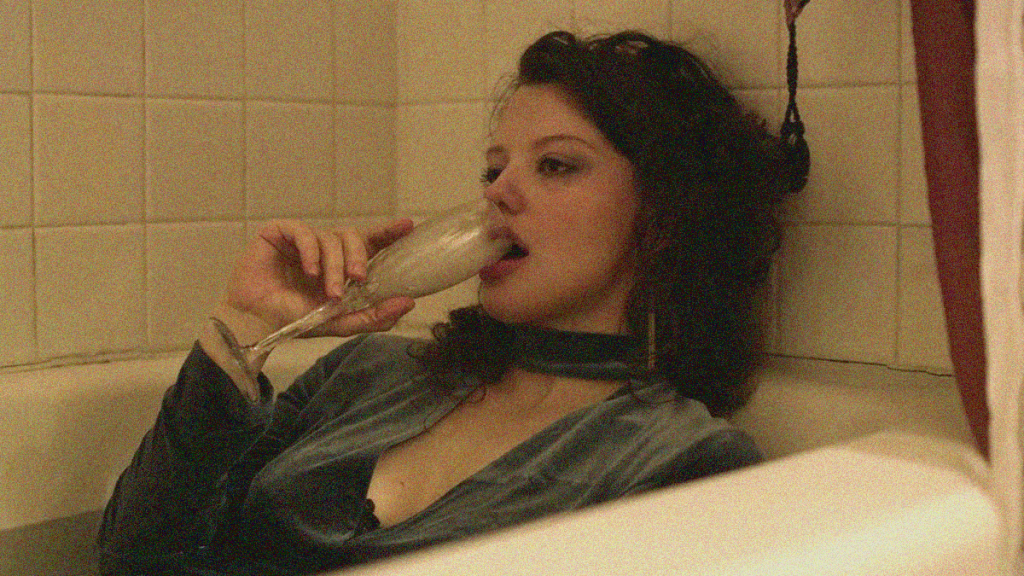
The day begins with a creak of an armoire. One door slowly opens by itself to expose a single dress hanging on the back wall. Bird (Chloë Levine) gets dressed, heads to the kitchen, and makes a cup of tea. There’s one mug in the pantry. One spoon in the drawer. One record she plays over and over. One tiny table and chair to sit at while waiting to look out her window at an old man standing by the gate. And when she decides to have a glass of wine only to break it on the floor, she must only turn away for the mess to disappear. Is it magic? Is it even real?
These were the questions I asked at the start of Renso Amariz’s Birdsong because everything we see arrives from Bird’s prison-like apartment. I even wondered if she was perhaps a ghost going through the rote motions of purgatory while the muffled sounds around her proved to be the product of the family now residing there on a different plane of existence. It’s only when her front door automatically opens like the armoire that we realize Bird isn’t fully removed from existence. It’s as though the apartment wants to introduce her new neighbor. To tempt an escape.
Suddenly the number Bird writes on the window in blood, 21,068, is given meaning—especially considering the new day brings an interstitial that reads 21,069. That’s how many days she has been isolated in this room. It’s how many days she’s made that cup of tea and gazed out the window at a man (David Cicci’s Bennett) who never acknowledges that he sees her back. Or maybe it’s the number of days she could have had that cup of tea considering we don’t know what transpired the previous 21,067. Soon we’ll discover she painted for 300 of them. Probably tested the lengths of this cage’s powers to deliver whatever she craves. And likely felt taunted by the one thing she couldn’t have: freedom.
Enter Silesia (Rebecca Knox). Apologetic. Friendly. Helpful. Bird doesn’t even know if she can invite this new neighbor into her world when telling her that she has some orange juice to give. Bird tells Silesia to wait and closes the door before opening her magic fridge to find a single gallon of the drink. She still probably wouldn’t have known if Silesia didn’t barge right in that night to repay the favor. But the moment she does set foot inside is the first time we see Bird smile with a sense of relief. Because, while it isn’t the means to leave, Silesia does provide the means for company. For connection. Hope returns to Bird’s heart. She allows herself to breathe.
So, why does she eventually retreat back into solitude? Why, when everything Bird wants comes true, does she reject it? I don’t want to ruin the answer, but know that she understands more about this situation than we do. She knows the man’s voice we hear alongside hers and why Bennett visits without ever knocking. The apartment does too. That’s why the gifts it starts to pile on when Silesia arrives begin to disappear. Why the bare necessities Bird had at her disposal before Silesia’s arrival also vanish. The scenario wants something from Bird. It wants to push her towards an end she’s wished to have granted, but for its own means. And Bird understands the cost.
Amariz is touching on mankind’s penchant for allowing itself to be held captive by love, longing, and desire. Birdsong‘s blossoming romance should be a sign of joyful release and an enthusiastic glimpse at the future, but it knows that a price must be paid. That’s not to say it’s a cynical piece judging love as sacrifice via compromise. It merely refuses to skirt the issue that one must give up something of themselves to truly commit to someone else. To build a life together is to leave a part of your independence behind. Most are willing to do so when the loss is equaled by your other. For Bird to be trapped, though, shows hers wasn’t. And because she was abandoned, she must abandon another to be free.
So, maybe it is a bit cynical. Or just honest. Yes, there’s beauty to the relationship that commences between Bird and Silesia. Yes, there’s conviction and love to Bird’s choice to hurt herself rather than the woman she loves. One could posit, however, that Bird could explain the situation. Not only explain it, but agree to ignore it and live in love within it forever. Would that ultimately lead to death? Perhaps. If the apartment decides to punish her, the pressure to leave will mount. The question then becomes whether a life together in squalor is better than a life alone with the potential for individual success. And if the only way to leave is to choose the latter, it’s no surprise Bennett’s guilt keeps him coming back.
The result is a quiet and thoughtful enterprise. We feel Bird’s struggle and agree with her choice regardless of whether we also condone it. Levine is great as ever, her indie genre filmography continuing to add unique and introspective work since I first saw her in The Transfiguration almost ten years ago. Knox is very good too as her innocent counterpart fully enveloped by love’s allure without a thought to what that might mean within unbeknownst circumstances. But the real draw is the production design and Amariz’s use of a single space to reveal time passing and a proverbial clock ticking. Do what her jailor needs and Bird will want for nothing. Don’t and she’ll wish she did.

Chloë Levine in BIRDSONG; courtesy of Cinequest.



 jaredmobarak.com
Leave a comment