
Rating: NR | Runtime: 90 minutes
Release Date: March 14th, 2025 (USA)
Studio: Several Futures
Director(s): Heiny Srour
Will this war ever end?
Looking into a mirror, Leila (Nabila Zeitouni) sees herself as a grandmother far into the future. She sits with her daughters and granddaughters, asking each who they are and whether they’ve married and/or had children. It’s an image of a woman’s patriarchal duty to serve men and something Leila rejects upon her return to reality. That’s neither the fantasy she wants nor the future she truly sees for herself. No, it’s the fantasy Arab men have been projecting upon her from the day she was born.
Heiny Srour’s documentary Leila and the Wolves mixes fictionalizations of true-to-life scenarios with archival footage and dream sequences adding context to each vignette. She gives her Leila character the ability to open windows into the past and share with us the untold tales of Palestinian and Lebanese women throughout the twentieth century. It’s a journey that stems from a London exhibit of photographs depicting the freedom fighting of these two people and the choice of its curator (Rafik Ali Ahmad) to only select images of men. “Where are the women?” she asks. “They weren’t involved in politics then.” is the reply.
Knowing this to be a false, revisionist statement, Leila’s glimpses backwards in time place Ahmad into the roles of domineering, traitorous, and conservative men standing in the way of or being duped by women leading their rebellious charge. We witness wives and daughters pouring boiling water onto the heads of British colonialists in Palestine during the 1930s. We witness the clandestine operations to resupply mountain rebels with weapons via wedding ceremonies no one would second guess. There’s the fight for women to join the military in both Palestine and Lebanon and the feminist desire to escape the oppressive nature of male counterparts demanding their service to the cause while also denigrating their desire to provide it.
The wolves of the title are therefore not just those holding British, Nazi, and Israeli flags. No, the sharp-toothed predators are just as prevalent within these women’s doors as they are outside of them. Brothers and husbands demanding warm dinners even as their sisters and wives worked all day filing down bullets to fit into their guns. Fathers limiting the education of their daughters so that they will marry and give birth to new male soldiers rather than be able to learn, lead, and strategize the fight themselves. There’s the struggle between enduring the abuse to serve their people and wondering if it would have been easier to simply stay home. The old guard shakes their heads while the new tightens their fists.
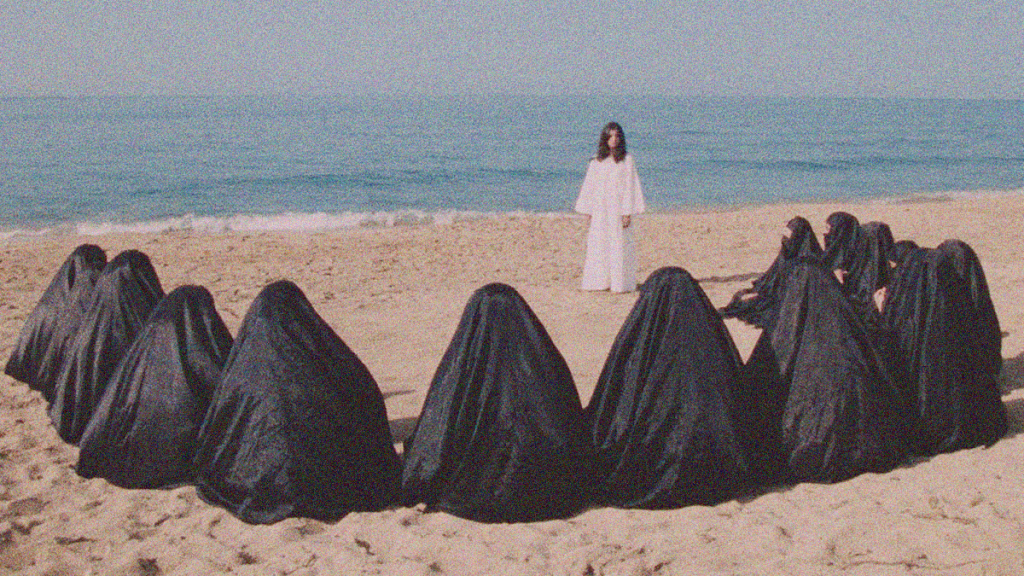
Throughout this timeline jumping history lesson are also scenes of women in full burqas sitting on the beach as though they are the ghosts of each story Leila invokes to share these generational touchstones. We see Leila in her white dress walking through scenes of war—some locations burnt out and destroyed while we hear the sounds and voices that one would imagine used to fill the space in happier times of peace. And for every moment of grief or empowerment lies a scene of violence and death with the British and Israeli armies killing and throwing out Palestinians or adding fuel to the Lebanese sectarian civil war. Some are battles. Others are slaughters.
The result is a powerful document of women’s crucial impact to the Arab world during this time of cultural and political upheaval. It ensures their voice won’t be silenced or pushed to the sidelines as if they weren’t there fighting the entire time. Where European and American sentiment looks to erase the entirety of Arab autonomy and ownership throughout the region or Arab men look to pretend they fought to preserve it all themselves, Srour—by way of Leila—helps to set the record straight.
A scene from LEILA AND THE WOLVES; courtesy of Several Futures.


 jaredmobarak.com
Leave a comment