
Rating: R | Runtime: 135 minutes
Release Date: December 25th, 2024 (USA) / December 26th, 2024 (UK)
Studio: Entertainment UK / Paramount Pictures
Director(s): Michael Gracey
Writer(s): Simon Gleeson and Oliver Cole and Michael Gracey / Robbie Williams (life story)
There’s an energy to revenge and it’s very, very seductive.
It says more about America than Robbie Williams that the “joke” surrounding Better Man has been some variation of “Who’s Robbie Williams?” Has the nation truly forgotten when “Angels” and “Millennium” played on the radio non-stop throughout 1999 and 2000? He was so instantly big that I thought I was purchasing his debut album when picking up The Ego Has Landed at Media Play. It wasn’t until later that I discovered he was once a member of UK boy band Take That and that The Ego Has Landed was actually an American compilation of the best tracks from his first two solo albums. But, considering it didn’t rank on the US charts and Williams rightfully focused on his global appeal with years of built-in traction, maybe the broader American public wasn’t paying attention.
So, it also speaks more to the American view of cinema when most of the press surrounding Michael Gracey’s film centers on that myopic sense of irrelevance. As though Robbie Williams doesn’t deserve the sort of platform a Hollywood release provides because “they” don’t remember his name. Bullocks. Not only is his international mainstream appeal worthy of a biopic, but his infamy ensures the story will be entertaining enough for audiences regardless of their familiarity. Williams was a coked-out alcoholic pop star who grabbed as many spotlights as women to guarantee maximum exposure without caring if he looked good or bad. To catch a glimpse of that circus is to ride the vicarious roller coaster of celebrity few experience themselves. Lesser names have received the same.
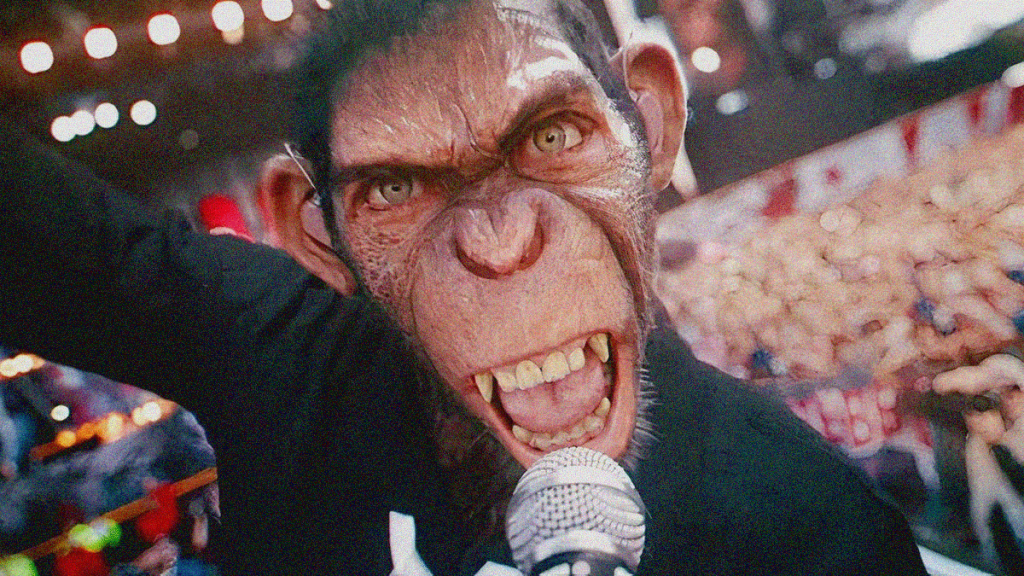
What sets Better Man apart is not the so-called gimmick of presenting Williams’ life behind the visage of a computer-generated chimpanzee, but its unparalleled honesty. The whole “performing monkey” metaphor may be cute on the surface, but it’s a devastating manifestation of crippling imposter syndrome at its core. While that psychological diagnosis would generally be projected upon the subject in your usual external production banking on controversy or outright ignored by your usual internal, self-produced honorific, Williams (who narrates the film) lets Gracey and his co-writers Simon Gleeson and Oliver Cole mine the truth in a way that allows the result to become as much a cautionary tale as an inspirational catharsis. Because few people would wish Williams’ life on their worst enemies once you peel back the tabloid sheen.
Beyond the self-loathing manifested by Chimp Robbie Williams (played by Jonno Davies) seeing scowling and rage-fueled versions of himself in the crowd also lies depression, abandonment, anxiety, and suicidal ideation. There’s nothing more horrific than hearing the line “Light ’em up!” and seeing him push the pain down to reveal a smile meant to hide the truth from fans and media. Admitting that Take That producer Nigel Martin Smith (Damon Herriman) forcing him to soften Robert to Robbie was the best thing he ever did for him isn’t some flippant remark to diminish that chapter of his success. No, it allowed Williams to better compartmentalize his personas and further dissociate as a means of coping with the reality that his every dream coming true could never fill the void inside.
You must give Williams a ton of respect for allowing himself to be as vulnerable as needed to ensure this script is as meaningful as it is entertaining. Yes, he’s still enjoying the process of taking the piss out of people from his past, the general public, and himself, but he’s also providing a window into the toll taken and the trauma endured to become the sort of person who would willingly give up their privacy for adulation. That’s not to say his demons are universally held. It’s just that his demons are the kind that help foster a trajectory of destructive behavior. There’s a reason some kids are quick to play the ham and earn applause. It’s often because they feel invisible to those that should never stop seeing them.
I wouldn’t have been surprised to find writing credits given to Williams’ therapists considering so much of what we witness feels straight out of a session trying to figure out the origins and triggers of his problems. Dad (Steve Pemberton) leaving. Mom (Kate Mulvany) staying. Nan (Alison Steadman) forever cheerleading. His friend Nate (Frazer Hadfield) trying to keep him grounded only to be ignored. His love for Nicole (Raechelle Banno) being born from a sense of kinship and understanding only to dissolve into resentment and jealousy. It means something that none of the drug use on-screen is glorified or rendered as “fun” too. Right from the start, Williams’ addictions are shown as damaging, disgusting, and embarrassing. It’s not about escape. It’s about desperately trying to hide.
Pair that authenticity with the impressive spectacle of show-stopping theatrics and it’s difficult not to get fully absorbed in the chaos. The “Rock DJ” faux one-shot is as fantastic as everyone has been saying, but I really loved the juxtaposition of love and heartbreak that comes from the “She’s the One” scene. “Angels” is also very affecting considering what transpires beneath it and the constant callbacks to Frank Sinatra’s “My Way” never cease to carry all the weight that comes with the baggage of its place within Robbie and his father’s dynamic. The success of these musical interludes has finally made me consider that watching Gracey’s The Greatest Showman might not be such a bad idea after all. Considering my utter lack of interest upon that film’s release, this revelation might be the biggest compliment to Better Man I can pay.

Nominee:
Visual Effects
A scene from BETTER MAN; courtesy of Paramount.




 jaredmobarak.com
Leave a comment