

Rating: NR | Runtime: 215 minutes
Release Date: December 20th, 2024 (USA)
Studio: A24
Director(s): Brady Corbet
Writer(s): Brady Corbet and Mona Fastvold
I’m not what I expected either.
It’s a story about mirrors. The “self-made” man of business with money to burn (Guy Pearce’s Harrison Lee Van Buren Sr.) opposite the displaced artistic genius whose legacy now rests in the hands of those who tried to erase him (Adrien Brody’s László Tóth). The silver spoon son who feels uncomfortable around people who don’t laud him with praise he didn’t earn (Joe Alwyn’s Harry Lee) opposite the mute Holocaust survivor whose resulting “difficult” demeanor makes it so the world still sees her as less than human (Raffey Cassidy’s Zsófia). The Jewish convert who suffered the unimaginable pain that came with it (Felicity Jones’ Erzsébet Tóth) opposite the Catholic convert who sold out his people for the assimilated American Dream (Alessandro Nivola’s Attila).
Director Brady Corbet and co-writer Mona Fastvold’s The Brutalist brings them together over the course of twelve years (plus an epilogue two decades later) to not only comment on those contrasts, but also force us to see ourselves in the reflections. This is especially important now as the world separates further into political, economical, ethnic, and religious factions because it sheds light on the reality that the heroes immortalized by a ruling class’s version of history are all too often the villains. The “leeches” aren’t the poor trying to survive as the wealthy hoard their resources, but the rich who suck the creativity, labor, and spirit of those they’d rather see dead than sitting next to them an their exclusive club. The gall of those with the money to bring an idea to fruition saying those they exploit to do the creating lack the work ethic to succeed.
So, it’s no surprise the narrative’s main thrust concerns artist (László) and benefactor (Harrison). Nor that their union begins with the latter berating the former out of sheer indignation while the former simply walks away after first patting the latter on the shoulder to say he had no interest in watching the tantrum. Only when Harrison discovers this man who modernized his den into an exquisitely intuitive library had value to him does he search for László to offer an apology and proposition. What this magnate doesn’t realize is that shaking his new architect’s hand is as much a devil’s deal for him as he believes it is for his partner. Whereas Harrison can hurt László at will now, though, the project’s completion all but guarantees László hits him where it hurts most: legacy.
That’s the big theme within this impressive epic of gargantuan proportions whether length (three hours and thirty-five minutes including a fifteen-minute intermission), scope, or production. Legacy as in heritage as much as lineage. Legacy where it concerns memory as well as impact. Yes, László is a stubborn drunk who self-sabotages as much as bites the hand that feeds, but he has integrity—something we discover early on in, perhaps, unorthodox fashion. Harrison cleans up well and has the power to grease the right wheels (for his own benefit and that of his friends, of which László is one as long as the quid pro quo obliges), but his temperament, greed, and cowardice reveal it’s merely a façade. He seeks to buy his own immortality by stealing the spotlight. László achieves his by seeking to simply reclaim his humanity from those who stole it away.
Everything that occurs on-screen presents this disparity. From the shouting to assert dominance (Harrison and László alike) to the prejudiced schemes looking to do the same (courtesy of Harry Lee and Emma Laird’s Audrey, wife to László’s fickle cousin Attila). From the demand for accountability to the violent response by those too deluded to realize knee-jerk aggression only proves weakness and guilt (courtesy of Erzsébet and Harry Lee via an emotionally complex sequence whose over-the-top melodrama proves necessary to drive home the difference between the solemn work of recognition and the loud cheat of absolution). From the harrowing experience of survivors revealing true strength to the superficial needs of debutantes revealing their crippling fear. And it all culminates in a stunning reveal that recontextualizes everything.
I can definitely see The Brutalist racking up the nominations this Oscar season from The Academy while also alienating audiences. It’s not an easy film, so it will be easy to dismiss as another “critical darling” without widespread appeal. I hope I’m wrong considering its message is crucial to our ability as a species to move forward into a future worth living. It’s crucial to recognizing how we’re hurtling towards an existence devoid of identity or culture. Crucial to accepting that the American experiment was no different than the any other because it too was built on codified systems of inequality and injustice. Perhaps it’s even worse since it only took two hundred and fifty years to fall into authoritarianism. The desire to form ethnostates can’t be the solution if it was the root of the problem.
Above the script’s elucidations, Corbet’s assured direction, and the impressive production design, though, are two of the year’s finest performances courtesy of Adrien Brody and Guy Pearce. They operate in tandem so effectively that I do think one would suffer without the other. A lot of that comes from the writing and their intrinsically bonded journeys, but their infectious passion and tortured pathos is necessary to pull it off the page. They’re the ones who ensure we experience the layers beneath the generic arguments about resources and budget so that the epilogue’s revelation doesn’t feel like a tacked on twist. Because it’s all there in what László is willing to bear and what he refuses to compromise. The line was drawn in his head right from the start. And not even Harrison can deny the poetry in it. After all, that’s exactly what sold him on hiring the man. He just couldn’t fathom it would ultimately sing at his expense.

Winner:
Lead Actor, Cinematography, Score
Nominee:
Motion Picture, Supporting Actress, Supporting Actor, Directing, Original Screenplay, Editing, Production Design
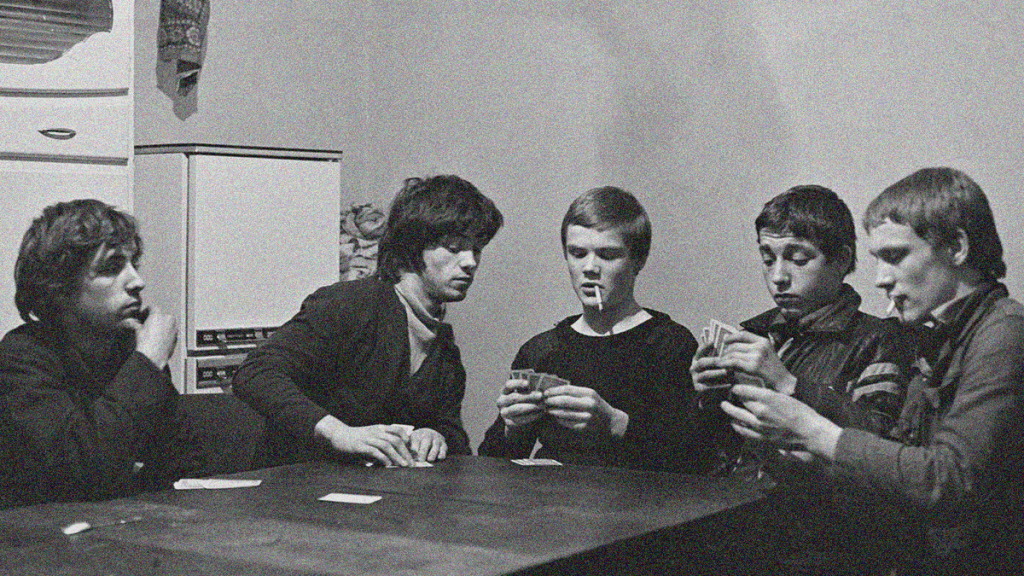
Adrien Brody in THE BRUTALIST; credit: Lol Crawley, courtesy of A24.


 jaredmobarak.com
Leave a comment