
Rating: R | Runtime: 88 minutes
Release Date: January 10th, 2025 (USA)
Studio: Roadside Attractions
Director(s): Gia Coppola
Writer(s): Kate Gersten
I’m old-er. I’m not that old.
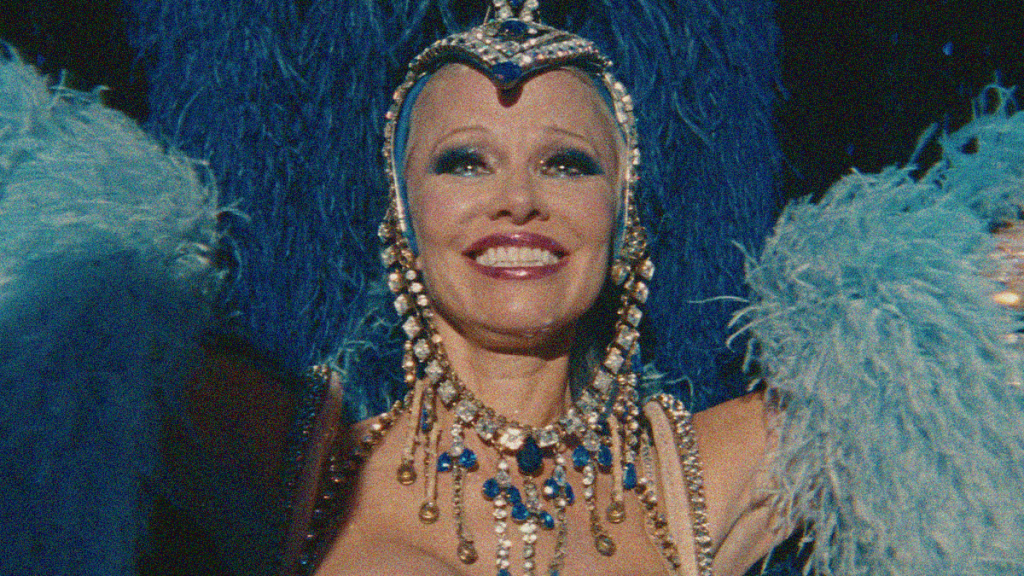
For thirty years Shelly (Pamela Anderson) has been the face of Le Razzle Dazzle. Decades passed and her place within the revue diminished, but she’s still wearing those giant wings as a centerpiece today. This performance is her life. Her everything. And now it’s closing as new ownership in the casino that’s been its home has decided to move to a more contemporary show instead. Coping is unsurprisingly a struggle—not just because it’s her livelihood and artistic purpose, but also because losing it puts into perspective what it forced her to lose already. Maybe that clarity can help Shelly attempt to mend fences. Or, perhaps, it’s too late.
Directed by Gia Coppola and written by Kate Gersten (partially based on her own unproduced play), The Last Showgirl utilizes the revue’s final two weeks as a backdrop for aging, regret, and the earth-shattering price of naive optimism. Because while Jodie (Kiernan Shipka) and Mary-Anne (Brenda Song) have the objectivity and youth to realize Le Razzle Dazzle was no different than any of the other topless shows in Las Vegas, Shelly’s craft and identity refuse to let her see it as anything but an iconic legacy piece that transcended whatever labels future generations have placed upon it. She must think that because the alternative is recognizing how those labels might also apply to her.
The time to evolve beyond it or escape from it has long since passed and there’s a definite chicken and egg quality to the question of whether she stayed because it was great and she was great in it or because it was the perfect mediocre showcase for her adequate talents. Was she on the posters because of her dancing or her body? Did people come for the artistry or the breasts? Sure, Shelly is probably correct to say there’s a level of empowerment to the whole thing (“That’s why so many women come to watch.”), but that doesn’t negate the reality that most of the girls on that stage are there for the paycheck. And even that is under protest since this career isn’t working towards a comfortable retirement (ask Jamie Lee Curtis’s Annette).
While reevaluating the job and its merits is one thing, however, reconciling everything she gave up to stay the course is another. Shelly talks about being married before he moved to New York without her because she decided to stay after too many failed auditions there. There’s barely scraping by on lemons because she never had the opportunity for a pension (like Dave Bautista’s show manager Eddie) or a “501k” (as Annette calls them). And, of course, there’s Hannah (Billie Lourd) her estranged daughter—the one she supported because of the show and the one who believes she picked that show over her. That’s the reason she’s never seen the final product. Not because of its questionable content, but because discovering it isn’t good would only make things worse.
The film feels like a play, so it’s no surprise that it partially started as one. It does a good job using the other characters to gain insight into Shelly (how she treats Jodie when the latter is looking for a mother figure or how Annette plays like a tragic mirror into her own future), but it can come off as being thin since those moments ultimately speak for themselves before disappearing for the next stepping-stone towards a necessary sense of self-awareness that sadly might be coming too late. That’s a critique you cannot give Anderson in the lead role, though. Hers is a three-dimensional performance that has her tapping into our preconceptions of her celebrity as well as her own regrets born from its hold on her to deliver a beautifully confident, soul-searching, and cathartic masterclass of authenticity.
The Last Showgirl had an Oscars-qualifying run on December 13th, 2024.
Pamela Anderson in THE LAST SHOWGIRL; courtesy of Roadside Attractions.


 jaredmobarak.com
Leave a comment