
Rating: R | Runtime: 97 minutes
Release Date: January 10th, 2025 (USA) / January 31st, 2025 (UK)
Studio: StudioCanal UK / Bleecker Street Media
Director(s): Mike Leigh
Writer(s): Mike Leigh
I don’t understand you, but I love you.
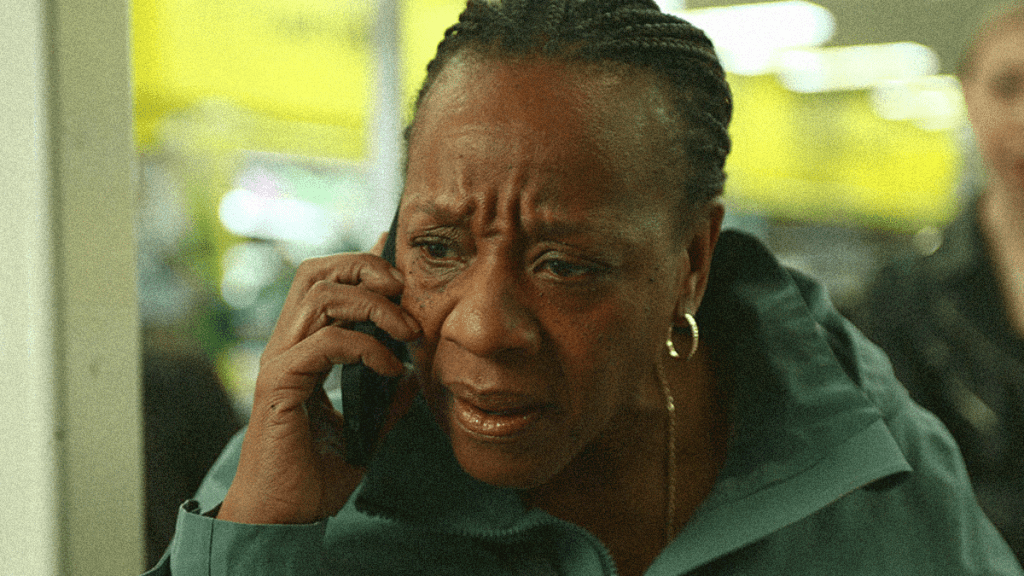
Pansy (Marianne Jean-Baptiste) is ranting to her husband about her day, sliding from one perceived slight to the next like they all happened simultaneously before hitting on what she thinks is a salient thought that justifies her indignation: “They don’t know me or what I might be going through.” It’s an ironic “gotcha” moment because she should consider those words in her own actions with strangers, yet she glosses right over it to get to the next injustice. Curtley (David Webber) couldn’t offer a comforting response even if he wanted because she’d either not hear it or accuse him of patronizing her. The only thing to do is witness the diatribe and hope the vitriol doesn’t turn his way.
That’s not to say Curtley is some perfect human being by comparison, though. Writer/director Mike Leigh makes sure all his characters within Hard Truths are flawed and selfish in their own way. It becomes an exercise in measures with Pansy firmly possessing ownership on one end of the spectrum while her sister Chantelle (Michele Austin) exists at the other. Curtley’s internalized emotions sit in the middle with his and Pansy’s under-achieving son Moses (Tuwaine Barrett) left to fend for himself within their broken household. Chantelle’s daughters fit between them and their mother—well-adjusted yet occupied by appearances to the point of doing others’ work or lying about their own. We recognize ourselves and our families in them … hopefully just not as extreme.
There’s reason for Pansy’s depression and martyrdom, though. She’s had a rough life raising her sister while their single mother worked before settling for a marriage out of security instead of love. Her past has hardened her. Crippled her with justifiable and unjustifiable fears that only exacerbated the abrasive nature that has left her alone and devoid of meaningful relationships. She flies off the handle with strangers as a means of maintaining control before guiltily fleeing the scene and dealing with the emotionally draining fallout of her own short fuse. Curtley and Moses become statues in their own home, desperate not to provoke another tirade despite their silence proving an equally worthy catalyst.
It’s her interactions with the world that serve as our main focal point. If there were a plot to describe, it would be Pansy’s steady shift from provocateur to fatigue. We catch a few glimpses into the others’ individual lives too, but less to give them three-dimensions than to contextualize the lead’s idiosyncrasies and pain. Because Pansy isn’t alone. They all feel something similar to her and might be able to find common ground if she were willing to listen, but Chantelle’s attempts too often fall on deaf ears. The others don’t necessarily see the point of trying at all when Chantelle’s declaration that one must be kind to receive kindness back is again better suited for Pansy than those victimized by her violent projection.
Such is life. It’s difficult. Complex. Imperfect. That everything we see occurs around Mother’s Day only highlights the disparity between these women and the lives they’ve been able to (or unable to) experience. But that’s also a matter of perspective since it’s not about Chantelle having daughters who make it a point to celebrate their mother while Pansy doesn’t. It’s Pansy who believes that fact. It’s Pansy who refuses to let her son in—so much so that when he does show affection, she cannot help but laugh first and cry later. That’s what happens when you never got that love yourself. How can you know to foster it if no one did the same for you?
The real truth of the matter is that they all need therapy to unpack their stubborn desire to avoid what’s really wrong. They all need to take stock and figure out what it is they want for themselves instead of getting caught up and dragged into the drama of others. Chantelle implores her sister to leave what is obviously a suffocating house only to have Pansy look frightened at the prospect. One could say someone should implore Chantelle to leave her sister, but that too isn’t something she’s willing to consider let alone do. One is too combative and insecure to listen to anyone else’s problems and the other is so compassionate that it’s literally all she does (with family and work as a hairstylist). So, we ultimately witness a series of panicked faces and silent tears.
And everyone excels at presenting both. It’s easy for performances like Webber’s and Barrett’s to get overshadowed because they are so internalized, but I honestly think their invisibly imprisoned souls are the ones that will stick with me most. Brown and Nelson add some necessary life to the whole with a genuinely joyous demeanor despite struggles at work and Austin provides the perfect contrast to her sister’s ails. But it’s Jean-Baptiste who shines brightest by showcasing her talent to maintain humanity through despicable behavior. Because her Pansy isn’t an evil person. We laugh at how her squabbles unfold more than wince since the cruelty isn’t logical. For all the bile she spews, the person who ends up hurt most by it is her.
Hard Truths had an Oscars-qualifying run on December 6th, 2024.
Marianne Jean-Baptiste in HARD TRUTHS; courtesy of Bleecker Street.



 jaredmobarak.com
Leave a comment