
Rating: NR | Runtime: 89 minutes
Release Date: February 12th, 2025 (Canada/USA)
Studio: Maison 4:3 / Oscilloscope Laboratories
Director(s): Matthew Rankin
Writer(s): Ila Firouzabadi, Pirouz Nemati & Matthew Rankin
The turkey has a ticket, just like you.
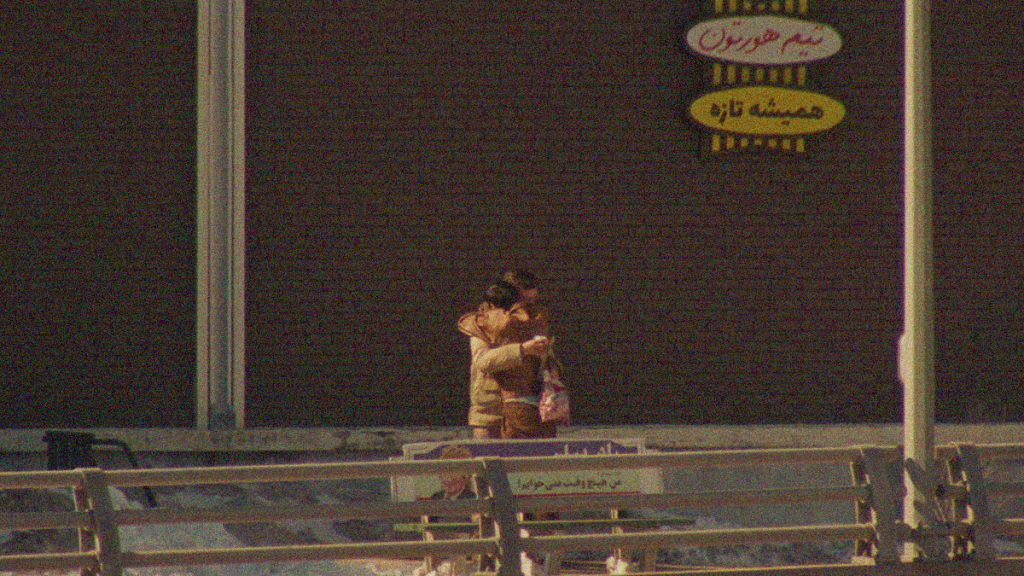
Set in a Canada where the dominate culture and language is Persian, Matthew (director Matthew Rankin) has decided to leave Montreal and return to the location of his birth: Winnipeg. He’s a man out of sorts and out of place. Thought to be a Québécois by the gentleman who sits next to him on the train and an Albertan by the children he meets back in Manitoba (a contrast that serves as the punch line to his Montreal boss thinking Winnipeg was in Alberta), this homecoming can’t shake its morose air since he’s not even sure he knows who he is anymore. So, when he calls his mother and here’s a strange man’s voice instead, he doesn’t know what to think.
Rankin’s (who co-wrote with Ila Firouzabadi and Pirouz Nemati) Universal Language is a delightfully absurd look at a microcosm of humanity that’s at once removed from and imbued with the intrinsic qualities of heritage and ethnicity. It’s a Canadian Tehran populated by Persians and an Iranian Winnipeg marked by its drab architecture, frozen winters, and lack of identity beyond its absence of one. The French teacher at the local school (Mani Soleymanlou) thinks himself cool because he wears an earring and turtleneck. A freelance tour guide (Pirouz Nemati) takes disgruntled patrons to “landmarks” known for what they were (a dry mall fountain) or what we can only imagine they might be (a lost briefcase, unclaimed for years).
We meet these eccentric characters mostly through the eyes of two sisters: Negin (Rojina Esmaeili) and Nazgol (Saba Vahedyousefi). The pair are running across town in search of a means to extricate a frozen note of 500 Riels that the former hopes to use to buy new glasses for her friend Omid (Sobhan Javadi)—whose original pair was stolen by a turkey. And while they take us through merchants offering useless machinery and brick and mortar shops holding the promise of an axe, Matthew arrives for us to follow down memory lane in an attempt to reunite with his mother. They’ll eventually cross paths at a Persian teahouse dressed like a Tim Horton’s, but not before we first enjoy the deadpan silliness of lacrimologists, perpetual cryers, and a walking Christmas tree.
The joke of this melting pot is that it’s as familiar to us in its pieces as it is strange in its juxtapositions. We laugh because the comedy is absurd, but also nod our heads in understanding because the feelings conjured through it are universal. Rankin and company are providing us a glimpse at the beauty of our shared human experience removed from labels and geography because it’s “something art can do which politics and ideology and online trolling plainly cannot.” He’s showing how the true “color blindness” of society isn’t achieved through homogeneity. We get there through acceptance. These characters are unapologetically themselves and yet still uniquely human.
I don’t want to say too much about the main example of our humanity speaking louder than our appearance since the reveal is worth discovering on your own, but it proves as hopeful in its display of pure compassion as it does heart-breaking in the realization that we have been too easily losing ourselves to the capitalistic demand for materialistic success. That’s not to say Matthew is selfish or a victim to greed as much as a slave to the system (we don’t really know much about what brought him to Montreal). Just that what you lose in the pursuit of personal gain is often that which you wish you could have kept instead.
The film therefore speaks to the post-election moment as more and more Trump voters realize the ramifications of their decision. Those who were once so vehement about their hate for anything “liberal” courtesy of the lies and spin fed to them in a tribalistic campaign of defamation and deflection are now waking to the reality that those things saved their family’s lives. They saved their lives too. We simply get so caught up in the spectacle that we forget to actually see what our own actions create. We become so disillusioned that it becomes easier to double-down and pretend our pain is happiness. Matthew isn’t maliciously getting “replaced”. He has rendered himself replaceable and a kind soul selflessly volunteered to fill the void.
Universal Language had an Oscars-qualifying run on October 18th, 2024.
Matthew Rankin as “Matthew” and Dara Najmbadi as “Dara” outside of Tim Horton’s. Courtesy of Oscilloscope Laboratories.


 jaredmobarak.com
Leave a comment