
Rating: PG-13 | Runtime: 140 minutes
Release Date: December 13th, 2024 (USA)
Studio: Orion Pictures / Amazon MGM Studios
Director(s): RaMell Ross
Writer(s): RaMell Ross & Joslyn Barnes / Colson Whitehead (book The Nickel Boys)
He just got into the wrong car.
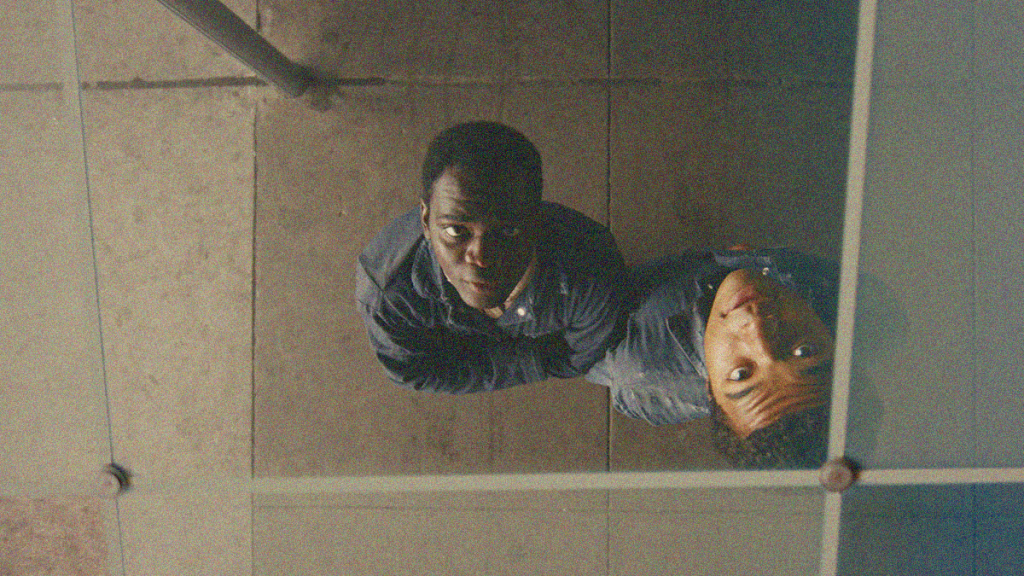
Everything is in close-up at the start of RaMell Ross’ Nickel Boys whether cards shuffling or a bracelet shimmering. And the frame is always off-kilter with diagonal vantage points or full 90-degree shifts abruptly leveling out whenever Nana (Aunjanue Ellis-Taylor) tells young Elwood to hop to it. We start to understand what’s happening in the back of our mind, but it isn’t until an iron exhales back and forth across the screen that the film itself reveals the trick. Because caught in that silver mirror is the image of a boy we’ve yet to see despite having met him in every scene. He is the origin of everything we’ve witnessed. The camera’s lens has been Elwood’s eyes.
It’s an impressive technical feat to accomplish in a world full of reflective surfaces. Not only does RaMell need to replace the camera with Ethan Cole Sharp on that iron, but he must superimpose the boy onto a storefront display or a teenaged Elwood (Ethan Herisse) on the window of a driving car to maintain verisimilitude. We become his character in the process—experiencing Dr. Martin Luther King, Jr.’s speech on the television and the aural soundscape of a classroom. We catch glimpses of shoes above the page of a comic book or watch as a brochure slowly slides down the refrigerator due to a weak magnet. We start to understand his curiosity, intelligence, and potential.
Then, just as he’s about to walk into the bright future laid before him, the racial and social climate of the 1960s he thought he was avoiding tragically consumes him whole after hitching a ride to a new prep school. The next vehicle we find ourselves in is a police car heading towards Dozier School for Boys instead. This will be the site of his “community service” sentence for inadvertently being in the company of a criminal: a segregated juvenile detention center now known for its own crimes. Not just abuse, unpaid labor, and malnutrition either. In the years following its 2011 closure, evidence of approximately one hundred boys dying was discovered with half buried on the property in unmarked graves.
Adapted from Colson Whitehead’s Pulitzer Prize-winning novel by Ross and Joslyn Barnes, Nickel Boys must soon leave all that optimism behind. Hope does remain, though, courtesy of a new friend in Turner (Brandon Wilson). This is his second stint at the institution—a fact he sobering explains away with the hindsight that the outside wasn’t much better for a Black teen anyway—and thus a crucial voice to help Elwood adjust in his first. He explains that the only person who can get him out of there is himself because Nickel Academy’s long and cemented legacy isn’t something that can be defeated. You must either endure it, receive a miracle intervention, run away, or die.
I was worried the first-person vantage would eventually start to feel like a gimmick, but Ross does well keeping it fresh by adjusting on the fly aesthetically, thematically, and narratively. The introduction of Turner allows for the opportunity to shift focus: Elwood remains the lead character, but the camera utilizes his new friend to propel the story forward when necessary. Ross also includes a ton of archival footage (video of King’s speeches or clips from The Defiant Ones and photos of the real victims of Nickel) to make historical connections and enhance our emotional investment. He even sporadically fast forwards to an adult Elwood with dreads (Daveed Diggs) in the third person to ensure we can intuit our place in time.
More than its visual purpose, though, the first-person is key to our ability to truly empathize with these boys’ plight. We’re not just watching Black bodies being abused from an external source of detachment. We’re there, in the scene, bearing witness just as Elwood and Turner do. We’re suffering the malicious hypocrisy of Blakely (Gralen Bryant Banks) helping this “school” continue its evil despite rumor saying he was a victim of it himself during his youth. We’re struggling with the inhumane Mr. Spencer’s (Hamish Linklater) enjoyment of doling out punishment so severe that his prey end up in the infirmary. And since Ross doesn’t actually portray the violence itself, our instinct to turn away fails us. So, we absorb every ounce through the lead-ups and aftermaths.
What’s more: we believe in a happy ending. Diggs is playing an adult Elwood after all. He survives! But it’s just one more psychological bit of storytelling trickery since we don’t see Turner with him. Does that therefore mean the latter didn’t make it? Or that they went their separate ways? What about all the research into Dozier’s closure from an outsider’s perspective? Does that mean Elwood’s attempt to take the school down failed? That he never got his journal documenting all the heinous things happening behind closed doors out? Perhaps Turner talked him out of exposing it? And what is survival anyway after all the pain suffered in the process? Horrors such as these don’t just disappear for the victims and shouldn’t for us. We must remember to prevent their return.
The film is a harrowing piece of American history and inspiring tale of mankind’s perseverance to overcome overall, but its pieces are just as powerful—in some cases more. I think back to Nana being refused access to visit Elwood and how she uses Turner as a surrogate to satisfy her maternal needs and provide him a much-deserved infusion of love. The heaviness of adult Elwood running into a former “inmate” at a bar and the simultaneous desire to avoid the subject and demand to speak about it (with a “You don’t remember?” that seems innocuous at the time yet devastates at the end). And the familiar moments of “freedom” shared by Elwood and Turner in the midst of their unsupervised slave labor—a juxtaposition revealing how context is everything.


Nominee:
Motion Picture, Adapted Screenplay
Ethan Herisse stars as Elwood and Brandon Wilson as Turner in director RaMell Ross’s NICKEL BOYS. Courtesy of Orion Pictures. © 2024 Amazon Content Services LLC. All Rights Reserved.




 jaredmobarak.com
Leave a comment