
Rating: NR | Runtime: 125 minutes
Release Date: June 4th, 2025 (France)
Studio: Bobine Films
Director(s): César Augusto Acevedo
Writer(s): César Augusto Acevedo
This world is also God.
We meet Basilio (Claudio Cataño) in a cemetery searching for what we assume is the grave of his mother Inés (Paulina García). The undertaker doesn’t recognize the name to easily place its spot and Basilio doesn’t seem to know when it was she died to help narrow things down. So, he keeps on walking, eventually coming to a house covered in overgrowth with a woman inside who tells him to keep moving. He tells her he’s her son, but she doesn’t recognize his voice. So, he starts to describe what the property used to look like when he was a boy—details nobody but her son would know. Finally, she opens the door and we begin to realize they’re standing in a memory.
César Augusto Acevedo’s Horizonte takes place out of time in a construct that feels most like purgatory if not an afterlife that produces an approximation of the locations the dead have been rather than some Biblical divide between Heaven or Hell. Inés has simply stayed put, waiting in death for her husband and son to return like she also did in life. The former was gone very early—never seen after working a harvest, everyone telling her to accept he wouldn’t be coming back and not ask any questions. The latter was taken not much later. Basilio was still a boy when soldiers scooped him up while she watched from inside. And he never set eyes on that house again until now.
That’s why she doesn’t recognize his voice. Inés only remembers him as a boy. A mother knows, though. She sees him for who he is and doesn’t bother asking where he went or what he’s done because it isn’t difficult to guess. Their lives intersected during the so-called Colombian Conflict, a half-century-long “low-intensity asymmetric war” that saw many different factions (government, paramilitary, criminals, and guerillas) vying for power. If Basilio lived long enough to become a man, the assumption is that he must have done some terrible things. Maybe she doesn’t want to confirm as much and pity her son or maybe she feels guilty for allowing him to be taken and forced into becoming a monster.
Well, the only way to move past such a nightmare is to acknowledge its occurrence. So, despite Inés and Basilio deciding to go look for his father, the supernatural force that’s allowed them to reunite in this amorphous dreamscape has other plans. Rather than keep them from their destination, however, it merely ensures the road first passes through the heart of Basilio’s crimes. Not to seek forgiveness or supply his victims vengeance, but to bear witness to the truth. Because it doesn’t matter what the dead think of their murderer or that said murderer understands his actions were wrong. All that matters is that the world doesn’t forget. Neither Inés, Basilio, nor we get to pretend it didn’t happen.
The result is a powerful reckoning that unfolds through the eyes of a corrupted soul and the woman who can no longer hide behind her closed door. This isn’t a journey they take on by choice, though, and they do not know which victim of Basilio’s violence will arrive next or what their responsibility is to them once they appear. As Inés tells one of the ghosts, “I don’t know what we’re supposed to do.” How could she? An apology isn’t enough. Retribution won’t bring closure. And ignoring what happened is a massive disservice to those affected by her son’s actions. All she can do is watch and walk and pray they’ll eventually escape the horror.
It’s an absolutely gorgeous film with stunning cinematography courtesy of Mateo Guzmán. So many shots linger in silent reverie, whether a glimpse of Basilio seen through the opening of Inés’ door or mother and son in an embrace of despair through a fog so dense we lose sight of them. There are shadows waiting to do Basilio harm and others demanding Inés see the brutality wrought upon them by her flesh and blood. One heartbreaking sequence has them digging up one of his victims from so long ago that he doesn’t recognize his assailant and instead hails him as a hero for freeing his soul. And there are the screams of nameless children who barely rate as footnotes on Basilio’s ledger.
Cataño plays the role in a constant state of distress. At one point he must relive one of his worst memories only to have Inés turn his gun to her chest in a bid to make him stop. But he can’t stop. He pulled the trigger then and must pull the trigger now before tearing out his eyes in the hopes he won’t have to keep reliving it all. Just because he’s blind, though, doesn’t mean he’s exempt from the suffering left in his wake. No matter what happens to Basilio or Inés in this place, they cannot die a second time. So, they get back up to meet the next figure and try to give them the respect in death he refused them in life.
The journey is slow, but impactful. Acevedo allows for plenty of introspection both on the part of the characters and the audience absorbing the ramifications of Basilio’s actions. There’s visual poetry to how it’s presented. This isn’t a history lesson wherein we follow a soldier to different battles and endure the heavy cost. We hardly see any of his actual crimes, just the weight of the fallout via the ghosts of those who suffered his wrath directly and those who suffered indirectly as a result. These are the echoes of the dead—of which even Basilio is included as a victim of the hellish circumstances he would subsequently cultivate. It’s the story of a nation confronting its own devastating truth.

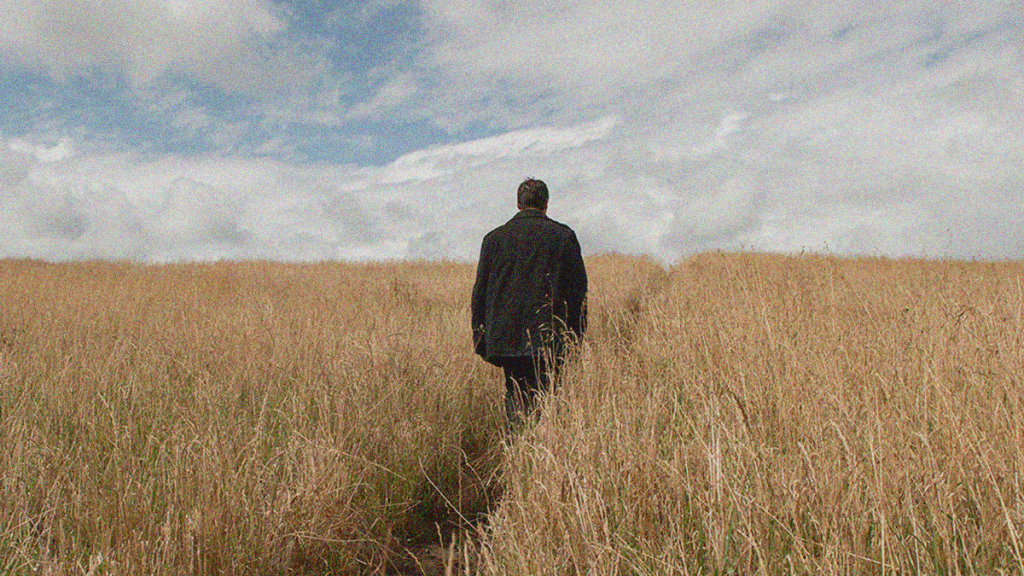
Claudio Cataño in HORIZONTE; courtesy of TIFF.



 jaredmobarak.com
Leave a comment