
Rating: NR | Runtime: 126 minutes
Release Date: November 22nd, 2024 (Taiwan) / November 21st, 2025 (USA)
Studio: Andrews Film / Dekanalog
Director(s): Xi Huang
Writer(s): Xi Huang
You can look at it and think of me.
Mothers and daughters come in many forms and Jin Aixia (Sylvia Chang) is one half of many of them. We meet her at the hospital in 2018 after breaking her leg the day she’s supposed to start caring for her recently-diagnosed-with-dementia mother (Alannah Ong’s Shen Yan-Hua). The latter has just returned to Taipei after spending time in New York City where her granddaughter Emma (Karena Ka-Yan Lam) lives—Ai’s biological child, but not her daughter since she was given to a family friend. The three wait for Fan Zuer’s (Eugenie Liu) arrival, Ai’s second biological child who was raised by her too. It’s the first time they’ve ever all been together and ultimately will also prove to be the last.
Daughter’s Daughter then fast-forwards to the present-day. Ai is enjoying her independent life in Taiwan with dance classes alongside her best friend and regular outings with her mother. She and Zuer have gotten closer in the six years since the prologue (wherein the two were very much at odds), but it’s time for the latter to start her own family alongside her partner Jia-Yi (Tracy Chou). They’ve decided to do so in New York, utilizing fertilization specialists to help them conceive before returning to Taipei. It’s all smiles and laughter (and happy tears) between them until a phone call leaves Ai in a panic. Zuer and Jia-Yi have died in a car crash and their viable embryo, ready to be implanted, is now under Ai’s guardianship.
Writer/director Xi Huang has thrown the kitchen sink of maternal possibilities at us with Ai serving as the nexus point. Here she is simultaneously mourning, revisiting her past, and deciding what to do with a third child. She wasn’t ready when she had Emma at sixteen. She was when she had Zuer (even if she wonders whether she failed as a mother). And now she’s not ready to do it all again in her sixties. Could she go the adoption route despite the mixed emotions of reuniting with Emma after so many years? Can she terminate the embryo this time despite not being able to then? Or will she honor her daughter’s hope of motherhood by finding a surrogate to let that dream live in her arms instead?
The film is a sort of “this is your life” episode wherein Ai must weigh the pros and cons of these alternatives by reliving the choices she’s already made. We get flashbacks to Zuer’s quest through IVF and her mother’s obvious disapproval in the thought that she isn’t ready. We watch Ai endure that same disapproval courtesy of her own mother’s ailment making it seem like she’s back in time telling her she’s not ready too. And then there’s the constant present-day fights with Emma as Ai uses her as a sounding board to cut through the fear and figure out whether she made the correct decision then and if it’s the same now. Is it selfish to want to walk away? The answer is complicated.
It’s a very emotional journey. Between the whiplash of finding out she might be a grandmother soon to suddenly having no one and the recoil of going from there to being responsible for another potential life, you can’t fault Ai for being on-edge. Not only is she thinking about blame for letting Zuer go to New York in the first place, she’s dreading what Jia-Yi’s parents might think of her for the same thing. The notions of fate and intent intersect to jumble what was a very regimented list of priorities in Ai’s head. And seeing Emma only confuses matters more since her existence is a direct result of a similar situation … although also very different considering the technological advancements in how this particular embryo will gestate.
There’s also something else going on to make Ai’s conflict even more uncertain. One could say she’s actually fighting against her own guilt in the pursuit of an outcome—both as a mother and a daughter considering how alike she and Zuer were as young women attempting to carve a path for themselves. And it all comes to a head with a poignantly authentic answer to Emma’s question: “What were you thinking when you gave me up?” It hits harder too because it comes after we’ve already seen Ai sign the fertility center’s paperwork. We don’t yet know which option she picked, but we know this moment of clarity has the same odds of confirming it as it does filling her with regret.
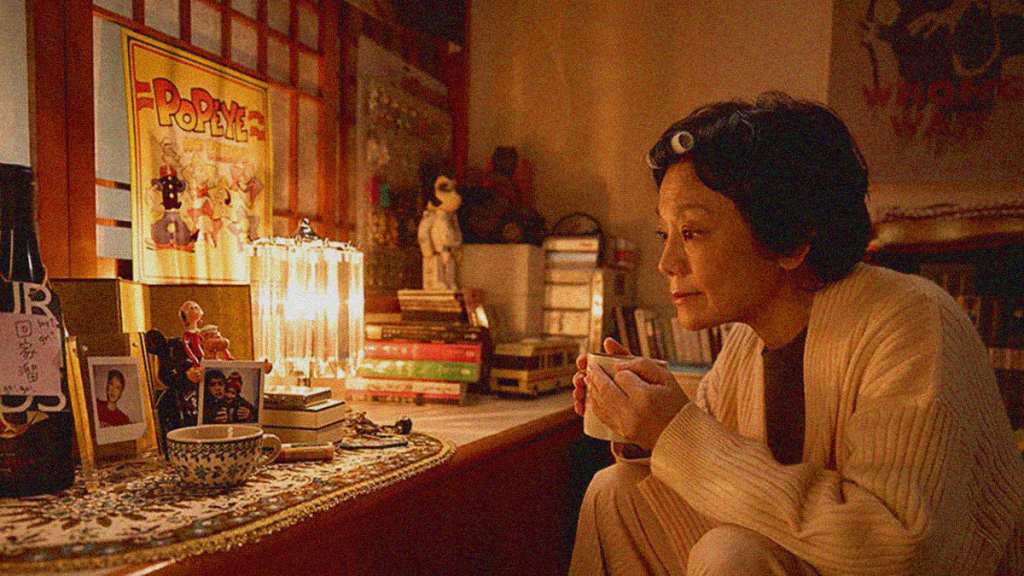
Chang is wonderful in the role. She gets a few tender moments (like the poster image of her resting her head on a sleeping Emma), but her Ai is more often than not lost in a sense of pragmatism that erases any potential for tenderness at all. This is why the character is so captivating and resonant, though. Her ability to understand her own desires and, for better or worse, projecting them upon those around her either by trying to change their minds or proving she won’t change hers is what makes her human. It’s why whatever she decides doesn’t matter because we know it won’t be taken lightly. Every choice she’s made to that point has been hers and none render her less of a person … or a woman.

Sylvia Chang in DAUGHTER’S DAUGHTER; courtesy of TIFF.


 jaredmobarak.com
Leave a comment