
Rating: NR | Runtime: 105 minutes
Release Date: October 11th, 2024 (Poland)
Studio: TVP Dystrybucja Kinowa
Director(s): Damian Kocur
Writer(s): Damian Kocur & Marta Konarzewska
No worries. It’s summertime!
They always knew a full-scale invasion of Ukraine could happen, but they held onto hope that it wouldn’t. How else could they enjoy a vacation abroad in the Canary Islands? This trip is supposed to be about fun. And connection. Roma (Roman Lutskyi) and Nastya (Anastasiya Karpenko) have recently gotten married and the relationship between her and his children (Sofia Berezovska’s Sofiia and Fedir Pugachov’s Fedir) remains tenuous and new. Add the beach, good food, and a warm sun, though, and perhaps their respective defenses might come down. Maybe this time away can help them learn to trust each other and return to Kyiv stronger than ever. That might have happened too if not for Russia’s war.
Damian Kocur’s Under the Volcano (co-written with Marta Konarzewska) turns quickly from the breezy nature of tourists preparing to get back to their real lives into a tense powder keg of futility. Not only is their house and loved ones being bombed by the Russians, but they are suddenly unable to leave. From vacationers to refugees in an instant, this family falls victim to a sort of survivor’s guilt. Yes, they are safe from danger, but they’re also helpless in the sense that they aren’t there to stand beside their countrymen and prove they exist. Because it’s not about being unable to fight. It’s about not being present to choose. People are dying and they’re stuck in paradise trying to reconcile smiling strangers against their tortured souls.
Even though the quartet looks happy on the surface, we can tell there was justifiable strain. The kids have a new mother. Nastya has two new children. Both sides of that equation understand the difficulty of the situation, but they have the patience and wherewithal to endure it in the hopes of either finding common ground or getting back home to the necessary space with which to co-exist independently of the other. Becoming trapped together even longer therefore commences the gradual chipping away of their resolve. Add the uncertainty of their family and friends’ safety alongside the awkward pantomime of pretending like this extended stay is anything but a painful reminder that vacations are meant to end and emotions can’t help but erupt.
Sometimes it’s an unintentional fact blurted out loud without the tact necessary to not be hurtful (Sofiia telling Nastya that it must feel good not having children of her own in times like these). Others it’s an inability to extricate yourself from mixed company to the point where little Fedir gets nightmares because his parents can’t stop fighting due to their already frayed nerves being torn further by a mistake as simple as forgetting to charge a cellphone. Sofiia wants to help by getting Fedir away from them until they calm down, but that has the potential of making matters worse when Roma and Nastya realize they don’t have the luxury of assuming they’re safe here either. Now when a Russian family acting like nothing is amiss stays at the same hotel.
It’s a timely narrative both because of what’s happening in Ukraine and in Gaza. These wars don’t simply impact those on the ground when a people’s very identity is what’s being destroyed. Those who are displaced—either voluntarily or not—feel every part of the tragedy in their bones as well. They wonder what they can do to help. Should they stay where they are and survive as a means of political warfare? Should they make some calls and find covert ways back to join the military and fight on the frontlines? Questions swirl around their heads until all they want to do is scream because there’s no correct answer. And the stress of these circumstances makes it so they end up suffering from PTSD without ever being there themselves.
The arguments between Roma and Nastya traumatize Fedir. The desire to fight back allows for adrenaline to race and create conflict where cooler heads usually prevail. And yet it’s Sofiia who feels the most out-of-sorts. She’s old enough to know the yelling is rooted in bigger issues than getting lost on a hiking trail but too young to be able to make decisions about where to go and what to do. She’s stuck in the middle, unsure whether to be mad at the oblivious Russians or assume she might end up alone like her new West African friend Mike (whose story of arrival is heartbreaking). Sofiia can’t have fun with the other teens at the beach and she can’t share her feelings with adults treating her like a child. What else is there to do but cry?
Kocur has given form to the purgatory of survival in times of horror. He and Konarzewska wield this family in ways that enhance the inherent drama of being angry without an outlet by having them say and act outside of the filter society constructs to keep the peace. Lutskyi and Karpenko are both great at toeing that line between being the adult and allowing themselves the room to release their own emotions, consequences be damned. They’re picking fights with each other and strangers, calling attention to their frustrations in ways that cannot be heard or healed when no one around them understands their pain. They’ve gone from entitled tourists turning their noses at Black street vendors to finding themselves lost inside the same boat.
It’s why Berezovska ultimately becomes the lead to bridge that gap. Her Sofiia doesn’t vocalize it or try to get her parents to understand, but she doesn’t need to for us to know. Because this island turns from Heaven to Hell in the blink of an eye. All the laughter and celebration become salt in the wound. Fireworks the sound of missile strikes. Not going back means potentially never seeing Kyiv again. Returning means potentially never seeing anything else. So, Sofiia wanders the streets filming others’ fun if only to know what she should have had herself if not for Russia. She watches her father cry without consoling him because nothing anyone says or does will take away their suffering. These human volcanoes cannot be put back to sleep.

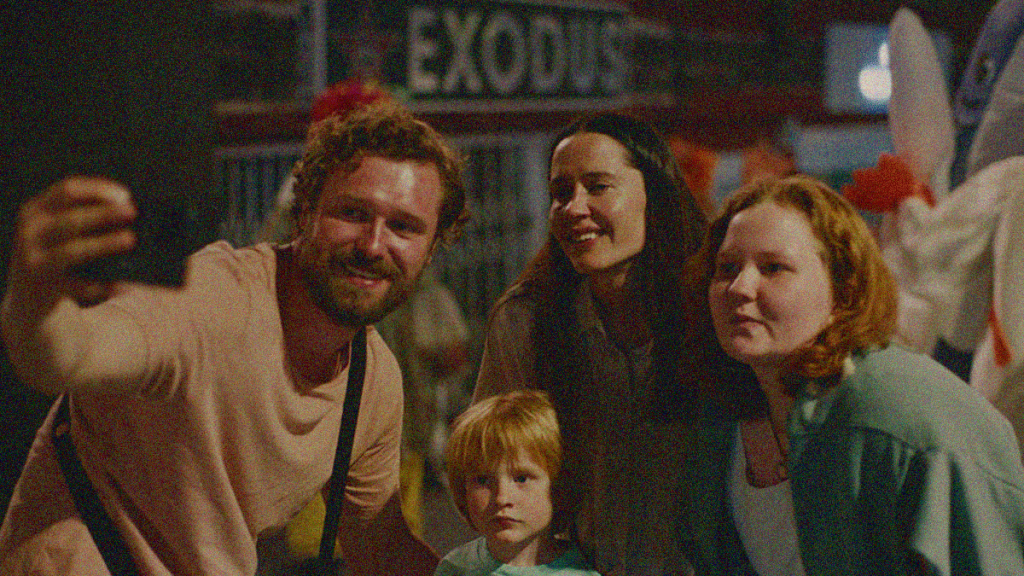
Roman Lutskyi, Fedir Pugachov, Anastasiya Karpenko, and Sofia Berezovska in UNDER THE VOLCANO; courtesy of TIFF.




 jaredmobarak.com
Leave a comment