
Rating: NR | Runtime: 96 minutes
Release Date: July 5th, 2024 (Sweden) / July 19th, 2024 (USA)
Studio: Film Movement
Director(s): Niclas Larsson
Writer(s): Niclas Larsson / Jerker Virdborg (novel Mamma I Soffa)
People tend to get confused in a place like this.
The obvious comparison points for Niclas Larsson’s Mother, Couch (loosely adapted from Jerker Virdborg’s Mamma I Soffa) are Charlie Kaufman’s Synecdoche, New York and I’m Thinking of Ending Things. It has that same sense of existential dread manifested by absurdly surreal scenarios that bleed the line between reality and imagination through the filter of a lead character’s chaotic psychology. And just because it can’t quite live up to the expectations that parallel may present doesn’t mean it doesn’t succeed in its own way to present a sort of litmus test for the viewer. Maybe you understand the emotional turmoil on-screen from experience. Maybe you don’t.
David (Ewan McGregor) is the focal point. A married father of two, his life is in a bit of a shambles. People think his marriage (to Lake Bell’s Anne) is on the rocks—he apparently does too considering his defensiveness whenever she brings up the father of their kid’s friend—and he thinks it’s his job to take care of his mother (Ellen Burstyn) because his half-siblings (David, Rhys Ifans’ Gruffudd, and Lara Flynn Boyle’s Linda all have different fathers) can’t be bothered. He doesn’t necessarily blame them since their mother was never really a good person. What he can’t forgive, however, is that they’ve distanced themselves from him too, seemingly because he stayed close to her.
So, here they all are under the same roof for the first time in what seems like forever. It’s not any of their roofs, though. It’s within the confines of a vintage furniture store about to close its doors after thirty years. Owned by Marco and Marcus (F. Murray Abraham) and currently under the former’s daughter’s (Taylor Russell’s Bella) care, David and company arrive in search of a dresser … or so it appears. In truth, their mother doesn’t seem to be looking for a dresser at all despite constantly speaking about one. It looks like she wants a couch instead. Or, better stated, she has found a couch upon which she refuses to leave. She doesn’t want it brought home. She wants to stay on it here.
You can start to figure out what it is we’re watching isn’t exactly what is happening. Why won’t she leave and why can’t David let her stay? The answer is simple for those who’ve lost a parent—regardless of whether their relationship with said parent was good or bad. Inklings are sprinkled in through dialogue (Gruffudd and Linda telling David they’ve come to help him, not her) and actions (Marco laying out some exposition to give this establishment, Oakbed’s Furniture, a purgatorial air). Events occur that show just how much like his mother David is and truths are told to remind him just how much she’s ruined. Will he finally abandon her? Will he stay like always? Will he simply learn to let go?
I love the idea that Larsson jumped off from Virdborg’s book rather than tying himself to a strict adaptation. He says he asked the author how much latitude he was allowed only to have Virborg state he could steal whatever he wanted and make it his own. Then there’s a story that the filmmaker broke down the truth of what was happening in each scene to the crew—without letting the cast know—so that they could anticipate the purpose of everything while the actors would conversely react in the moment. Because there is a lot going on. Storms rage outside the windows as though the building is a ship on the ocean. Blood is spilled literally and figuratively with a letter knife. Characters obfuscate as a rule.
And it’s all for David’s benefit … and torture. It’s all to keep him off-balance as he traverses his own delicate psyche when it comes to past, present, and future as well as nature vs nurture. Which of his wants and desires are real and which are conditioned? Does his dream of having a relationship with his siblings better contextualize why he remains close to his mother or is that closeness a form of self-sabotage to ensure he never will? Is David’s inability to be there for his kids a result of how his mother treated him or does he stay away so he won’t do the same and thus finds himself locked in a self-fulfilling prophecy? He’s working through his trauma and the complex feelings that bind his love and hate for the only parent he has ever known.
McGregor is fantastic in the role. The rest of the cast is great too (Russell and Burstyn are standouts), but this whole thing lives and/or dies by what his David does. It’s not a choice between Mom and everyone else either. It’s one that pits her against him. Can he put himself first for once? Can he break the bond that she has cultivated (despite blaming him for being clingy) to stop blaming everyone else for his sadness and actually fight to be a part of their lives? Whether the answers to those questions are enough to render Mother, Couch a success is up to you. Because while I think it’s all there on the screen, I won’t deny that Larsson might keep things a bit too esoteric at times. He wants us to fill in the blanks. How does this story relate to our life? Its power demands our participation.
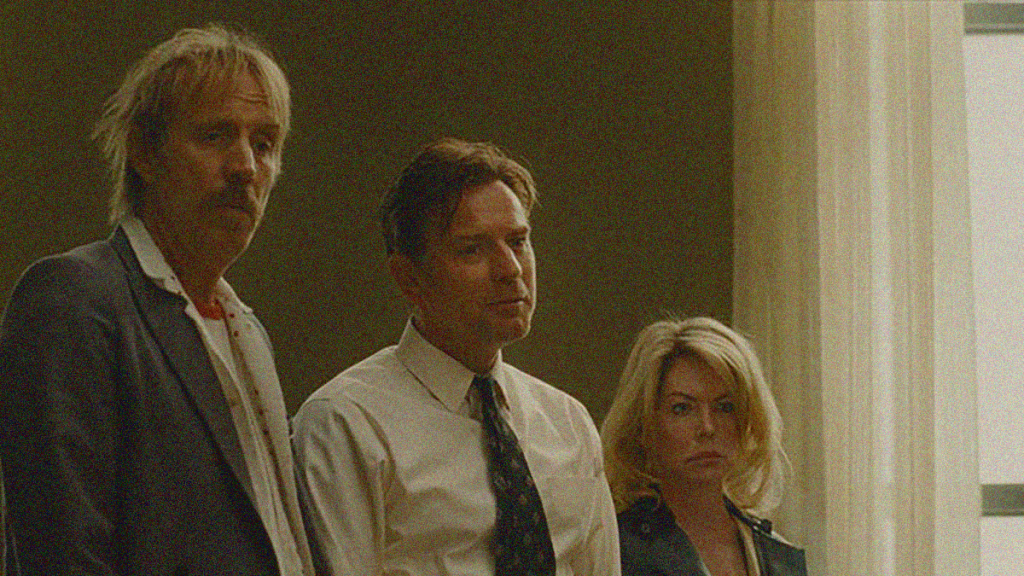
Rhys Ifans, Ewan McGregor, and Lara Flynn Boyle in MOTHER, COUCH; courtesy of Film Movement.




 jaredmobarak.com
Leave a comment