
Rating: NR | Runtime: 105 minutes
Release Date: May 2nd, 2024 (Israel) / June 28th, 2024 (USA)
Studio: Cohen Media Group
Director(s): Jake Paltrow
Writer(s): Jake Paltrow & Tom Shoval
What are you?
Am I reading too much into it? Probably. But the use of the word “integration” throughout the press notes for Jake Paltrow’s June Zero can’t help intriguing me when the word he should be using is “assimilation.” Because that’s what his film is showing by focusing two-thirds of its runtime on Arab Jews. It might not seem that way since the two characters in question (Noam Ovadia’s David and Yoav Levi’s Haim) aren’t overtly choosing Israel over their own cultures or heritage, but the script is very clearly blurring the line between persecution and patriotism in a way that demands their choices be made to prove loyalty.
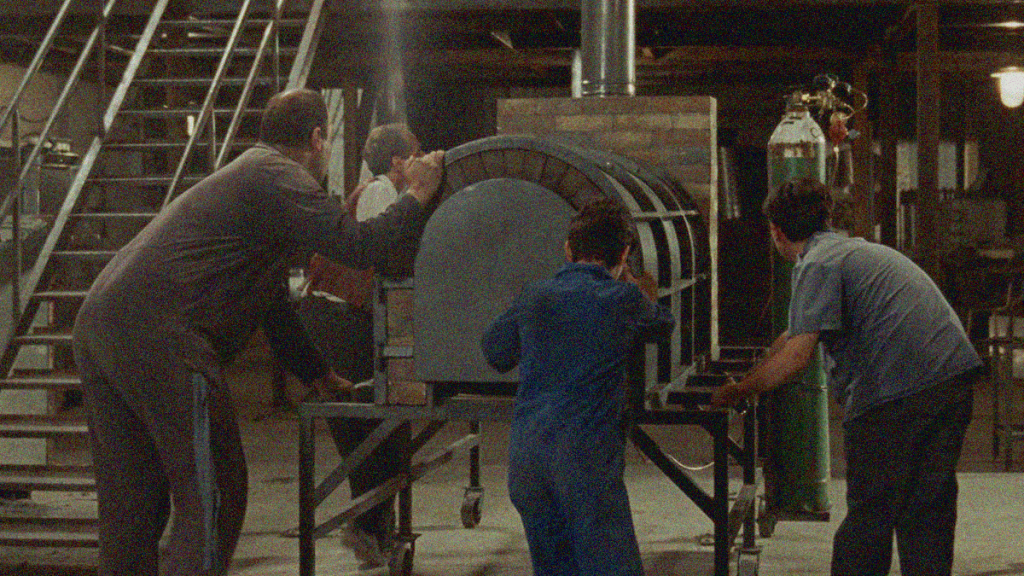
“What are you?” asks WWII hero Shlomi Zebco (Tzahi Grad), “Because your skin color is dark.” David responds, “Israeli.” to which Shlomi says, “Good answer.” That’s not integration. That’s not allowing this Libyan immigrant to retain his heritage while adding a new home atop it. No, that’s a very clear example of implicit revocation. That’s a child being taught that he must decide one or the other. And what better way of proving his choice than helping to build the oven that would eventually cremate Nazi monster Adolf Eichmann? No one could call him a fake then (if he can prove it).
It’s therefore tough to watch this well-crafted film (co-written by Paltrow and Tom Shoval) without also engaging with the context that it is being released while Israel itself commits war crimes and genocide against Palestinians. This whole thing is about retribution in so transparent a way that David is thrown out of his classroom when he dares to criticize his teacher’s “eye for an eye” bloodlust by stating how “an eye isn’t a life.” That the boy then quickly falls in line to excitedly partake in that violent justice (thinly deflected by his parallel passion and pride to be useful and smart) is less about character growth than it is about indoctrination.
This isn’t necessarily the case with Haim. He’s a Moroccan immigrant tasked with being Eichmann’s bodyguard so as not to let him die before the state can kill him. Why does his being Moroccan matter? Because his ethnicity is intentional. As he explains to a new barber brought in without his permission, only Arab Jews are allowed in proximity to the prisoner so that “emotions” won’t get in the way of legality. It’s another intriguing bit of historical detail that again holds unique context with current events. It becomes both a test of loyalty (you’re Israeli now) and a manipulation of optics every minority knows well: How can an institution be racist if it employs members of the race being abused?
Is this all peripheral to the main text at-hand? Yes. But one cannot simply dismiss it as such when the implicit absence of commentary about it proves so deafening when weighed against Israel’s actions today. Does it lessen the impact of the story? No. It merely puts Paltrow’s motivations into question considering his angle on Israel’s justified hatred towards the Nazis should be an obvious mirror to Palestinians being allowed that same justified hatred towards Zionists murdering them in the street. Or perhaps I’m being too diplomatic by separating that text from its subtext. Yes, the movie is effective when taken on its own as a lesson in commemorating tragedy, but mustn’t we also become blindly complicit to the current tragedy in Gaza to let it exist without questioning those politics?
Enter the third lead: Tom Hagi’s Micha Aaronson. Here is a Holocaust survivor who grew up to become an Israeli investigator on Eichmann’s case. A man who knew first-hand what this monster did and could finally be vindicated when the stories he told—that were too nightmarish to be believed—were put on the record in court via numerous corroborations. Where David’s story lends youthful energy through his troublemaker finding purpose and Haim’s story lends a sense of duty and allegiance to the law, Micha’s is about true courage in the face of horror. While some might be correct to say his story is being exploited for tourism dollars, he’s not wrong to admit that it doesn’t matter as long as that story gets told.
Because commemoration isn’t a glorification of the crime. It’s a remembrance of the victims. We must know who Eichmann is and how he died so we don’t forget what the Nazis did. It’s not enough to remember how many people were murdered during the Holocaust when the way they were killed ensures the perpetrators won’t be absolved of guilt through misleading language. We don’t let the Nazis off-the-hook by calling the Jewish death toll of WWII the product of “a conflict.” So, we shouldn’t absolve Netanyahu and his cronies of the same. Jews didn’t just “die” in the Holocaust and Palestinians aren’t simply “dying” today. They were and are being slaughtered, respectively.
A scene from JUNE ZERO; courtesy of Cohen Media Group.



 jaredmobarak.com
Leave a comment