
Rating: NR | Runtime: 78 minutes
Release Date: June 28th, 2024 (USA)
Studio: Factory 25
Director(s): Lucy Kerr
Writer(s): Lucy Kerr
When are we going to take the picture?
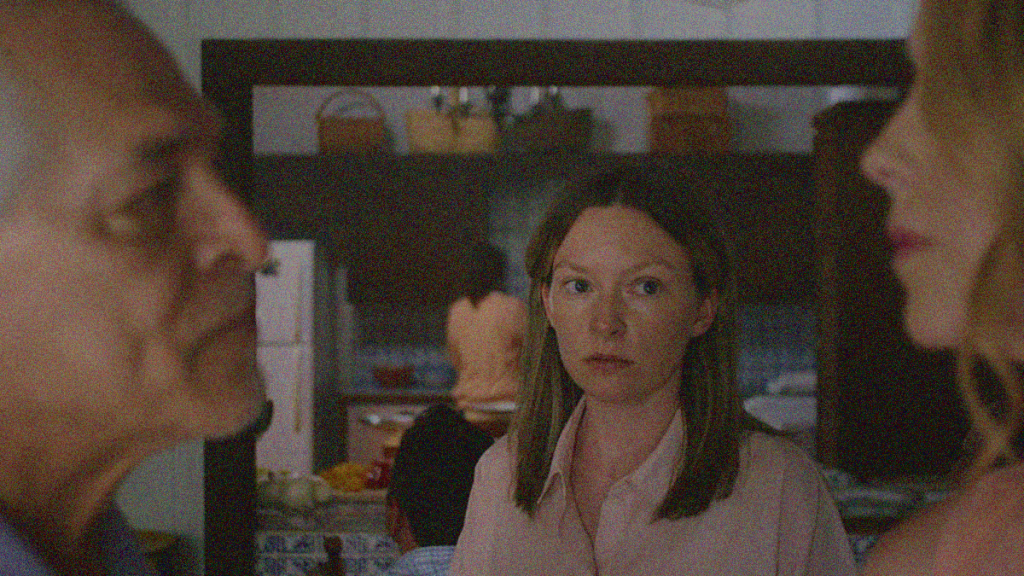
Why is Katy (Deragh Campbell) so fixated on getting their family photo done as planned? It’s not because she cares about the image or her mother’s (Silvana Jakich’s Barbara) obsessive desire to take one every year for her elaborately designed Christmas cards. No, it’s because she needs to go. Her boyfriend Olek (Chris Galust) and her have a flight to catch and a schedule to keep. The least the rest of them can do is be ready for the main purpose of this summer get-together at their river retreat. Heck, Olek isn’t even allowed to be in the photo since he isn’t “family” yet. It’s all therefore a manufactured attempt at Barbara’s ideal of normalcy regardless of the truth: No one else really cares.
And yet Lucy Kerr’s Family Portrait is also a work that wants us to recognize how they should. Not about the photo, but the group’s collective presence. Why? Because it may not be possible again. One of them could drop dead at any moment from an exposed wire under the sink or an unknown virus that has them in the hospital one day and at the morgue the next. Do we think about that when engaging in the ritualistic nature of these events? Maybe. Subconsciously. In the moment, though, we lament the chore. We laugh at those who take it seriously and try our best not to hurt anyone’s feelings even if they’re acting insane. Despite time passing, we continue pretending like the tradition doesn’t have an expiration date.
This is why Barbara’s disappearance is so compelling. The film itself is constructed as a series of mundane set-ups wherein the family talks about things that don’t matter as though they do and things that do as though they don’t. Only the words Katy reads to Olek from a piece she found online create a sense of self-recognition beyond small talk, platitudes, and grievances. The passage is about a woman remembering the blank stare of her mother. “Where did my mother go when she would leave her empty gaze fixed on me?” It’s that vacancy that we fear even though it’s always present through distraction or fatigue. Does the body still being there make it better? Does it make it worse?
Because once Barbara is gone and Katy desperately seeks to find her so they can get this photo finished, no one else seems to mind. “Oh, she’s just off somewhere. Stop worrying.” Whereas a blank stare has you acknowledging a problem through the coexistence of absence and presence, removing the body from the equation makes it just as likely that nothing is amiss as it does to signify a tragedy. And so we get caught in Katy’s frantic search—one that in and of itself forgets its purpose when she’s waylaid by another activity. So many characters fall victim to this as they tell each other they’ll be right back only to end up somewhere else as though that was their destination all along.
Where everyone else embraces that restart, however, Katy cannot fully let go. No matter how much time lapses, she still always comes back to, “Where’s Mom?” Not that it leads anywhere beyond the reality that Mom will one day be gone. No matter how many memories she holds onto of the two of them swimming in that river, the vultures’ arrival is inevitable. No matter how many photos are taken to capture a life, there will always be one coming that captures death by omission. Family Portrait is thus less about the act of taking one than it is Katy’s internal acceptance of our mortality and how the inherent drama that they abhor proves the real finished product. It’s the experience, not the picture.
The process of presenting that truth won’t be for everyone. Despite a runtime of only 78-minutes, I’d be lying if I said the film wasn’t a slog. I’d also be lying if I neglected to agree that this fact was part of the point. That so much of what’s said and done is hollow makes the notion that it will still be grieved after it’s gone more potent. In the end, these horrible days that feel more like work than vacation with kids screaming, adults talking out their asses, and “fun” facts with zero contextual relevance to anything will be missed. Because presence always trumps absence. Knowing Barbara might still be found is better than remembering this year’s photo would never include her smile.
Deragh Campbell in FAMILY PORTRAIT; courtesy of Factory 25.


 jaredmobarak.com
Leave a comment