
Rating: PG-13 | Runtime: 166 minutes
Release Date: March 1st, 2024 (USA)
Studio: Warner Bros.
Director(s): Denis Villeneuve
Writer(s): Denis Villeneuve and Jon Spaihts / Frank Herbert (novel Dune)
You underestimate the power of faith.
The problem with Messiah stories is that the stakes become obsolete. Yes, there’s a chance that the character everyone believes to be the Messiah won’t turn out to fulfill that role, but certain properties like Frank Herbert’s Dune render that hope moot. We know Paul Atreides (Timothée Chalamet) is who the fundamentalists think he is. Not because he was destined for the role. But precisely because they believe. And if those who need that faith to survive can help sway the non-believers to their side, prophecy is made whole through perception alone. The more times Paul succeeds, the more they believe … and allow themselves to be led.
It’s why Chani (Zendaya) is the most intriguing character of the whole of Denis Villeneuve’s Dune: Part Two. She’s the one who is being led by her own motives and desires—much like Paul in the first installment. Whereas that one excels because the most intriguing character exists at its center, this one fails to meet its potential by desperately trying to make us care about the one person we shouldn’t care about. Because no matter how believable the conflict might seem inside Paul’s heart (he doesn’t want to go south knowing he will lose himself), we know he must. So, our only hope is that he is made the secondary mirage he is.
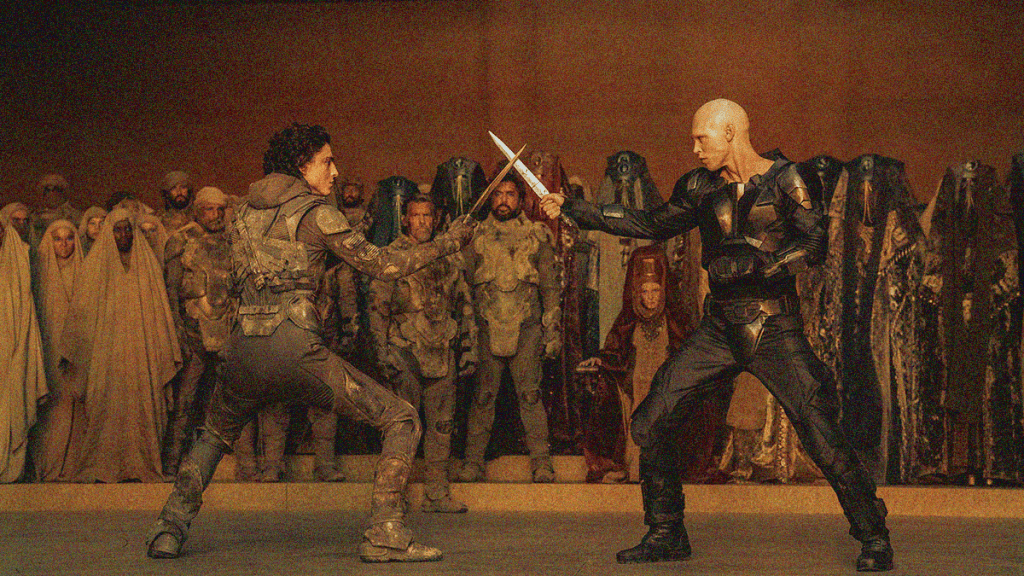
The fact that he doesn’t leads to hollow artifice. Beautiful, but hollow. This beast is gorgeous to behold regardless of how little it says beyond the central tenet that power corrupts. That benevolent leadership is a fallacy because mankind doesn’t care about world peace, only peace and prosperity for itself. So, Paul and Gurney (Josh Brolin) can fight for revenge. Jessica (Rebecca Ferguson) can too by twisting who she is and what she was made for into that entity’s demise. Stilgar (Javier Bardem) can lose himself to his religion and Feyd-Rautha (Austin Butler) can act on the impulses of his psychosis (what a waste of an unhinged performance on a one-dimensional cog). In the end, we know where they’ll once the credits roll. It’s only Chani that makes us wonder.
As such, Part Two proves to be more expository than its predecessor. I guess I shouldn’t be surprised considering we never even meet the Emperor (Christopher Walken) or his daughter (Florence Pugh) in the first despite them being so crucial to David Lynch’s adaptation. By holding them back, Villeneuve, Jon Spaihts, and Eric Roth were able to craft a captivating yarn for the fall of an empire. And now that Villeneuve and Spaihts must finally introduce them, they must also bog down momentum (if repetitive montages of Paul becoming “one with the desert” can possess momentum) with mythology. What’s funny, though, is that they get about ten total minutes of screentime anyway. They’re pawns, much like everyone else.
Is it worth a look? Yes. For the production value alone. Also, for anyone who enjoyed the first movie and still believes a third is in the offing (they’ve made too much money for Zaslav not to greenlight it). I too want to continue the story and see where this corruption of soul is heading and whether Chani’s love can change things for the better (or make things worse). We must therefore suffer through the doldrums of pure set-up to get there with Dune: Part Two proving that lull of a bridge episode pushing us forward with action scenes and betrayal so that the lines can be drawn in the sand for future drama (this is pretty much an over-long epilogue leading towards Messiah). I just expected a whole lot more considering the critical and audience acclaim.

Winner:
Visual Effects, Sound
Nominee:
Motion Picture, Cinematography, Production Design
(L-r) Timothée Chalamet and Austin Butler in DUNE: PART TWO; courtesy of Warner Bros. Pictures. Credit: Niko Tavernise.




 jaredmobarak.com
Leave a comment