
Rating: NR | Runtime: 118 minutes
Release Date: December 14th, 2023 (Denmark) / May 17th, 2024 (USA)
Studio: Nordisk Film / Shudder
Director(s): Ole Bornedal
Writer(s): Ole Bornedal
What makes you think Wörmer’s dead?
How do you make a sequel to a cult film thirty years later despite it having as concrete an ending as you could imagine? You open it back up. After all, gunshots aren’t always fatal. Maybe Peter Wörmer (Ulf Pilgaard) didn’t die. Maybe he was simply incapacitated and sent to a psychiatric hospital instead, left to fade away from the public consciousness until death finally took him too.
His presence would keep looming large over the minds of his victims. Because despite Martin (Nikolaj Coster-Waldau) and Kalinka (Sofie Gråbøl) shielding their daughter Emma (Fanny Leander Bornedal, the director’s own daughter) from the whole ordeal, they couldn’t escape it themselves. So, it was only a matter of time before she also discovered the truth while rummaging through her late mother’s personal effects as Dad numbed himself with pills. Only a matter of time before Emma decided to discover what happened on her own.
Credit Ole Bornedal for crafting a solid way back into these characters lives and breathing new life into their story. It helps that Nightwatch: Demons Are Forever was able to coax most of the original cast back too—even if only for a few minutes where some are concerned. Bornedal needs a few red herrings and victims to keep things moving forward, so why not have them arrive in the form of familiar faces? And since this go is much more serious in tone, having Kim Bodnia’s Jens appearing midway through proves a necessary balm of humor.
Who then is the perpetrator now that Wörmer is unable to continue his own work? A copycat (Casper Kjær Jensen’s Bent)? A child of his own? Maybe Dr. Berthelsen’s (Niels Anders Thorn) frustration has boiled over after babysitting Martin way back then and teaching his daughter now? The hope is that the psychiatrist (Sonja Richter’s Gunver) and detective (Paprika Steen’s Kramer) assigned to the case once Emma unintentionally kicks the hornet’s nest to spill new blood will figure it out before it’s too late.
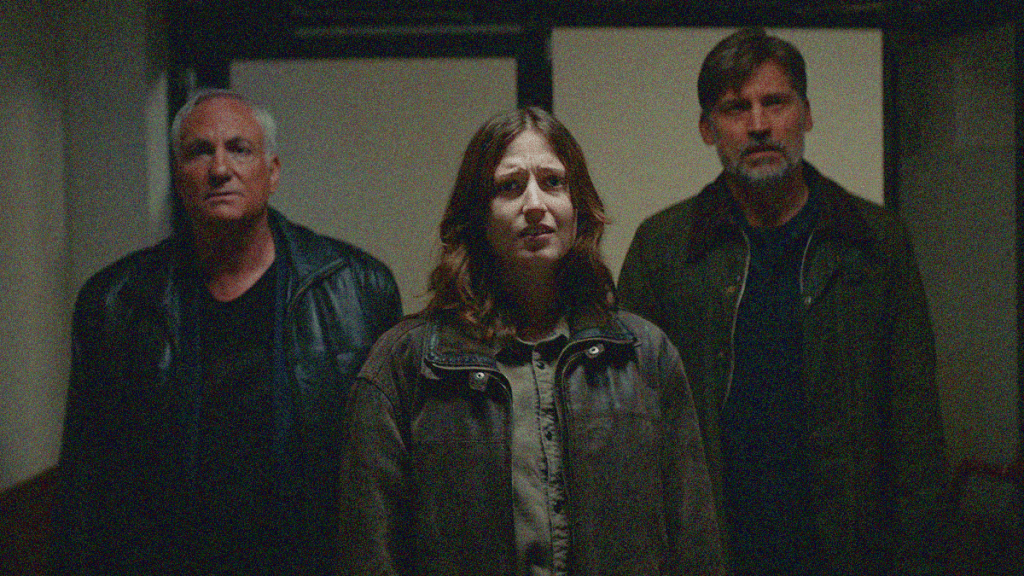
As such, the parallels to the original (Emma takes the nightwatchman job while trying to learn everything her father refuses to say) are merely an entry point. This isn’t the “re-quel” it might initially risk becoming. There are still some scares in the forensic hospital, but mostly as a means to set the board for a climactic finale where past and present collide. And despite the reunion (with a wonderful bit of emotion shared by Coster-Waldau and Bodnia), this is very much Leander Bornedal’s film. Her Emma is the catalyst, target, and, ultimately, potential hero to close the physical and psychological wounds on-screen.
It’s personal. It’s about revenge both for her and Wörmer insofar as him falling under the textbook definition of “victim” if not the moral one. The “Demons are forever” part of the title has some duality too in the idea of a so-called “It” driving the bus of these evil deeds (think a supernatural entity a la “Bob” in “Twin Peaks”) and the lasting invisible scars of trauma refusing to disappear. The film therefore works best as a character study of burden and entitlement while the mystery (Who is the murderer?) becomes a secondary concern—a good thing since it’s not too difficult to figure out.
Will the result have as lasting an impact as the original? No. I think a lot of that one’s charm came from its comedy—even if most of it aged poorly. Bornedal tries to inject some via Emma’s med-school classmates (Nina Terese Rask’s Maria, Alex Høgh Andersen’s Frederik, and Sonny Lindberg’s Sofus), but it’s too tangential in scope. Emma and Martin’s relationship, Emma’s infiltration into Wörmer’s life, and the killer’s actions are way too severe to let that stuff be more than a brief respite. And that’s fine. It merely renders the whole much more conventional than its predecessor. Thankfully, it proves effective, nonetheless.

Kim Bodnia, Fanny Leander Bornedal, and Nikolaj Coster-Waldau in Ole Bornedal’s NIGHTWATCH: DEMONS ARE FOREVER. Courtesy of Christian Greisnæs. A Shudder Release.



 jaredmobarak.com
Leave a comment