
Rating: NR | Runtime: 146 minutes
Release Date: February 7th, 2024 (France) / April 5th, 2024 (USA)
Studio: Ad Vitam Distribution / Sideshow / Janus Films
Director(s): Bertrand Bonello
Writer(s): Bertrand Bonello / Bertrand Bonello, Benjamin Charbit & Guillaume Bréaud (treatment) / Henry James (short story “The Beast in the Jungle”)
By purifying your DNA, you’ll explore your past lives, to clean away old traumas inherited over centuries.
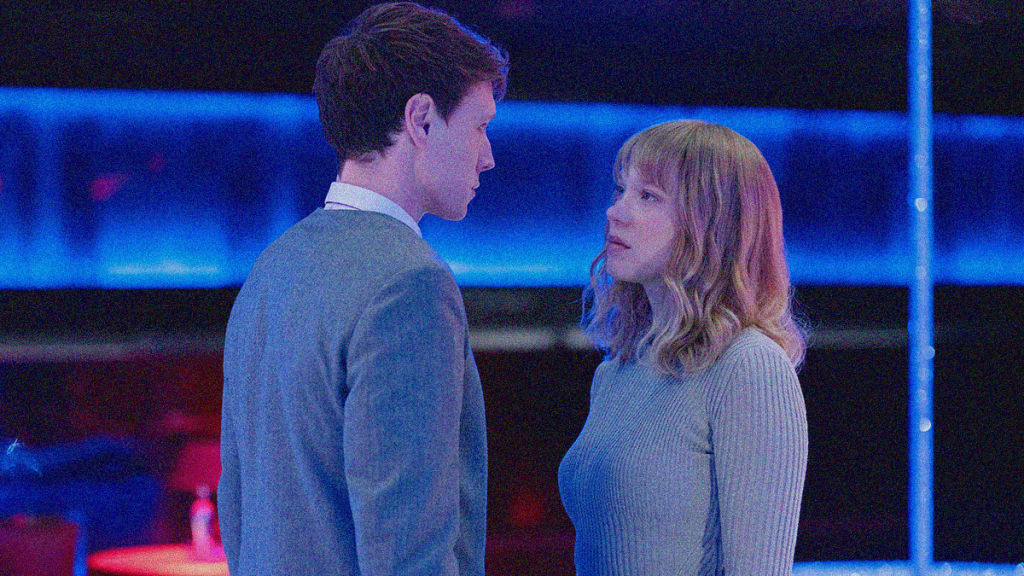
The year is 2044 and Gabrielle (Léa Seydoux) is relegated to a data entry position because she is otherwise too “emotional” to make the decisions necessary to fulfill an “intelligent” occupation. Artificial Intelligence makes it so that unemployment is over 60% with the only means of finding a satisfying job being a purification of your feelings. By going through the process of reliving your worst fears and greatest loves from this life and all others prior, you can be rid of them and become more like the “dolls” (Guslagie Malanda) that populate our new world. You can strip yourself of identity to win everything you could ever want or maintain your humanity and exist within a life unworthy of it.
It’s an intriguing concept that director Bertrand Bonello does well to bring to life alongside Guillaume Bréaud and Benjamin Charbit. Based on Henry James’ “The Beast in the Jungle”, The Beast seeks to take us back into Gabrielle’s subconscious to find what it is she must risk to have the life she wants. So, we watch her lying in a pool of black viscous liquid, memories she didn’t even know were hers flooding back yet not erasing for her to move forward. If anything, this journey is making her reconsider the whole process—especially once she runs into the man who has been inextricably bonded to her (George MacKay’s Louis) throughout time.
I really loved the first half of the film and its weird fourth wall break on an actress manifesting Gabrielle’s metaphorical fears into a literal scene of horror shot against a green screen. That’s actually how we meet her—Seydoux going through the motions despite nothing being there to truly provoke her emotional outburst. Not that it’s needed when she has lifetimes of the same nightmare imprinted upon her DNA. So, we go back in time to 19th century Paris as Louis and Gabrielle run into each other years after first igniting a love neither dared to pursue. Here she’s a pianist, also surrounded by dolls, and caught in a marriage with a robotic husband. It’s a compromise: art for security. It’s a life she enjoys despite knowing the excitement Louis could bring would prove so much better.
But maybe it’s not destined to be. Maybe the fear that pulls at Gabrielle is fate reminding her that the pure love she desires can never last. How that message comes through in the second half with a memory of 21st century Los Angeles as a housesitting actress didn’t work for me, though. I think I get the notion of wanting to mirror the happiness this connection between Gabrielle and Louis can bring with its equally destructive nature, but it renders the final hour a slog when I believe Bonello hoped for suspense. Because here Louis is an incel hellbent on murdering the next blonde woman he meets that he “knows” would never sleep with him. And despite Gabrielle giving him every sign to the contrary (unprovoked, mind you), tragedy will run its course anyway.
I simply didn’t care about them like I did at the beginning. Maybe it’s because the first hour was so romantic despite its own tragic end, but I really invested in those characters and the mystery of whether the sheer magnetism of their coupling could transcend time and finally reach its happy end in the present. If Bonello had crosscut all three eras at once for the duration, perhaps the shift to Louis the homicidal bore and Gabrielle the ever-exploited victim wouldn’t have felt so trite by comparison. Everything during the 21st century portion is so on the nose that it doesn’t just repeat motifs and dialogue, it replays them to make certain the obvious callbacks aren’t missed.
It’s a shame because I also really loved the final sequence and its dawning reality that love is so impossibly difficult to preserve and pursue in a world that wants us to become numb to its unavoidably prevalent horrors. What’s worse too is that I’ve seen people call The Beast “Lynchian” and I just know that they mean it in context with that second hour and its superficial choice to move through time and space and identity in a way that bastardizes what Lynch did in Lost Highway rather than truly homage or equal it. Seydoux is fantastic throughout, but even her performance can’t help that incel plotline feel as real or as dangerous as the others. It grinds momentum to a halt, rendering all authenticity into melodrama.

George MacKay and Léa Seydoux in THE BEAST; courtesy of Sideshow.


 jaredmobarak.com
Leave a comment