
Rating: NR | Runtime: 197 minutes
Release Date: September 29th, 2023 (Turkey) / February 23rd, 2024 (USA)
Studio: Bir Film / Janus Films / Sideshow
Director(s): Nuri Bilge Ceylan
Writer(s): Akin Aksu, Ebru Ceylan & Nuri Bilge Ceylan
Your face carries the pains and happiness of this land.
From the moment Samet (Deniz Celiloglu) arrived at the Eastern Anatolian “wasteland” school taking the first four compulsory years of his teaching service, he believed he was better than his hosts. As a result, he never truly got to know them as more than country bumpkins who he could teach about modernity. And, of course, he never possessed the humility to learn what it was they might in turn teach him about surviving or truly living for life’s sake. Because they have meaning, purpose, and worth beyond any role as Samet’s pet projects. His easy contempt and ridicule say nothing about them, but everything about him.
Not being familiar with Turkish history, I cannot speak about the ways director Nuri Bilge Ceylan and his fellow co-writers Akin Aksu and Ebru Ceylan specifically comment on their country’s politics throughout About Dry Grasses. I can only talk about the increasing prevalence of people like this central character—people who complain without acting and who pontificate for hours about a subject without ever actually saying what it is they think or feel about it. Everything good and bad happens to them. They could stick a gun to their own temple and pull the trigger, but still somehow blame someone else for their death.
It’s not just Samet either. Yes, he’s the worst culprit as an outsider who thinks himself superior to everyone, but the men from this place are almost as bad being that they are insiders who believe themselves superior to their neighbors. This can be shown via the generational gap of young radicals and older “get off my lawn” types. It also appears on a gendered scale where Samet’s roommate Kenan (Musab Ekici) and their friend Nuray (Merve Dizdar) are concerned—specifically the shift in their dynamic once the potential to sleep with her evaporates. And, of course, there’s also the power structure between teacher and student.
The latter two provide the main story threads. The stuff with Nuray intrigues mostly because of how interesting her character is as a “retired” revolutionary who lost her leg in a suicide bombing and thus has more life experience than her city mouse and country mouse friends combined. Her mere presence causes conflict between the men despite Samet introducing Kenan to her for the sole purpose of playing matchmaker. Jealousies can’t help cropping up anyway, though. These are simple men with simple desires. Men who posture and compete out of boredom and for ego. Men who see everything outside of themselves as a conquest during their pursuit and worthless upon their failure.
But it’s the teacher/student relationship that succinctly reveals the hypocrisy at play. Samet and Kenan (and Nuray for that matter) are all teachers. They exist to steward the next generation forward by educating them in their subjects as well as in life. When their “kindness” becomes challenged, however, the first thing these men do is wonder about their own wellbeing. What does this mean for their careers? What does it mean for their reputations? These are men willfully putting their arms around young girls like Sevim (Ece Bagci) one second before punishing them for admitting it to the principal. And even though their positions as teachers and men give them the benefit of the doubt, they still want retribution.
The film is thus a fantastic depiction of men’s growing insincerity—even going so far as to take us out-of-frame and through the soundstage in one wild fourth wall-breaking instance that shows Samet to be a hollow façade. He is a well-liked man with authority who weaponizes his privilege in ways that blind him to its existence en route to demonizing everyone else for doing the same if they ever call him out. Samet is allergic to the possibility that the world doesn’t revolve around him. That anyone could voluntarily want to stay in this place or a woman could be friendly with a man without also sleeping with him. He’s a manipulator who ultimately becomes manipulated into facing his own insecurities and shame.
Does he learn his lesson? No. Because he doesn’t need to learn within a patriarchal society that rewards a lack of curiosity and conviction. All he must do is lick his wounds and bide his time before beginning fresh elsewhere. It used to be that we traveled to foreign places in order to educate ourselves and discover new experiences—to foster empathy. Now, more than ever, it seems our ability to hear about and see other cultures has only helped us retreat further into the vacuums of our selfishly myopic bubbles. We close our eyes when the time to open them arrives. We demand satisfaction and terrorize anyone who chooses to satisfy another instead. Because freedom of choice is mine alone … not yours.

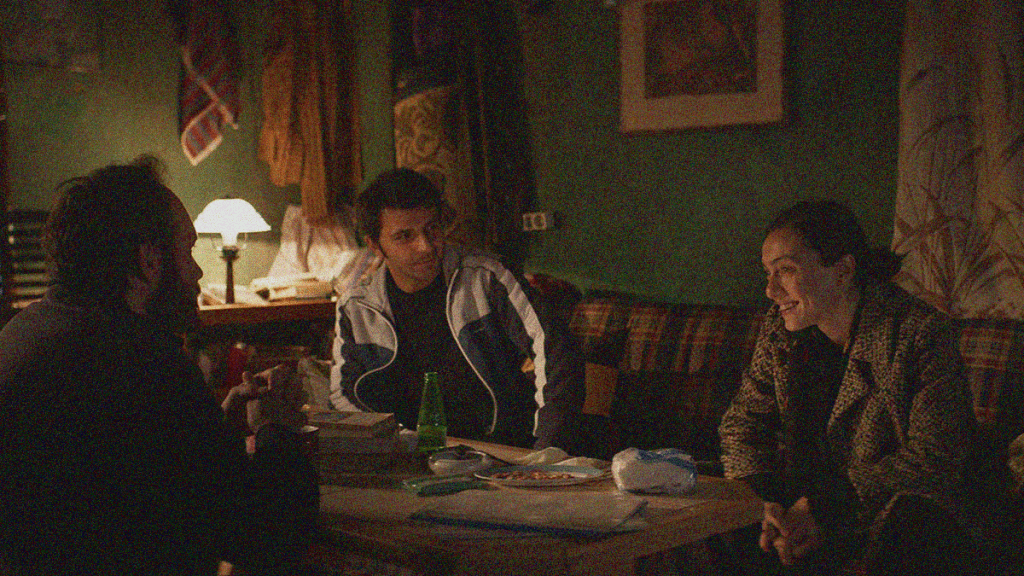
From L-R: Deniz Celiloğlu as Samet, Musab Ekici as Kenan, Merve Dizdar as Nuray in ABOUT DRY GRASSES; courtesy of Sideshow/Janus.


 jaredmobarak.com
Leave a comment