
Rating: PG-13 | Runtime: 98 minutes
Release Date: May 4th, 2023 (Germany) / December 25th, 2023 (USA)
Studio: Alamode Film / Sony Pictures Classics
Director(s): Ilker Çatak
Writer(s): Johannes Duncker & Ilker Çatak
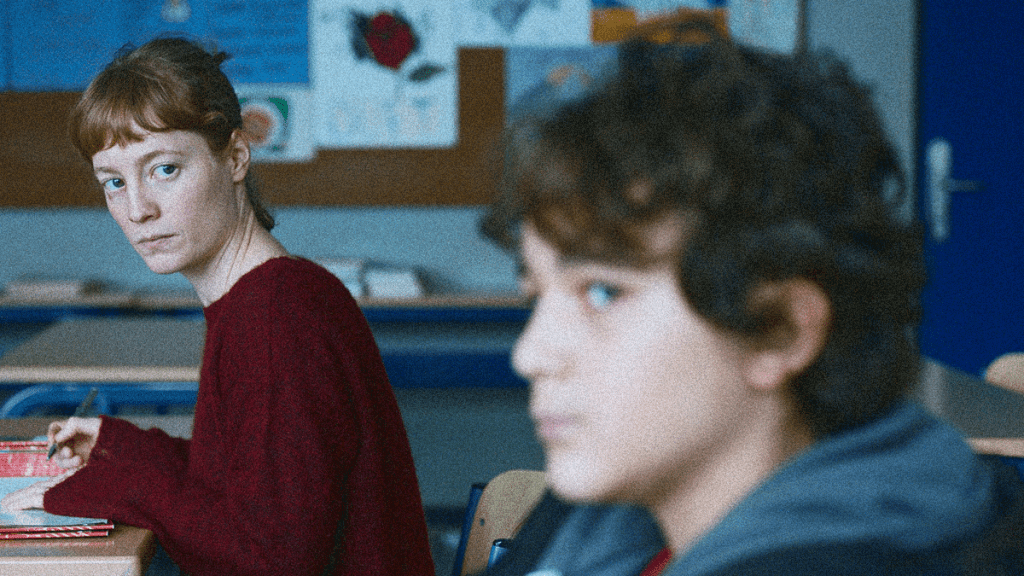
From the first scene inside the titular lounge, Ilker Çatak’s film (co-written with Johannes Duncker) portrays how the faculty is just as cliquish and immature as the students. They gossip. They judge. They villainize and conspire. It eventually gets uncomfortable enough that Carla Nowak (Leonie Benesch) tells the assistant principal (Rafael Stachowiak’s Dudek) they need to stop speaking Polish and stick to German so as not to alienate themselves. She’s new to the school after all. This is her first semester and she’s on the outside looking in. She doesn’t yet know that crossing over might take her soul.
The Teachers’ Lounge starts with a tribunal of sorts. Someone has been stealing money and supplies and, for reasons undisclosed, the staff believes it is a student in Nowak’s class. So, she, Dudek, and Thomas Liebenwerda (Michael Klammer) confront the class’s “representatives”—two students who are in effect singled out to rat on their friends. Nowak does all she can to defend the kids and tell them they don’t have to say anything. Liebenwerda pulls out an attendance list and asks them to nod when he reaches a suspicious name.
That’s all it takes to label a child guilty. No proof. No witness testimony. No confession. Just assumption. And one that’s easily negated as far as facts are concerned once the parents get involved. Yet it sticks nonetheless in the court of public opinion. That child is marked now. Being the child of immigrants, he already was. The teachers can apologize or shrug off the effect of such stigmatizations (casting Liebenwerda as a Black actor adds crucial layers to his actions as persecutor throughout the film) all they want, but they don’t truly care.
The only one who does is Nowak. Sadly, that knowledge is worthless when you’re on an island alone amongst a group of catty fear-mongers worse than children because their age and “experience” embolden them to believe they have irrefutable authority. It leads Carla to take matters into her own hands by staging a scenario that might allow her to clandestinely catch the real perpetrator in the act. The unfortunate reality of the overall circumstances, however, demand that she involves others after doing so. Others that escalate, confuse, and exacerbate an already tenuous ecosystem.
It’s a tense and heartbreaking journey as the ripple effects of what occurs threatens to destroy futures. The psychological damage is immense as accusations are hidden, facts are shrouded by ambiguous language, and rumors are allowed to run rampant. What then is the truth? Is truth even a legitimate concept anymore when half the population has been trained to use opinions and self-satisfying desires as a means to “refute” empirical evidence? And, to make matters more complex, truth should become secondary to the most important aspect of the whole: the safety of children.
Nowak might be the lead, but it is young Oskar Kuhn (Leonard Stettnisch) who sits at the center of this drama. His mother (Eva Löbau) wants revenge on the school, using him as a pawn to get it. The school wants blood from the thief who took “hundreds of pencils,” neglecting him to procure it. And then there’s Carla watching the world implode around her best student. Carla, the person who unwittingly started the whole ordeal and now regrets how her role allowed the collateral damage (the kids) to steal control of the narrative and create even more.
Benesch is fantastic. The exasperation. The compassion. The guilt of causing pain and the anger that those around her think it was warranted. Even when she tries to do the right thing, those in power deny her so as not to show weakness. To them, sacrificing one kid is worth sweeping it all under the rug. Listening to the loudest voices causes less trouble than listening to the voices of reason. Because, at the end of the day, schools aren’t made for kids. They aren’t built to educate and better society. They’re institutions of capitalism. They babysit so parents can work, training the next generation of workers. So, who cares if one gets left behind?

Nominee:
International Feature
Leonie Benesch as Carla Nowak, Leo Stettnisch as Oskar in THE TEACHERS’ LOUNGE. ©if Productions. ©Judith Kaufmann. Courtesy of Sony Pictures Classics.



 jaredmobarak.com
Leave a comment