
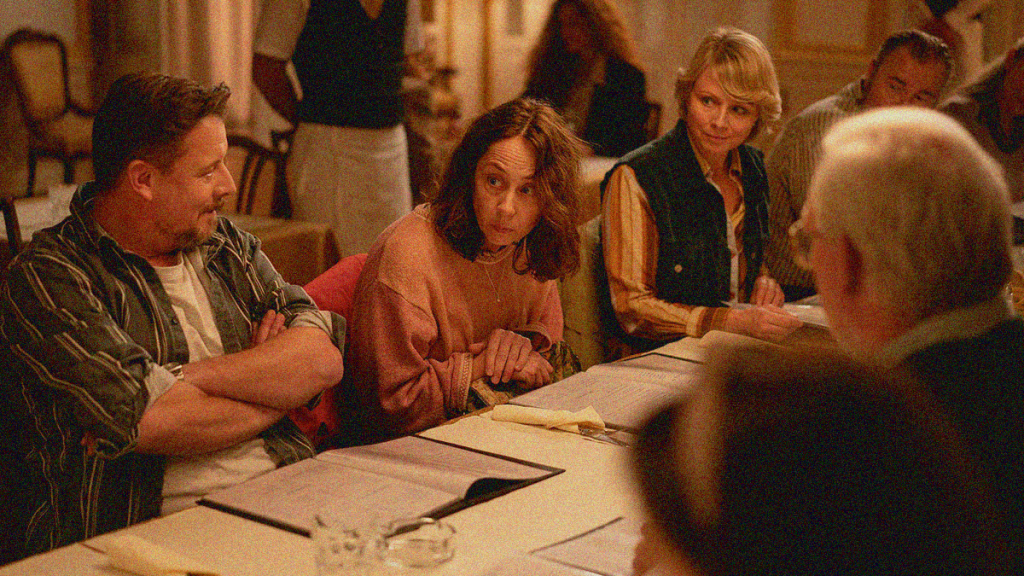
Rating: NR | Runtime: 106 minutes
Release Date: February 24th, 2022 (Denmark) / December 8th, 2023 (USA)
Studio: Nordisk Film / Game Theory Films
Director(s): Niels Arden Oplev
Writer(s): Niels Arden Oplev
I’m not contagious.
For writer/director Niels Arden Oplev, Rose is very personal. Inspired by his own sisters—one of whom is an institutionalized schizophrenic and the other her primary caregiver—the film depicts a coach trip from Denmark to Paris wherein Ellen (Lene Maria Christensen) and new husband Vagn (Anders W. Berthelsen) hope to bring her sister Inger (Sofie Gråbøl) some happiness by returning to a place she adored before her diagnosis. Maybe remembering might heal her in some way. Getting away from Mum should at least remind her she isn’t a complete invalid.
The journey isn’t without clichés (Søren Malling’s Andreas plays antagonist as a temperamental old man, the likes of whom are thankfully no longer in the majority where treating mentally and physically disabled people is concerned, while his twelve-year-old son, Luca Reichardt Ben Coker’s Christian, becomes a fast friend and confidant), but the honesty in which they’re depicted alongside Ellen’s brave struggles and Inger’s intense confusion trumps any conveniences. This isn’t an easy story to tell without falling prey to the risk of going too far one way or another. Oplev must avoid reducing his troubled lead to either a “burden” or a “gift.”
Inger is simply Inger. And besides Andreas and Mum (Karen-Lise Mynster’s Gudrun), everyone allows her that dignity. Moments of lucidity, like when she translates a Parisian menu and orders the table wine, become about praise and thanks rather than emotion-fueled lessons to be learned. Oplev knows, having lived it, that people like Andreas and Gudrun can’t change. They can get surprised to the point of finally shutting up, but one crack in the façade of their impossible definition of “normalcy” will have them Chicken Little-ing just the same. This isn’t therefore about their fear. It’s about Inger’s humanity.
Rose does a wonderful job ensuring that aspect stays in the spotlight whether through drama or comedy. Because, despite the pitfalls of the subject matter, this is a very funny movie. Gråbøl’s fantastic turn lets the inherent humor of Inger’s condition’s lack of filter and keen self-awareness shine. Christensen and Berthelsen are a huge part of this too: always caring, but never overbearing. A balance between safe and autonomous can be found without sacrificing the reality that closure and catharsis can still bring someone who feels as deeply as Inger just as much pain as relief.
This heartfelt tale empowers rather than demeans. It shows how the Ingers of the world are worthy of our time and empathy despite society’s attempts to pretend the opposite—especially in America. That’s why a dynamic like Andreas and Christian’s is relevant regardless of its familiarity. Just because the former is too old to grow doesn’t mean the son he’s trying to indoctrinate must follow suit. The next generation can be more sympathetic and compassionate. Not out of pity either. Christian’s friendship is born from genuine curiosity, fun, and even love. There may still be hope for the future after all.
Anders W. Berthelsen, Sofie Gråbøl, and Lene Maria Christensen in ROSE; photo by Martin Dam Kristensen, courtesy of Game Theory Films.



 jaredmobarak.com
Leave a comment