
Rating: R | Runtime: 123 minutes
Release Date: October 5th, 2022 (France) / September 22nd, 2023 (USA)
Studio: Les Bookmakers / The Jokers / IFC Films
Director(s): Sébastien Marnier
Writer(s): Sébastien Marnier
Are we sure she’s Stéphane?
Her girlfriend (Suzanne Clément) has two more years in jail. Her landlord’s sister is coming home and thus making it so she can no longer use the spare room. And working at an anchovy plant leaves her smelling of fish with little money to show for the trouble (we assume the opening credit sequence depicts a union organizer handing out flyers for a long fight to try winning more). So, after calling and failing to do so many times before, Stéphane Marson (Laure Calamy) decides to finally talk to the estranged father she’s never met.
From cluttered and crammed rooms of the working class, The Origin of Evil writer/director Sébastien Marnier takes us to an island mansion to show how the “other half” lives. That’s where Serge Dumontet (Jacques Weber) resides with wife (Dominique Blanc’s Louise), daughter (Doria Tillier’s George), granddaughter (Céleste Brunnquell’s Jeanne), and maid (Véronique Ruggia’s Agnès). And while the fact he had another child out of wedlock is hardly a secret, his first question of “How did you find me?” reveals he never tried giving Stéphane or her mother any kind of support.
While the script plays it straight as far as Stéphane’s emotions and trepidation, however, you can’t help realizing we’ve never heard anyone in her life call her by her name. That doesn’t mean she isn’t Stéphane Marson—a question George instantly wonders to herself. Just that Marnier is intentionally making it an unspoken mystery of the first hour of the film so we can try and figure these characters out first. After all, it’s not everyday someone falls to the ground in distress only to watch his family sit and continue drinking their tea.
The answer to Stéphane’s identity isn’t the only reveal made at the film’s midway point. Everyone’s masks start to slip. Are these women sabotaging Serge’s existence to take control of his money? Is Serge positioning Stéphane to be his knight in shining armor to stop them? Is he constructing a façade of “sweet, concerned, and tired old man” to do so? What about Louise admitting it would be in her self-interest to befriend Stéphane just in case the inheritance goes sideways? If all George cares about is the company, who will care for her?
The game twists as everyone plays everyone else to their advantage—mostly without any deception too. Once Serge’s temper starts peeking out and Stéphane’s desperation begins to hold her in volatile situations seemingly outside her control, decisions must get made on the fly. A little gossip can expose who has whose ear and who is ready to throw who into the fire, letting Stéphane know exactly who she can trust to be the person she needs them to be. Because she can’t actually trust any of them. How could she when they can’t (and don’t) trust her?
Calamy pivots on a dime when scenarios provide new opportunities to make or break an alliance. Blanc steals scenes with a compulsive spending habit that perfectly complements her vindictive side as far as paying her husband back for the suffering he’s caused. And Clément proves a crucial piece to the puzzle despite being on the outside. The deeper Stéphane gets with the Dumontet family, the more she pulls away from her imprisoned love. And the last thing Stéphane needs is a jealous violent offender escaping jail for a house call.
Marnier crafts a complex and entertaining yarn by injecting this stranger into Serge’s imperfect and cutthroat family. Half the time you wonder about Stéphane’s intentions and the other figuring out if the Dumontets are using her. It leads to an inevitable conclusion that grows darker and murkier than expected via the blur between reality and psychosis, but its familiar and obvious choices always seem fresh. Because whether or not Stéphane is who she says she is, none of this is about money. Unfortunately, a yearning to be loved comes at a much higher price.
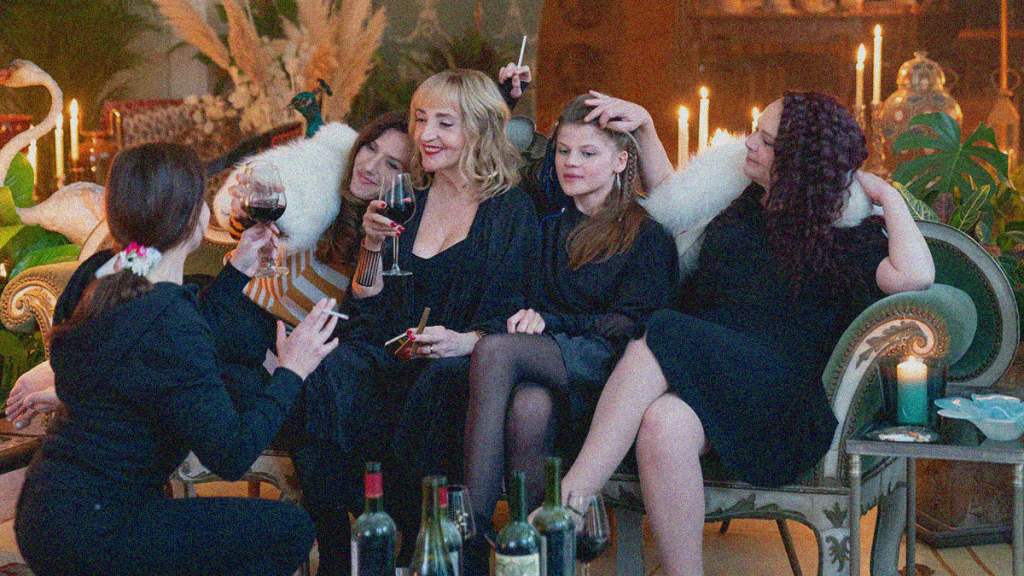
(left to right) Laure Calamy as “Stéphane”, Doria Tilllier as “George”, Dominique Blanc as “Eugénie,” Suzanne Clement as “Stéphane”, Céléste Brunnquell as “Jeanne”, and Véronique Ruggia Saura as “Agnès” in Sébastien Marnier’s THE ORIGIN OF EVIL. Courtesy of Laurent Champoussin. An IFC Films Release.




 jaredmobarak.com
Leave a comment