
Rating: NR | Runtime: 106 minutes
Release Date: July 7th, 2023 (USA)
Studio: Netflix
Director(s): Mel Eslyn
Writer(s): Mel Eslyn & Mark Duplass
There’s goodness in change.
I watched the trailer upon completing Mel Eslyn’s directorial debut Biosphere because I wasn’t exactly sure what the studio had decided to tell potential audience members considering how absurdly surprising the film’s “twists” prove. What I discovered is that it gives nothing away. So, while it’s a move I can respect (IFC previously made a mistake, in my opinion, by ruining Rogue Agent’s best narrative secret in its marketing materials), it also makes talking about the plot difficult.
I’ll do my best to keep from any overt spoilers, but definitely stop reading now if you’re worried since the real purpose behind what Eslyn and co-writer Mark Duplass created is one of those aforementioned surprises. Because it’s one thing to “adapt” to survive as the last two humans on Earth and another to “evolve.”
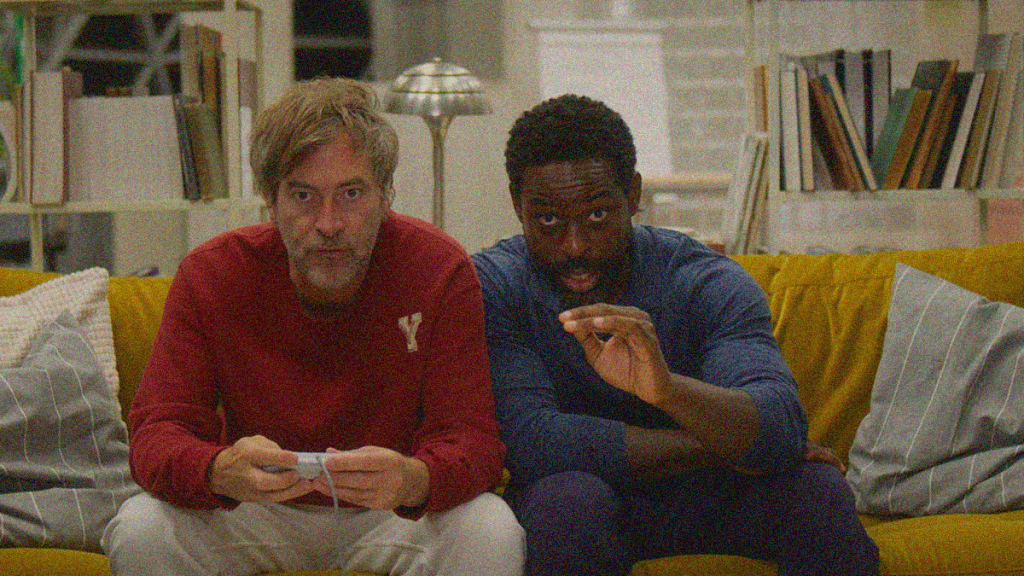
It even seems unfair to talk about who Billy (Duplass) and Ray (Sterling K. Brown) are since that is also a bit of a reveal in context with the end of the world and why they have this biosphere at their disposal and survived the past few years (the total number is left vague). Just know that their opening dialogue about the Mario Bros. is apt as far as who they are together.
Childhood friends and self-proclaimed “brothers from another mother,” these two have kept close throughout the years right up until this extinction point. Billy has always been the front-facing member of the pair (Mario) while Ray provided the “secret sauce” in the shadows (Luigi). Does that mean Billy was smart enough to know his limitations? Or that Ray had been using him as a puppet to advance his own ideas? Maybe it’s a mix of both.
Regardless, the film opens on a potential catastrophe via the death of the last female fish in their self-sustaining pond. It should spell disaster as far as giving them a protein source in the future and Billy takes the news as expected: a panic attack. Ray, ever the optimist, believes they shouldn’t worry yet. He has faith in his scientific acumen to come up with a solution and fate appears to grant him one too—albeit through a miracle that he has no control over.
Those who know a few things about certain fish and aquatic creatures can probably guess what this development is, but even they probably wouldn’t jump to the conclusion that the same “miracle” might happen to the men trapped in this dome too. Add the sudden appearance of a green dot in the otherwise black, atmosphere-less sky and you can’t help but wonder what’s going on. Is this the death knell or a new beginning?
I think Biosphere is an intriguing if not genuinely good film. I think the themes it touches on as far as survival and hope and adaptation are sound with Duplass and Brown giving their all to captivate and endear themselves to us along the journey. I do wonder, however, how fleshed out some of those ideas prove considering the construct presenting them is played as more gag than metaphor.
That the issues are weighed and absorbed by two cisgender males also feels a bit short-sighted since the fluidity of gender norms and toxic masculinity on display inherently demand we move past the binary that ultimately becomes a crucial hang-up to progress on-screen. The film’s success is thus more in line with supplying a catalyst for conversation than anything concretely valuable to add to that dialogue, so I’m very much looking forward to reading what non-cisgender viewers/critics have to say. That alone does make what is probably a misguided artwork worthwhile.
Sterling K. Brown as “Ray” and Mark Duplass as “Billy” in Mel Eslyn’s BIOSPHERE. Courtesy of IFC Films.


 jaredmobarak.com
Leave a comment