
Rating: NR | Runtime: 95 minutes
Release Date: November 1st, 2024 (USA)
Studio: Level 33 Entertainment
Director(s): Sav Rodgers
Writer(s): Sav Rodgers
Something that’s problematic can still mean a lot in your development.
When you first hear about Sav Rodgers’ Chasing Chasing Amy, it’s easy to presume the finished project will be a fan-centric lovefest of a work of art with a controversial history and relationship to its subject. That’s not inherently a bad thing, though. I loved Chasing Amy when I first saw it twenty years ago and still enjoyed it a lot upon rewatching it in preparation for this documentary.
There’s something worthwhile in reconciling nostalgia with newfound clarity and context. Of being able to balance the good with the bad without discounting one or the other. And to Rodgers’ credit, despite starting this project from the perspective of how Kevin Smith’s indie darling “saved his life,” he never shied away from that reality. He chooses the right people from the film to interview and the right culture critics and in-the-know contemporaries from the era to intelligently dissect the film’s place within the cinematic and LGBTQ+ canons.
Because regardless of his own feelings about the work, the first line of questioning he pursues is one that acknowledges its flaws. That’s both with its creator (an always reflective Smith), its champions, and its detractors. Why do members of the LGBTQ+ community dislike it? Do you understand those critiques? Can you find something worthwhile within it anyway? These are very interesting queries and the answers from experts and/or people who lived it are genuinely honest and sometimes surprising.
They are also necessary insofar as accepting how the messiness makes it more important as a time capsule that exemplifies everything wrong with the era in which it debuted. That it took a white cishet male’s perspective on lesbianism to bring the topic to the mainstream in 1997 even as films like Guinevere Turner’s Go Fish were screening beside it. That you needed a character as crass and homophobic as Jason Lee’s Banky to provide an entry point for audiences that wouldn’t otherwise spend money on a queer film.
But Rodgers’ film is also a lot more personal than pointing out the obvious. You can’t watch Chasing Amy today without remarking on its unintentional critique of biphobia or its best, heartfelt moments being baked in insensitivity and ignorance via the unavoidable fact that Smith’s lesbian is in many ways still that unrealistic fantasy Banky places next to Santa Claus and the Easter Bunny even if the role of Alyssa Jones and performance by Joey Lauren Adams transcends it.
That stuff is great and relevant, but it only scratches the surface because it’s an intellectual read on an art form that’s more interested in earning an emotionally visceral reaction instead. So, we follow Sav’s own journey of self-discovery and identity as a trans man within the confines of the film as well as outside it while also, perhaps unintentionally, providing a platform for Adams to finally exorcise demons she couldn’t back then. Demons stemming from the industry’s abuses and how Smith’s auto-catharsis about their relationship left her pain unspoken.
The result is therefore much more than you could expect going in thinking, as Sav’s wife Riley did, that this endeavor was nothing more than a love letter to Kevin Smith. He, like Chasing Amy itself, is merely a touchstone. A springboard. Because while the film saved Sav, it disgusted others. While it gave bisexuals/pansexuals a glimpse of themselves on-screen, it also reductively provided caricatures of lesbians to others. It saved Smith’s career just as it served as a reminder of a dark time for Adams.
By putting its production and impact and failings in context with Sav’s personal awakening, his documentary supplies a deep dive the likes of which couldn’t happen if a deep dive was the initial goal. By letting those involved witness Sav’s vulnerability, they in turn allow themselves to be vulnerable and speak truths that may ultimately color Chasing Amy worse in the end. And that’s okay. Because it’s not about success. It’s about legacy. How art has the power to create and destroy and how the best art does both.

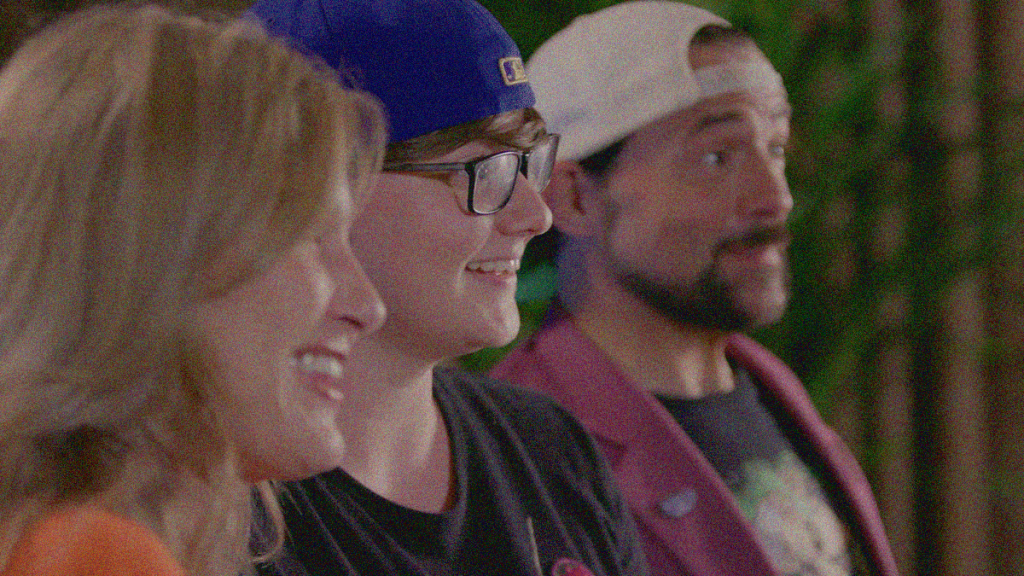
Joey Lauren Adams, Sav Rodgers, and Kevin Smith in CHASING CHASING AMY.




 jaredmobarak.com
Leave a comment