

Rating: NR | Runtime: 101 minutes
Release Date: June 7th, 2023 (USA) / July 14th, 2023 (UK)
Studio: Dogwoof / Utopia
Director(s): Anton Corbijn
Writer(s): Trish D Chetty
It’s the poor man’s art collection.
You know that iconic album cover you love from that seminal 1960s or 70s rock band? It was probably designed by Storm Thorgerson and Aubrey “Po” Powell’s Hipgnosis. And with the former passing away in 2013 while the latter, as well as their contemporaries/client list spanning Roger Waters and David Gilmour to Robert Plant and Jimmy Page to Peter Gabriel and beyond, moves into his twilight years, it’s about that time when putting the shared history of their work on the record becomes a now or never sort of prospect.
That Anton Corbijn would come aboard to direct only seems fitting since, like Powell, he’s built his career off photography, art direction, and music video work in the rock sector. He and screenwriter Trish D Chetty make Squaring the Circle (The Story of Hipgnosis) an entertaining and educational account of how the scene’s drugs, art, and egos created the timeless imagery that defined a musical generation.
Powell is the obvious “star” of the show with a wealth of archival footage of Thorgerson to flesh out their thought process and evolution, but having the aforementioned rock legends and an always-game-for-a-memorable-sound-bite Noel Gallagher to inject backstory and anecdotal detail is priceless. Add a handful of friends and co-workers to the mix and you can start to the feel the pure energy that went into igniting a literal shift of perception and possibility in the medium.
It was no longer about just putting an image of the band on the cover. You could be abstract, avant-garde, and absurd. You could even be willfully obtuse and difficult in order to create a buzz or a laugh at the expense of the band, the audience, or, in many cases, the record label. As long as the music sold and the money flowed, budgets became obsolete. To many people of that era, the artwork became as important to the vinyl as the songs themselves.
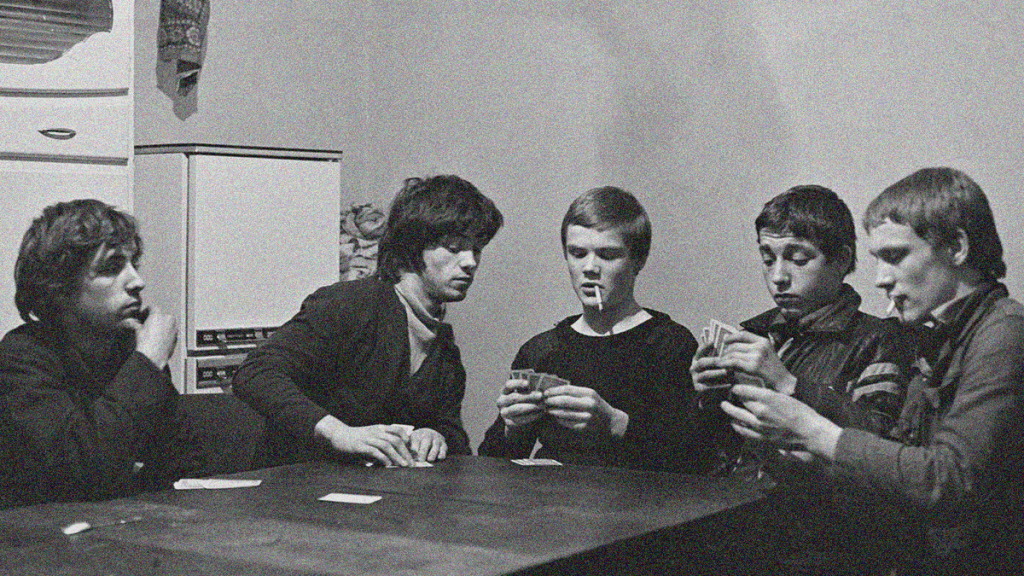
This isn’t a documentary on album design, though. There aren’t any talking head experts comparing, contrasting, and/or defining Hipgnosis’ work in relation to others of the moment (despite some contemporaries in the field lending their insight about the duo itself). Corbijn’s assignment was Powell and Thorgerson’s partnership. How they met. How they befriended Pink Floyd, backed into cover design, and subsequently began their legacy in the field.
It’s about their process. The push and pull in the studio, collaboration with their clients, and the candid accounts of the volatility that can be born out of having so many headstrong narcissists in the same room vying for their voices to be heard. Don’t therefore expect any insight into Powell and Thorgerson’s solo careers either (I personally love the stuff StormStudios did with The Mars Volta, Muse, and Biffy Clyro in the 00s). It begins with Po walking into Storm’s flat as a sixteen-year-old and ends with their studio’s inevitable dissolution in 1983.
So, rather than gain insight into the industry, the film’s worth is in its captivating stories about the phenomenon that was these two men. Blowing up the red balls from The Nice’s Elegy with a bicycle pump in the Sahara. Collaging multiple shots in the rain to manufacture a seamless, hand-tinted artwork for Led Zeppelin’s Houses of the Holy. Murphy’s Law causing chaos on-site as they tried to capture Roger Waters’ helium-inflated pig above the Battersea Power Station. Every single cover has its own backstory that excites even when it comes down to “it took about two minutes to decide” because we’re hearing it from those who lived it.
Things can get melancholic with talk about Syd Barrett and full-on hilarious with Gallagher reminiscing about having to explain to his twenty-first century daughter what “cover artwork” even is too. But beyond the first-hand accounts and historical timelines is also the centering of Powell himself. Because Thorgerson is the “name”. Google some Hipgnosis covers and find that many sites forget to include his partner at all. Hopefully, that won’t be the case anymore.
Aubrey “Po” Powell in SQUARING THE CIRCLE; courtesy of Utopia.



 jaredmobarak.com
Leave a comment